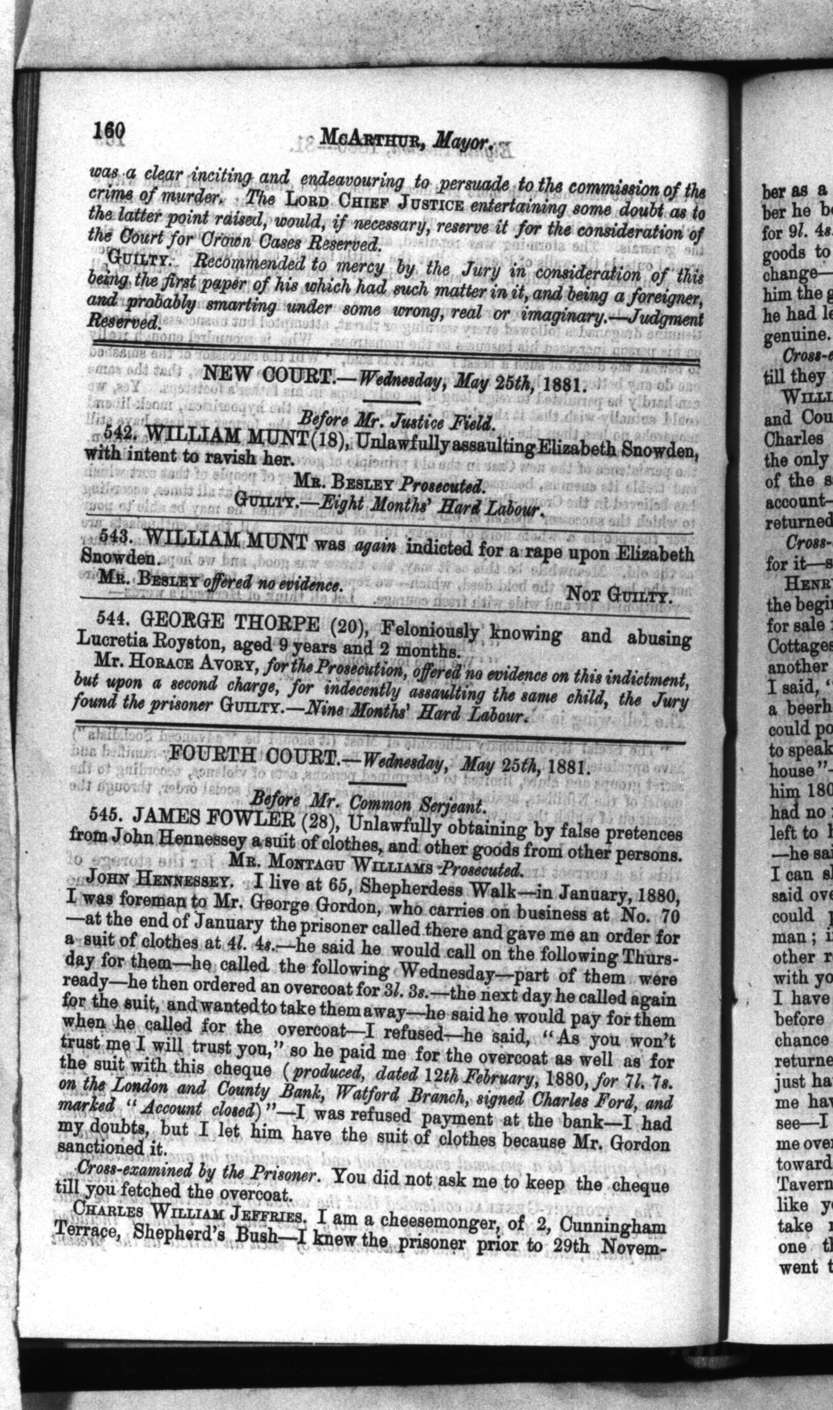
John Hennessey had a suit priced at four pounds four shillings, an overcoat at three pounds three shillings, and standing before him a customer who wanted to carry off the suit before paying. The foreman refused. According to Hennessey, the customer turned the objection around by offering to pay in advance for both garments, including the one he would come back for later. The check came to exactly seven pounds seven shillings. It was dated February 12, 1880 and signed Charles Ford.
Hennessey had his doubts. George Gordon, for whom he worked on Shepherdess Walk, authorized releasing the suit. The matter might have ended on the customer’s next visit, with the delivery of the coat. It was at the bank that the story took another turn. The bank refused the check, and the instrument later produced in court bore the endorsement of a closed account.
Receive Free: “The Secret Registry Dossier (La Reynie & Picaud) + 5 Audio MP3s”
The authentic police archives behind our historical novels, unlocked together with 5 complete audio stories read aloud.
The Earlier Checks
In Shepherd’s Bush, the cheesemonger Charles William Jeffries had reason to trust the man. He had already cashed two checks for him, and both had cleared. He even remembered that his customer had left them behind while waiting for collection. So when the man bought sixteen shillings’ worth of cheese and bacon and presented a check for nine pounds four shillings, Jeffries handed over the difference. He was to send the provisions to an address he knew; a boy turned up and carried them off. When the bank dishonored the check, the shopkeeper went to make inquiries and learned that his customer had left the address six weeks earlier.
A clerk, William Parker, came from the Watford branch of the London and County Bank with a statement of account. On October 9, 1879, the man had opened the account under the name Charles Ford. He had deposited one hundred and seventy-five pounds and paid in nothing further thereafter. The last check the bank had honored, for one pound, left a balance of fivepence. The bank had sent a letter closing the account, which came back undelivered for want of an address. The ledger illuminated what the shopkeeper could not see from behind his counter. It did not say when his customer had learned that the bank had closed the account.
The Promise of a Public House
Henry Budge, a coachman, knew his acquaintance as James Fowler. He had written to him in reply to an advertisement offering a beerhouse. Fowler called on him in a trap with another man, whom he introduced as a prospective buyer. He asked Budge to put down five pounds in front of this rival. Budge had wages to pay and could not part with the whole sum; he agreed to produce the five pounds on condition that he took three back. What one man called a deposit gave the other, for two pounds, the assurance of having first refusal.
Budge went down to Reigate. Fowler showed him the Railway Tavern and took him as far as the yard, where he talked about the price of the pigs the landlord had supposedly just slaughtered. He also showed him a hotel near the station. Budge preferred the smaller house. He paid another forty-eight pounds against a written agreement. Then Fowler returned to announce a hitch over the lease and proposed another property, the Black Horse at Horley. They went to inspect that one in turn. Fowler advised Budge to hide his eagerness from the sitting tenant, whom he claimed he had to buy out. With a printed inventory and possession promised for March 25, Budge said he believed Fowler’s representations. He received neither public house.
In court, a solicitor identified the true owner of the Railway Inn at Earlswood. An auctioneer who managed the Black Horse for Charles Austin Master testified that Fowler had never bought it and held no interest in it. An executor likewise explained that the cottages Fowler had claimed to own, according to Budge, were held in trust for a child. Budge had seen real establishments, met the people running them, and held a receipt in his hand. It had taken a courtroom to hear those who could say to whom those properties actually belonged.
At the Prison Gate
The chemist Edward Wavell remembered an earlier check that had come back unpaid. On that occasion, the man had paid him cash and retrieved the paper. On a second visit, Wavell accepted another check and gave change. This time, the check drawn on a different bank returned marked no account. As witnesses brought forward their papers, the jury had to sort through signatures, branches, and transactions. The checkbook Constable Robert Sage seized when he arrested Fowler upon his release from prison in Manchester came from yet another bank. In Manchester, the man was calling himself John Head.
On May 25, 1881, before the Fourth Court of the Old Bailey, James Fowler maintained that he had believed the checks would be honored. He denied having claimed that the properties belonged to him. The prosecution had indicted him for the suit obtained from Hennessey and for other goods. The proceedings record a guilty verdict and five years’ penal servitude. They do not break down the verdict across each of the episodes recounted on the stand.
Hennessey had started by laying down the simplest rule a tradesman knows: the customer could take the suit once he had paid for it. Seven pounds seven shillings were indeed written on the paper. To find out what that sum was worth, one had to step outside the shop.