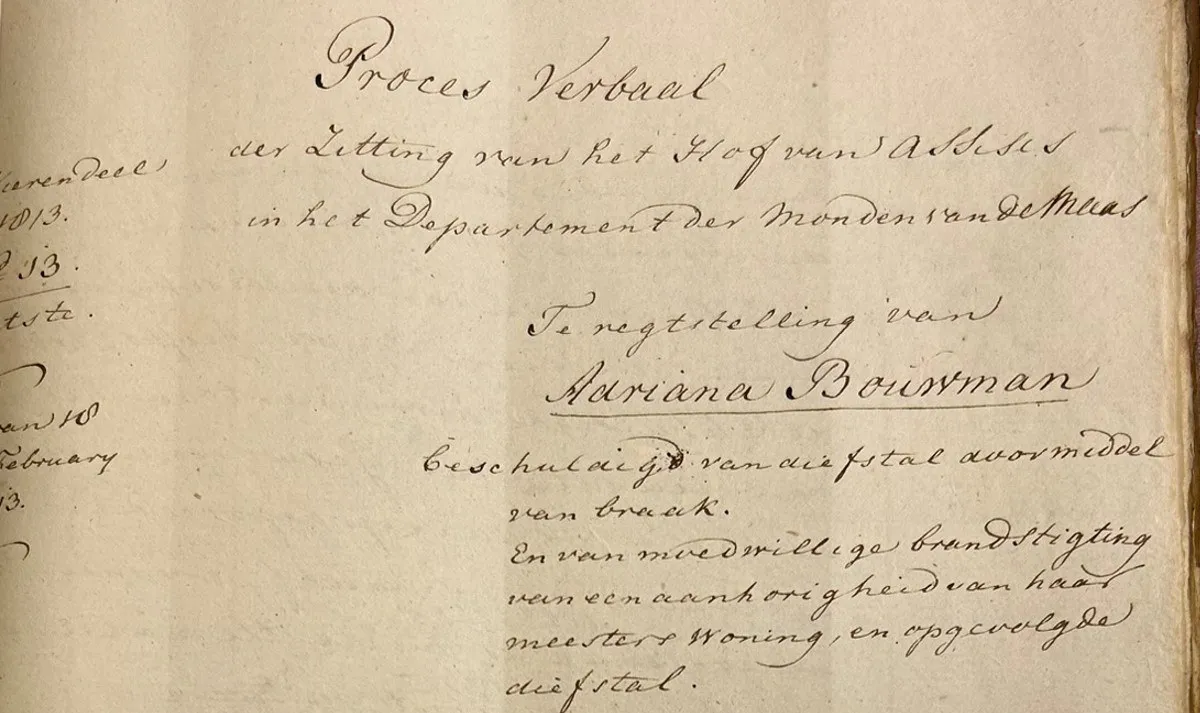
“You will only tear it further.”
The wardress did not answer at once. She held her sleeve up against the light filtering down from the high window; the cloth had given way near the elbow, and every movement broadened the rent. Adriana reached out her hand. It struck her as unbearable to watch someone finish a tear when a seam might yet arrest it.
“Give it here.”
“I have no needle for you.”
“You have one for your sleeve.”
The woman lowered her arm. She had come merely to bring water. In this prison at The Hague, in the spring of 1813, she was not expected to find employment for the condemned. Adriana Bouwman was to die. A damaged sleeve had no place in the preparations for that death; which was precisely what rendered it precious.
“I shall remain beside you,” the wardress said.
“Remain, then.”
She took off her jacket, drew from a fold of her cap a needle already threaded, and laid it upon the table. Adriana waited for her without another word. She knew this manner of counting objects before entrusting them to another hand. In her masters’ houses, they counted the linen, the coin, the time a maidservant took to return from an errand. Here, they would count a needle. She took up the sleeve and turned the edges of the cloth inward.
The first stitch was poor. Her fingers had lost their former nimbleness, and the light fell from too high a slant. The wardress dragged the stool toward the window. That slight movement made the wood scrape harshly against the stone; Adriana raised her eyes with a start, then returned them to her work. She had discovered that within a cell, an ordinary noise could pierce straight through a person.
“It must be taken up further along,” she remarked. “The fabric is eaten away.”
“Do as best you can.”
“One always says that beforehand. Afterward, one complains that the work is ill done.”
The woman’s mouth twitched, though it stopped short of a smile. Her name was Marit. Adriana did not know whether this was her true Christian name or merely the one she gave to prisoners. She did not ask. Each had her assigned task: the one was to sew, the other to watch the hand that did the sewing.
The thread at last passed through without snagging. Adriana’s thoughts turned to Ary van Vliet’s house at Nieuwerkerk, where she had been in domestic service. In the night between the twenty-first and twenty-second of August past, fire had consumed the buildings. Sundry goods had vanished while men were striving to save what could be saved; a portion of them had reappeared among the shopkeepers of Gouda. She had confessed to the thefts, then to the arson. The trial in February had condemned her; her appeal had been rejected. These few dry facts now formed an unyielding boundary, its edges beyond the power of any needle to draw together.
Marit watched the seam. Adriana wished she would look at her face instead, then instantly regretted the longing. A human face demands an answer. Cloth asks only to be held.
“You might say something,” she said.
“What should I say?”
“What people say when someone works for them.”
“Thank you.”
The words fell between them with an almost indecent sharpness. Someone was still thanking Adriana. The young woman drew the stitch too tight, picked it out, and began again. She had spent weeks amidst interrogations that demanded accounting; this thank-you asked nothing of her. She did not know what to do with it.
“I am not done yet.”
“I can see that.”
On the back of Marit’s hand, an old scald had left the skin paler than the rest. Adriana traced the mark with her eyes, forgetting the needle. The wardress curled her fingers inward, as if caught in possession of some private trinket.
“An iron pot,” she said.
“I asked nothing.”
“No.”
Silence settled once more, though its weight had altered. Adriana examined the sleeve against the daylight; a backing piece would be needed, or the mend would pull and pucker. She offered to cut a strip from inside her own hem. Marit refused. A condemned woman’s garments had to remain intact upon her.
“For how long?”
The wardress turned toward the heavy door. Someone was passing in the corridor outside. They waited until the footfalls died away in the distance, neither having felt any impulse to call out. At length, Marit reached into her jacket pocket and drew forth a worn handkerchief.
“There, along the border. That will serve.”
Adriana did not take it.
“It must be cut.”
“I know.”
“Then you will have two damaged things.”
“And one repaired.”
This time, the young woman smiled despite herself. Marit snipped a narrow ribbon of cloth with her small scissors, then put them away. Adriana slipped the scrap beneath the tear. The repair would remain visible; she said as much. Her companion merely shrugged. She wished only to wear her jacket again, nothing more.
As the stitches advanced, Adriana slackened her pace. She realized how easy it would be to undo a stretch of work, to pretend the thread had snapped, to ask for better light. The labor was buying her another woman’s presence. When the sleeve was finished, Marit would take back her jacket, her needle, and the cold distance of her office. No one could forbid her from walking out.
“Are you nearly done?”
“Nearly.”
She drew the thread through one last time. It would have been enough simply not to knot it. Her hand remained poised in the air, and Marit ceased moving. For the first time since they had sat down, the vigilance grew palpable: the wardress’s eyes left the cloth to fix upon the steel. Adriana saw the shift. The needle was no longer an implement on loan; it had become an object that must be recovered.
The young woman tied her knot.
Then she set the needle upon the table, cleanly parted from the thread. It was a deliberate, unhurried motion, entirely free of defiance. She pushed the jacket toward Marit, compelling her gaze back to the stitchery. Marit first verified that the needle was whole, then pinned it into her cap. The wardress slipped her arm into the sleeve, bent her elbow, and bent it again. The stitches held.
“That will do,” she said.
Adriana waited. Marit amended her words.
“It is well done.”
She had spoken as to a seamstress. The condemned girl bowed her head, this time without seeking a reply. She had repaired neither the crime nor the ruined homestead, and no belated charity could quench the memory of the flames. She had merely finished the task that had been entrusted to her.
When Marit left, she took the needle with her, but left the mutilated handkerchief on the table. Adriana folded it with care. She did not know whether it was an oversight; she chose not to call the wardress back.
On May 1, 1813, Adriana Bouwman was guillotined on the Plaats in The Hague. Marit put on her jacket to go on duty. At the elbow, the mended cloth pulled slightly. She wore it so.