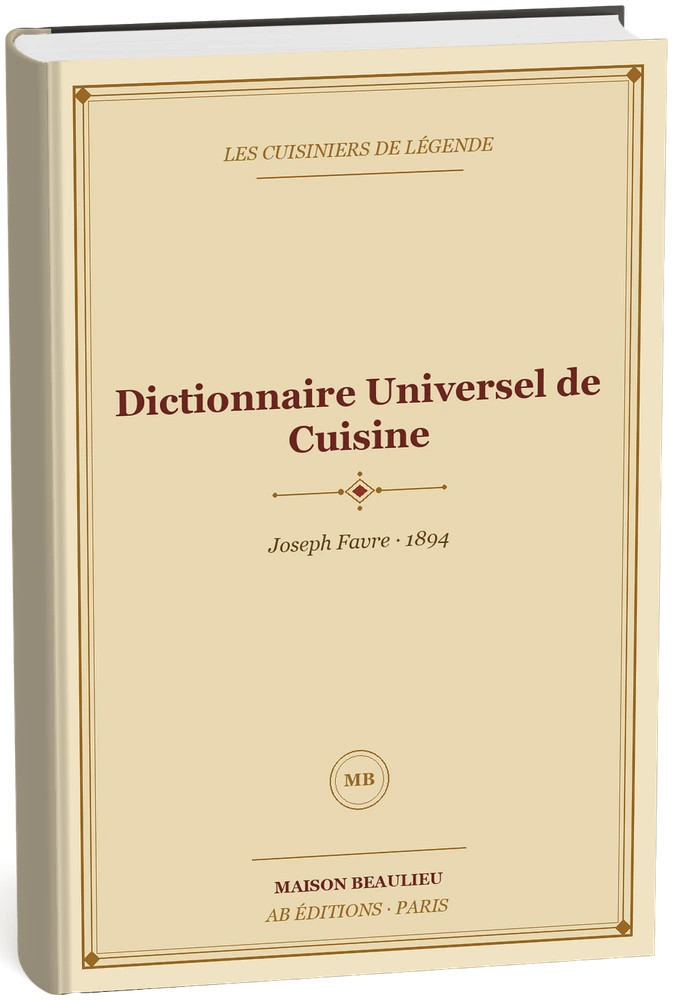
Dictionnaire Universel de Cuisine Pratique (1895–1905)
Joseph Favre
Les Grands Classiques (Originaux) · L'encyclopédie monumentale du fondateur de l'Académie Culinaire de France
Découvrir l’ouvrage → MAISON BEAULIEUAB ÉDITIONS · CUISINE & LETTRES
La Maison Beaulieu présente l’œuvre de Joseph Favre selon son architecture éditoriale complète : d’abord I. Les Grands Classiques (les textes originaux d’époque), puis II. L’Héritage des Maîtres (l’édition française modernisée — 500 recettes mises au goût du jour), et enfin III. Le Rayonnement International (l’édition modernisée traduite en 10 langues). Tarif officiel Cuisine AB Éditions : Ebook · 9,90 € · Broché (PB) · 24,90 € (+ port réel) · Relié Collector (HC) · 34,90 € (+ port réel).
Le texte historique intégral de Joseph Favre, établi et restauré dans sa typographie et sa langue d’origine, avec ses couvertures de collection originales.
Pour cuisiner réellement Joseph Favre aujourd’hui chez soi sans brigade : chaque recette est codifiée et structurée selon le protocole de la Maison (Ingrédients calibrés en grammes pour 4 personnes · Préparation pas à pas avec temps et températures exacts · Conseil du Chef), dans le respect absolu du goût et de l’esprit du Maître.
Conformément à la doctrine éditoriale de la Maison, ce n’est jamais le français archaïque d’époque qui est traduit, mais notre édition française modernisée (L’Héritage des Maîtres — 500 recettes au goût du jour), afin d’offrir aux lecteurs du monde entier des recettes claires, précises et immédiatement réalisables en 10 langues (EN, DE, ES, IT, PT, NL, SV, PL, JA, ZH) :
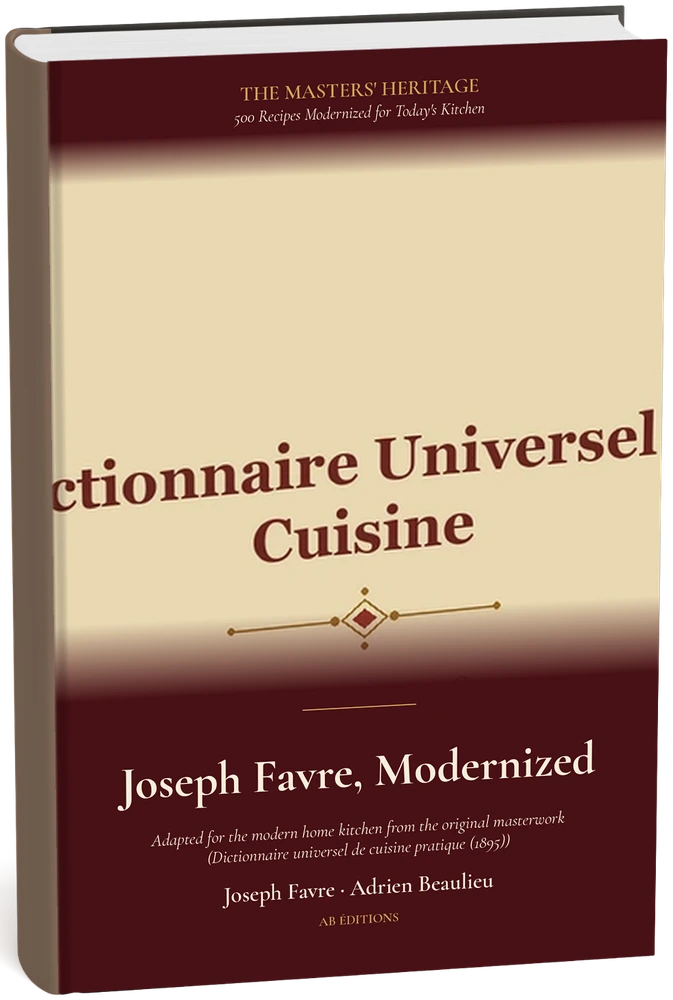
Joseph Favre · Adrien Beaulieu
Édition internationale en Anglais · L'Héritage des Maîtres
Découvrir l’ouvrage →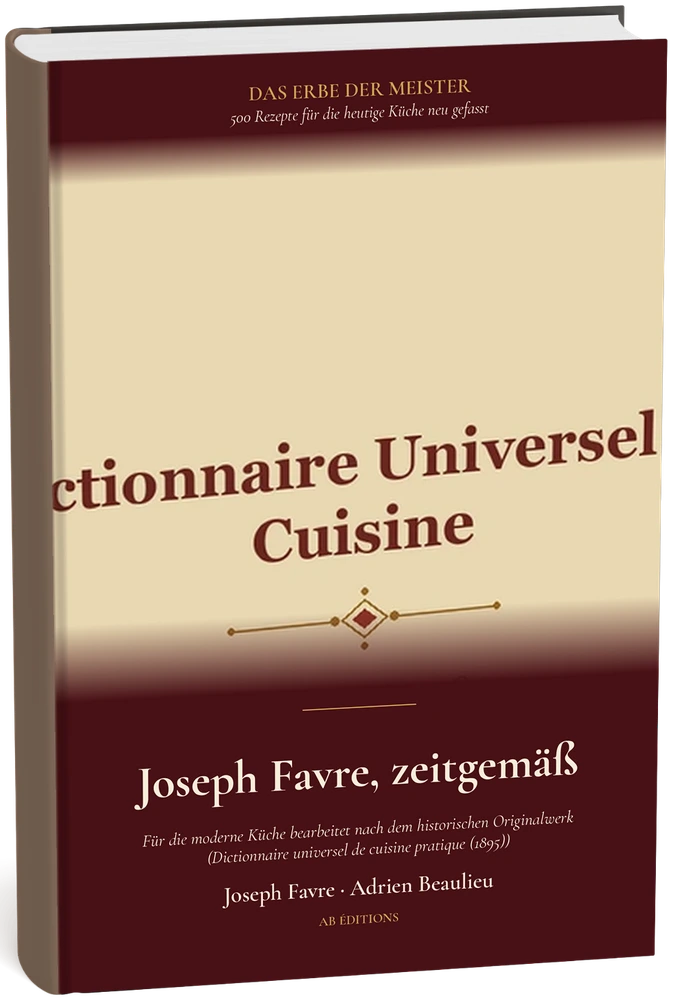
Joseph Favre · Adrien Beaulieu
Édition internationale en Allemand · L'Héritage des Maîtres
Découvrir l’ouvrage →
Joseph Favre · Adrien Beaulieu
Édition internationale en Espagnol · L'Héritage des Maîtres
Découvrir l’ouvrage →
Joseph Favre · Adrien Beaulieu
Édition internationale en Italien · L'Héritage des Maîtres
Découvrir l’ouvrage →
Joseph Favre · Adrien Beaulieu
Édition internationale en Portugais · L'Héritage des Maîtres
Découvrir l’ouvrage →
Joseph Favre · Adrien Beaulieu
Édition internationale en Néerlandais · L'Héritage des Maîtres
Découvrir l’ouvrage →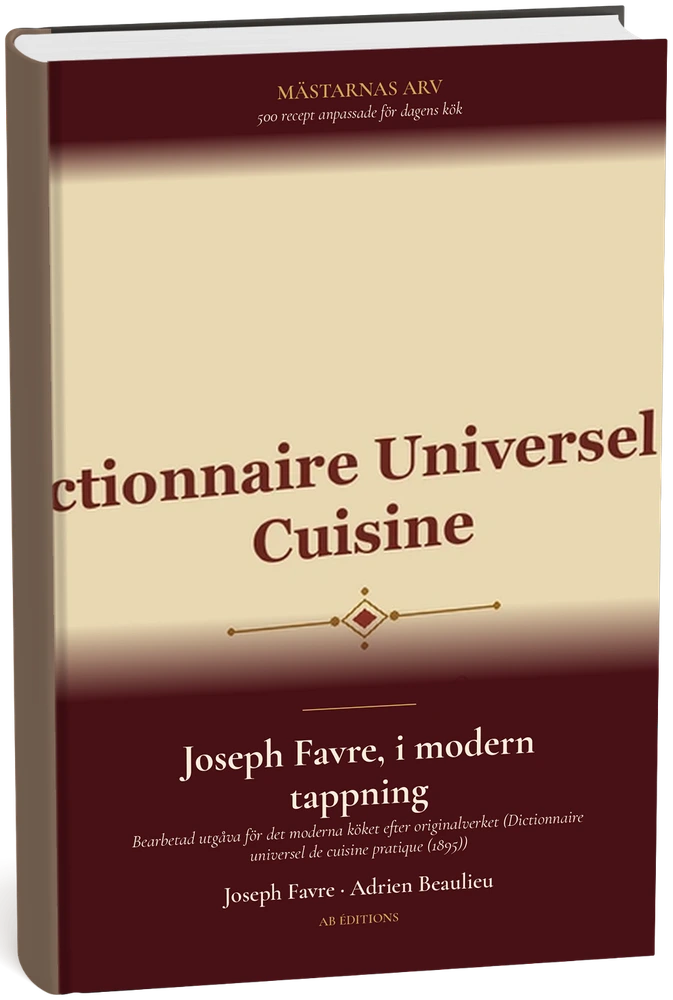
Joseph Favre · Adrien Beaulieu
Édition internationale en Suédois · L'Héritage des Maîtres
Découvrir l’ouvrage →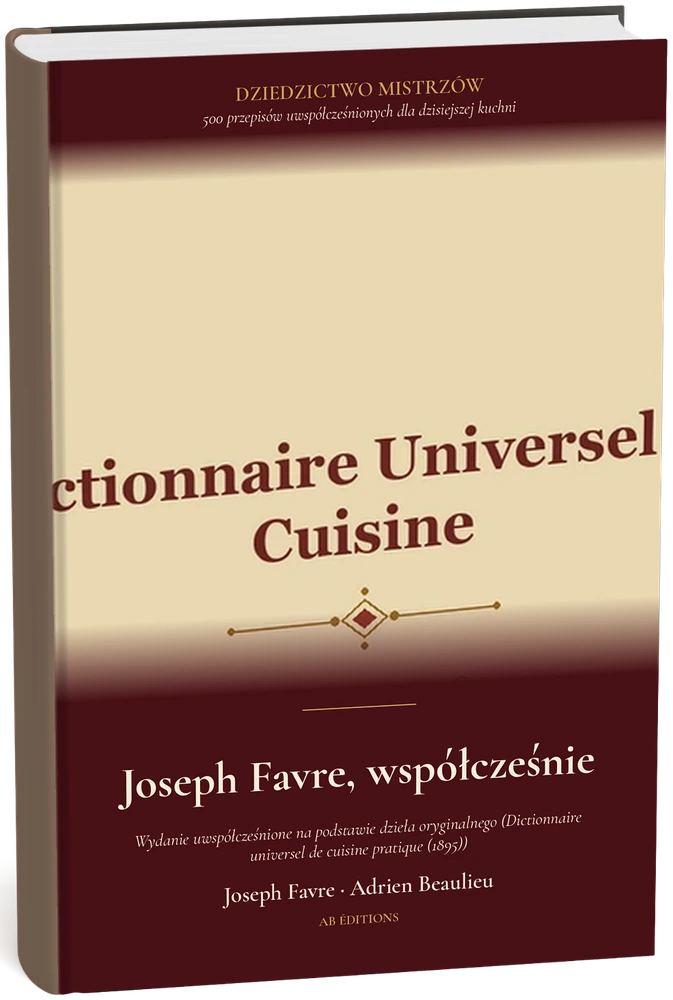
Joseph Favre · Adrien Beaulieu
Édition internationale en Polonais · L'Héritage des Maîtres
Découvrir l’ouvrage →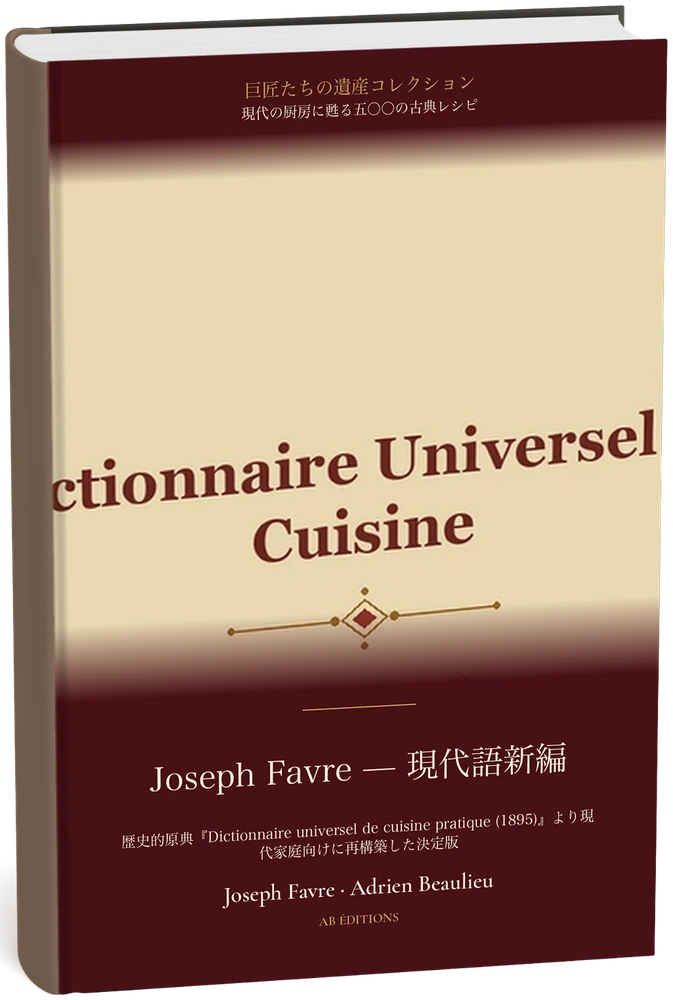
Joseph Favre · Adrien Beaulieu
Édition internationale en Japonais · L'Héritage des Maîtres
Découvrir l’ouvrage →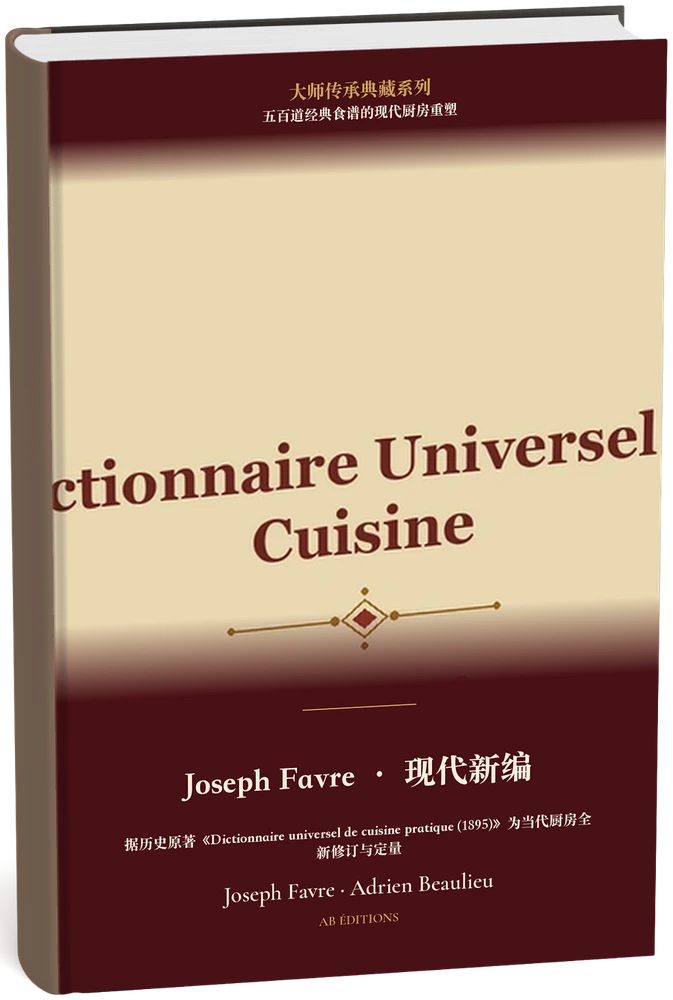
Joseph Favre · Adrien Beaulieu
Édition internationale en Chinois · L'Héritage des Maîtres
Découvrir l’ouvrage →Joseph Favre is the author of the monumental Dictionnaire Universel de Cuisine Pratique, an encyclopedic treatise that gathered thousands of recipes, technical procedures, and culinary terms. Championing scientific rigor in the kitchen, Favre forged a definitive culinary lexicon, embraced by masters of the craft to codify and elevate professional practice.
A visionary chef and lexicographer of the nineteenth century, Joseph Favre confronted formidable tribulations in bringing forth his Dictionnaire Universel de Cuisine Pratique—a work of staggering scope that laid the foundations for modern culinary science. Among the chief obstacles that marked his grand enterprise were:
• The Standardization of Culinary Terms and Techniques. In an epoch when culinary practices and vocabularies varied wildly by province, Favre applied himself to codifying a unified culinary language. This required collating, elucidating, and harmonizing terms that were often parochial, contradictory, or hopelessly obscure—a monumental labor of philological curation. His aim was to establish a shared vernacular for practitioners and epicures alike, thereby securing the seamless transmission of kitchen knowledge.
• Rigor and the Scrutiny of Sources. Resolved to infuse gastronomy with genuine scientific method, Favre insisted upon exhaustive inquiry and empirical verification for every preparation and formula. Sourcing reliable historical authorities and validating their exactitude proved an immense challenge in itself, particularly within a discipline where oral habit and unexamined tradition had long held sway over written doctrine.
• The Elevation of Cookery to a Scientific Discipline. While the era largely regarded cookery as a mechanical craft or manual toil, Favre campaigned passionately for its recognition as a rigorous branch of science. By asserting that the kitchen must rest upon the laws of hygiene, chemistry, and physiology, he encountered stubborn skepticism—even from within the culinary fraternity, where his cerebral and hygienic principles were dismissed as eccentric novelties.
• The Shifting Complexities of Technique and Taste. The nineteenth century witnessed rapid gastronomic revolutions, propelled by industrial apparatus and the rise of cosmopolitan palates. Favre was obliged continually to overhaul and modernize his entries to reflect these innovations—a relentless burden in a work of such sweeping dimensions, which demanded perpetual vigilance over emerging practices.
• The Democratization of Haute Cuisine. Favre burned with the desire to make the refinements of high cuisine accessible to the broader public, yet he had to navigate an era in which fine dining was regarded as the exclusive domain of an aristocratic elite. By formulating methods and recipes suited to modest kitchens and limited means, he ruffled traditional sensibilities while succeeding in elevating the domestic table.
These arduous struggles only burnished Joseph Favre’s legacy as a true pioneer of modern gastronomy. His Dictionnaire Universel de Cuisine Pratique remains an unshakeable monument of culinary literature, celebrated for its bold alliance of empirical science and the epicurean arts, having established the common foundation that still instructs and inspires the kitchen today.
Recettes, histoires, parutions et éditions de collection — quelques lettres par an, jamais davantage.