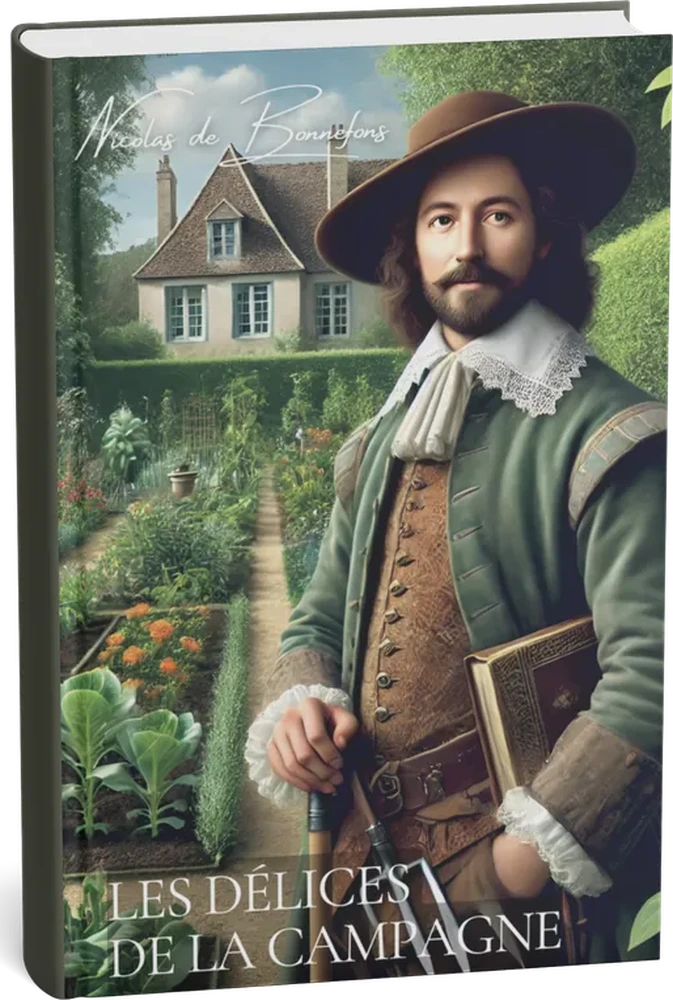
Les Délices de la Campagne (1654)
Nicolas de Bonnefons
Les Grands Classiques (Originaux) · L'art de préparer pour la table ce qui croît sur la terre
Découvrir l’ouvrage → MAISON BEAULIEUAB ÉDITIONS · CUISINE & LETTRES
La Maison Beaulieu présente l’œuvre de Nicolas de Bonnefons selon son architecture éditoriale complète : d’abord I. Les Grands Classiques (les textes originaux d’époque), puis II. L’Héritage des Maîtres (l’édition française modernisée — 500 recettes mises au goût du jour), et enfin III. Le Rayonnement International (l’édition modernisée traduite en 10 langues). Tarif officiel Cuisine AB Éditions : Ebook · 9,90 € · Broché (PB) · 24,90 € (+ port réel) · Relié Collector (HC) · 34,90 € (+ port réel).
Le texte historique intégral de Nicolas de Bonnefons, établi et restauré dans sa typographie et sa langue d’origine, avec ses couvertures de collection originales.
Pour cuisiner réellement Nicolas de Bonnefons aujourd’hui chez soi sans brigade : chaque recette est codifiée et structurée selon le protocole de la Maison (Ingrédients calibrés en grammes pour 4 personnes · Préparation pas à pas avec temps et températures exacts · Conseil du Chef), dans le respect absolu du goût et de l’esprit du Maître.
Conformément à la doctrine éditoriale de la Maison, ce n’est jamais le français archaïque d’époque qui est traduit, mais notre édition française modernisée (L’Héritage des Maîtres — 500 recettes au goût du jour), afin d’offrir aux lecteurs du monde entier des recettes claires, précises et immédiatement réalisables en 10 langues (EN, DE, ES, IT, PT, NL, SV, PL, JA, ZH) :
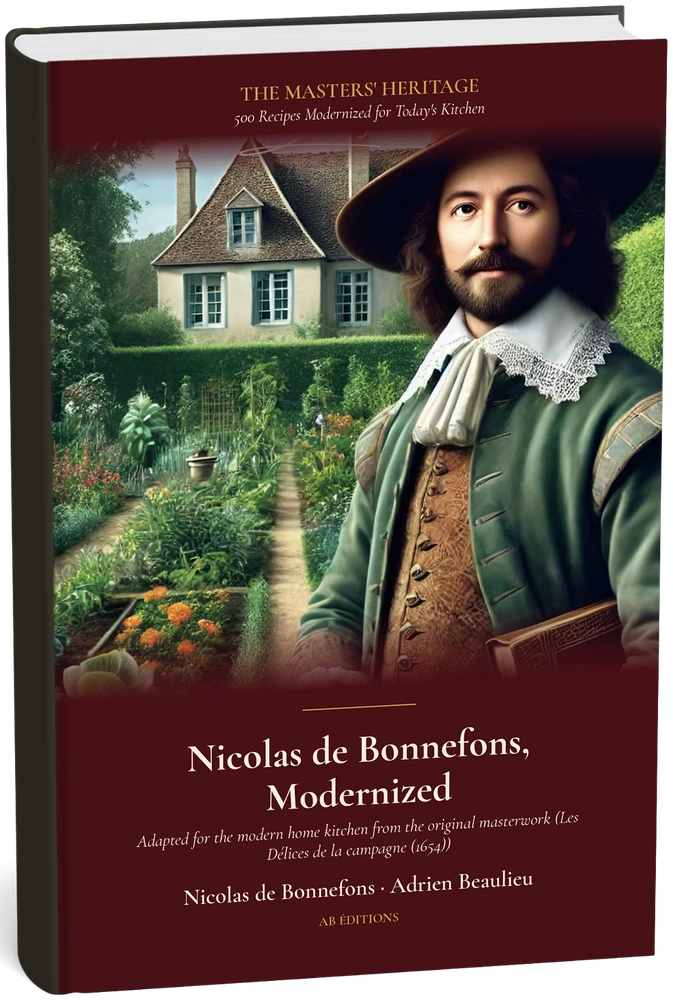
Nicolas de Bonnefons · Adrien Beaulieu
Édition internationale en Anglais · L'Héritage des Maîtres
Découvrir l’ouvrage →
Nicolas de Bonnefons · Adrien Beaulieu
Édition internationale en Allemand · L'Héritage des Maîtres
Découvrir l’ouvrage →
Nicolas de Bonnefons · Adrien Beaulieu
Édition internationale en Espagnol · L'Héritage des Maîtres
Découvrir l’ouvrage →
Nicolas de Bonnefons · Adrien Beaulieu
Édition internationale en Italien · L'Héritage des Maîtres
Découvrir l’ouvrage →
Nicolas de Bonnefons · Adrien Beaulieu
Édition internationale en Portugais · L'Héritage des Maîtres
Découvrir l’ouvrage →
Nicolas de Bonnefons · Adrien Beaulieu
Édition internationale en Néerlandais · L'Héritage des Maîtres
Découvrir l’ouvrage →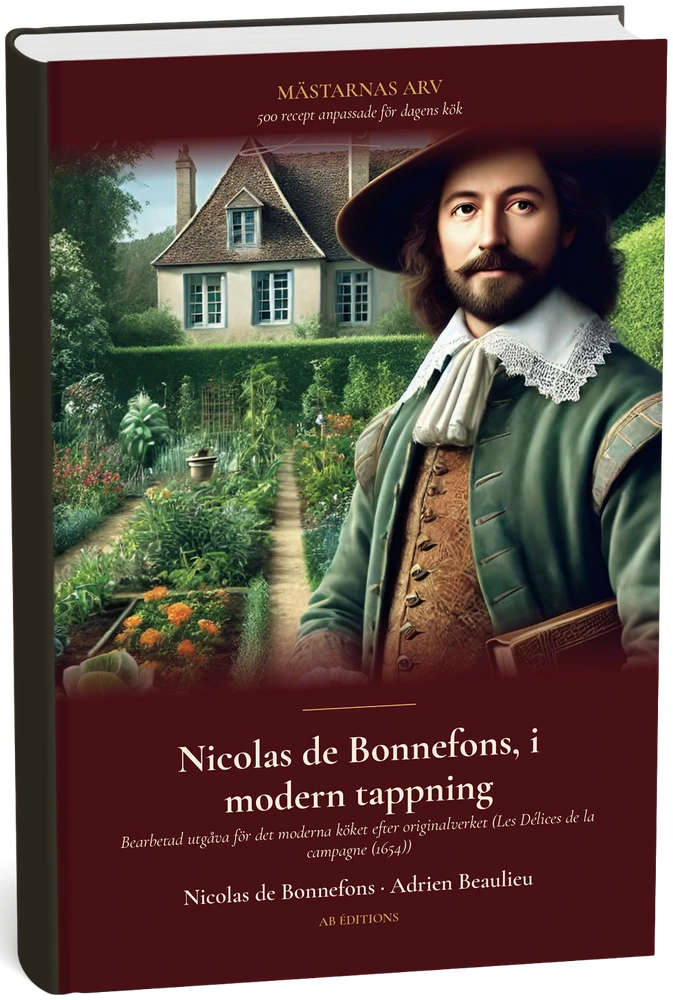
Nicolas de Bonnefons · Adrien Beaulieu
Édition internationale en Suédois · L'Héritage des Maîtres
Découvrir l’ouvrage →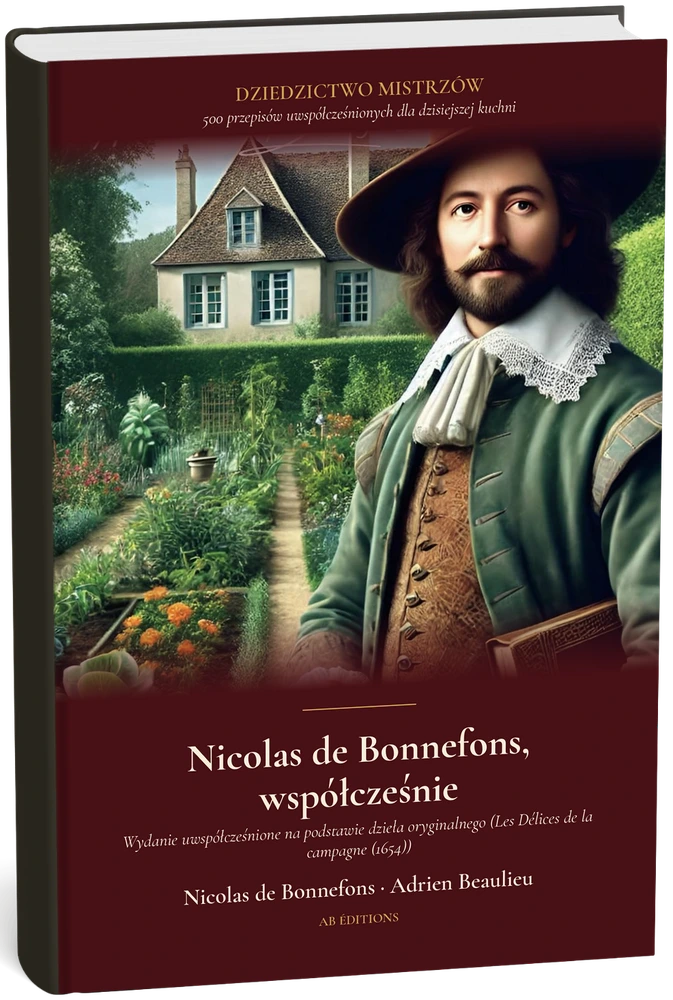
Nicolas de Bonnefons · Adrien Beaulieu
Édition internationale en Polonais · L'Héritage des Maîtres
Découvrir l’ouvrage →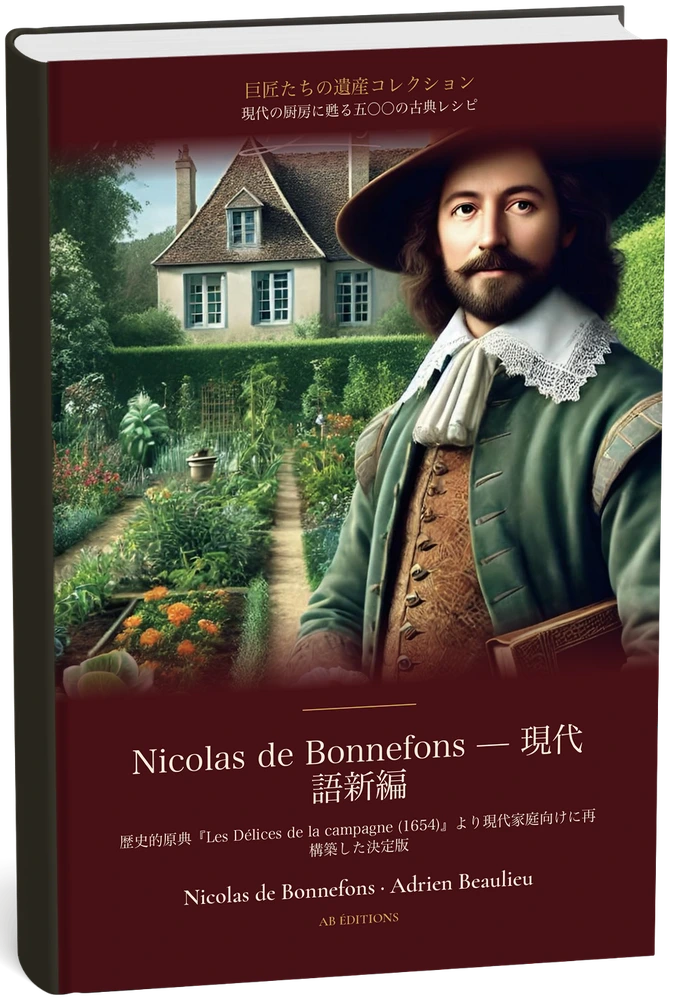
Nicolas de Bonnefons · Adrien Beaulieu
Édition internationale en Japonais · L'Héritage des Maîtres
Découvrir l’ouvrage →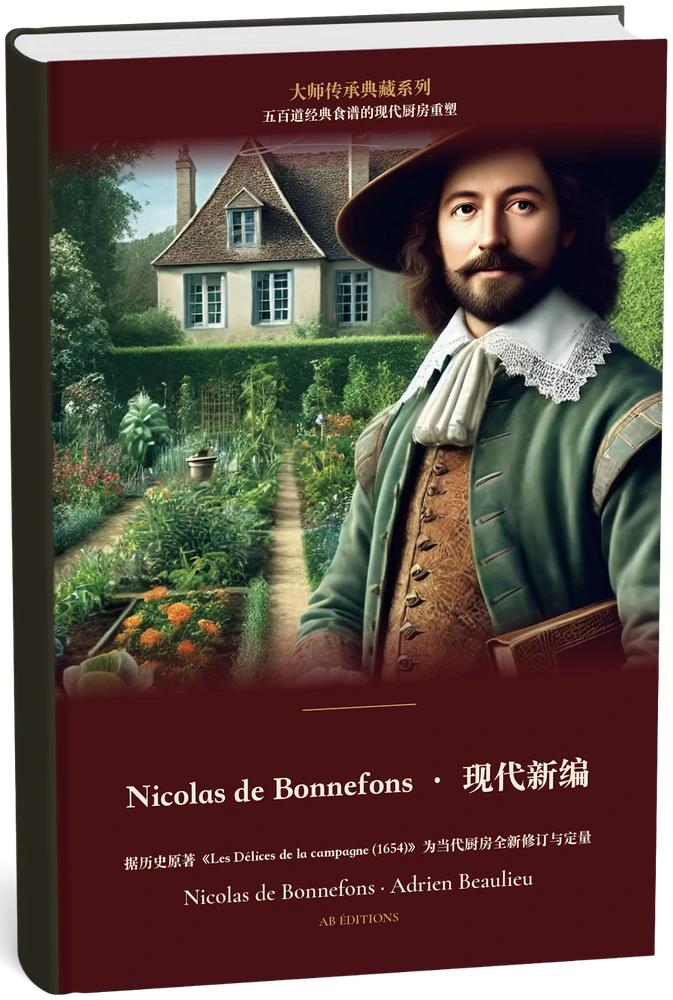
Nicolas de Bonnefons · Adrien Beaulieu
Édition internationale en Chinois · L'Héritage des Maîtres
Découvrir l’ouvrage →Nicolas de Bonnefons stood at the singular crossroads of gardener and cook at the seventeenth-century court of Versailles—an epoch when royal cookery was defined by sumptuous confections and labyrinthine techniques designed to dazzle the aristocracy. Born in 1637, Bonnefons held the station of valet de chambre to King Louis XIV, a privileged perch from which he observed the intimate habits and dining caprices of the court. While the gastronomy of contemporary grandees was synonymous with unbridled luxury and ornamental excess, Bonnefons distinguished himself by an earthy, rustic authenticity, which he set forth with conviction in his masterwork, Les Délices de la Campagne, published in 1654.
This volume championed a cookery of unadorned clarity, centered upon the morning-fresh integrity of ingredients, in stark defiance of the bewildering complexity then reigning at court. In an era when dishes were often smothered beneath artificial refinements, Bonnefons celebrated the intrinsic virtue of the soil’s bounty, exalting the natural savor of garden vegetables, wild and cultivated herbs, tender meats, and farmhouse dairy. His approach—both revolutionary and gently provocative—would indelibly steer the course of French gastronomy toward purity, honesty, and restraint.
1. The Preeminence of Simplicity and Local Bounty
Bonnefons advocated for a culinary art of profound deference to the ingredient, wherein raw freshness took absolute precedence over ornate manipulation. His treatise, Les Délices de la Campagne, stood as a direct retort to the sybaritic opulence of Versailles. He prized honest, noble ingredients—chiefly those yielded by native soil—and exhorted cooks to draw forth the unblemished essence of the earth. This candid ethos broke decisively with palace custom, where viands were routinely drowned in exotic spices and tortuous preparations.
2. The Democratization of the Table
Unlike courtly dining, which was the exclusive preserve of a gilded oligarchy, Bonnefons carried the culinary craft into the reach of the wider world. By codifying straightforward methods requiring neither arcane instruments nor alchemical lore, he democratized the pleasures of the table. His receipts were conceived for modest households desirous of wholesome, flavorful sustenance, observant of the seasons and mindful of regional produce. In this, he laid the cornerstone for a more inclusive French cuisine—one destined to be savored by all.
3. The Elevation of the Garden Vegetable
Among Bonnefons’s foremost triumphs was the restoration of garden vegetables to a place of honor—an element long neglected at court in favor of gargantuan roasts and heavy, cloak-and-dagger sauces. For Bonnefons, vegetables were never mere garnish or afterthought, but noble protagonists that demanded cooking methods capable of preserving their vital juices and native character. His pages abound with carrots, leeks, cabbages, and garden turnips, gently coaxed to retain their restorative virtues and distinct sweetness. In this regard, he anticipated the flowering of eighteenth-century cuisine bourgeoise.
4. The Judicious Use of Aromatic Herbs
Bonnefons was equally celebrated for his temperate yet masterly deployment of garden herbs. In an age when heavy caravans of exotic spices were routinely marshaled to disguise the imperfections of questionable meats, he turned rather to the fragrance of native soil—parsley, thyme, chives, and bay laurel—elevating his broths and stews without ever violating their natural identity. This delicate economy of seasoning profoundly influenced the evolution of French gastronomy, which would ever after venerate the subtle perfumes of its own terroir.
5. The Sanctity of Fine Meats and Dairy
Bonnefons attached supreme consequence to the provenance of meats and the purity of dairy. Fresh butter, sweet milk, and farmhouse cheeses were essential to his repertoire, employed to lend richness while preserving an airy lightness of flavor. He was no less exacting regarding poultry and game, preparing them with unadorned frankness so that their natural flavor might sing, rather than burying them under heavy marinades and suffocating sauces. To his mind, every element must shine in its most pristine state, honoring the natural grain and tender savor bestowed by nature.
The receipts of Nicolas de Bonnefons are hallmarks of rustic elegance and restraint, designed solely to glorify their natural elements. The following examples capture his singular vision:
1. Leek and Potato Soup
The leek and potato soup stands as a consummate testament to how Bonnefons harnessed humble provisions to create a soothing, deeply savory dish. Leeks and potatoes are gently simmered, then milled into a velvety potage, finished with a modest whisper of salt, cracked pepper, and sweet butter.
• Principal Ingredients: Leeks, potatoes, butter, salt, pepper.
• Method: The leeks and potatoes are gently stewed until tender, then passed through a sieve or mill to achieve a silken texture. A knob of fresh butter stirred in at the final moment heightens the natural sweetness and imparts an unctuous grace.
2. Roast Chicken with Garden Herbs
Roast chicken with garden herbs embodies Bonnefons’s philosophy regarding meats: absolute reverence for the bird and uncomplicated hearthcraft. The fowl is roasted simply alongside aromatic herbs—thyme and bay—yielding a succulent roast unburdened by superfluous ornamentation.
• Principal Ingredients: Chicken, thyme, bay laurel, butter, salt.
• Method: The chicken is rubbed generously with coarse salt and sweet butter, then roasted gently with freshly gathered garden herbs to foster a subtle, harmonious perfume. A patient roasting ensures the flesh remains tender and juicy, steeped in the aromatic vapors of the herbs.
3. Compote of Apples and Plums
The compote of apples and plums reflects Bonnefons’s deep affection for seasonal orchard fruits and unstudied simplicity. Apples and plums are simmered with a modest measure of sugar to coax forth their innate sweetness, producing a humble yet deeply satisfying dessert.
• Principal Ingredients: Apples, plums, sugar.
• Method: The fruits are pared, quartered, and gently simmered with sugar until they yield into a tender compote. Served warm or cooled from the cellar, it perfectly illustrates the pastoral grace of Bonnefons’s culinary art.
The legacy of Nicolas de Bonnefons within the annals of French cuisine is beyond dispute. Through his lucid and forthright philosophy, he laid the foundations for a cuisine bourgeoise anchored in the pristine quality of its provisions and respectful cookery. By championing local terroir and democratizing culinary craft, he helped shape modern French gastronomy, which continues to revere freshness and the natural integrity of food.
By exalting the native dignity of ingredients, favoring unpretentious methods, and opening the kitchen doors to the world, Bonnefons heralded the eighteenth-century cuisine bourgeoise. This culinary movement, born in conscious opposition to the theatrical excesses of the court, was founded upon deference to the product, economy of gesture, and the shared conviviality of the table—principles that Bonnefons had long since championed.
Nicolas de Bonnefons was a visionary pioneer of the ethos of eating locally and in harmony with the seasons—a creed that remains the beating heart of contemporary gastronomy. His insistence upon drawing sustenance from one’s immediate countryside and observing the natural calendar inspired generations of culinarians, cementing the enduring conviction that the finest cooking is that which honors the bounty of neighboring fields and respects the cycles of the earth.
Bonnefons was likewise instrumental in demystifying the culinary arts. By translating the delights of fine dining into forms accessible to households possessing neither the fortunes nor the retinue of the royal court, he redefined gastronomic pleasure, bestowing it upon the many. His doctrine of cookery—simple, authentic, and inclusive—reverberates with striking modernity in the kitchens of our own day.
Nicolas de Bonnefons embodies a culinary philosophy grounded in the absolute sincerity of the ingredient and the purity of technique. In elevating regional bounty and championing a direct, pastoral simplicity, he precipitated a profound culinary transformation across France. Today, his influence lingers in every bowl of freshly gathered garden greens, every herb-scented bouillon, and every orchard fruit cooked with attentive care.
In sum, Nicolas de Bonnefons remains an indispensable figure in the pantheon of French gastronomy, whose ideals continue to inspire masters of the hearth and lovers of fine fare across the globe. His Les Délices de la Campagne stands as a timeless hymn to natural savors, and his spirit lives on wherever cuisine is practiced with truth, reverence for the soil, and gratitude toward those who till it.
Recettes, histoires, parutions et éditions de collection — quelques lettres par an, jamais davantage.