La Cuisinière Bourgeoise (1746) & Les Soupers de la Cour (1755)
François Menon
Les Grands Classiques (Originaux) · Le plus grand best-seller culinaire du XVIIIe siècle français
Découvrir l’ouvrage → MAISON BEAULIEUAB ÉDITIONS · CUISINE & LETTRES
La Maison Beaulieu présente l’œuvre de François Menon selon son architecture éditoriale complète : d’abord I. Les Grands Classiques (les textes originaux d’époque), puis II. L’Héritage des Maîtres (l’édition française modernisée — 500 recettes mises au goût du jour), et enfin III. Le Rayonnement International (l’édition modernisée traduite en 10 langues). Tarif officiel Cuisine AB Éditions : Ebook · 9,90 € · Broché (PB) · 24,90 € (+ port réel) · Relié Collector (HC) · 34,90 € (+ port réel).
Le texte historique intégral de François Menon, établi et restauré dans sa typographie et sa langue d’origine, avec ses couvertures de collection originales.
Pour cuisiner réellement François Menon aujourd’hui chez soi sans brigade : chaque recette est codifiée et structurée selon le protocole de la Maison (Ingrédients calibrés en grammes pour 4 personnes · Préparation pas à pas avec temps et températures exacts · Conseil du Chef), dans le respect absolu du goût et de l’esprit du Maître.
Conformément à la doctrine éditoriale de la Maison, ce n’est jamais le français archaïque d’époque qui est traduit, mais notre édition française modernisée (L’Héritage des Maîtres — 500 recettes au goût du jour), afin d’offrir aux lecteurs du monde entier des recettes claires, précises et immédiatement réalisables en 10 langues (EN, DE, ES, IT, PT, NL, SV, PL, JA, ZH) :
François Menon · Adrien Beaulieu
Édition internationale en Anglais · L'Héritage des Maîtres
Découvrir l’ouvrage →
François Menon · Adrien Beaulieu
Édition internationale en Allemand · L'Héritage des Maîtres
Découvrir l’ouvrage →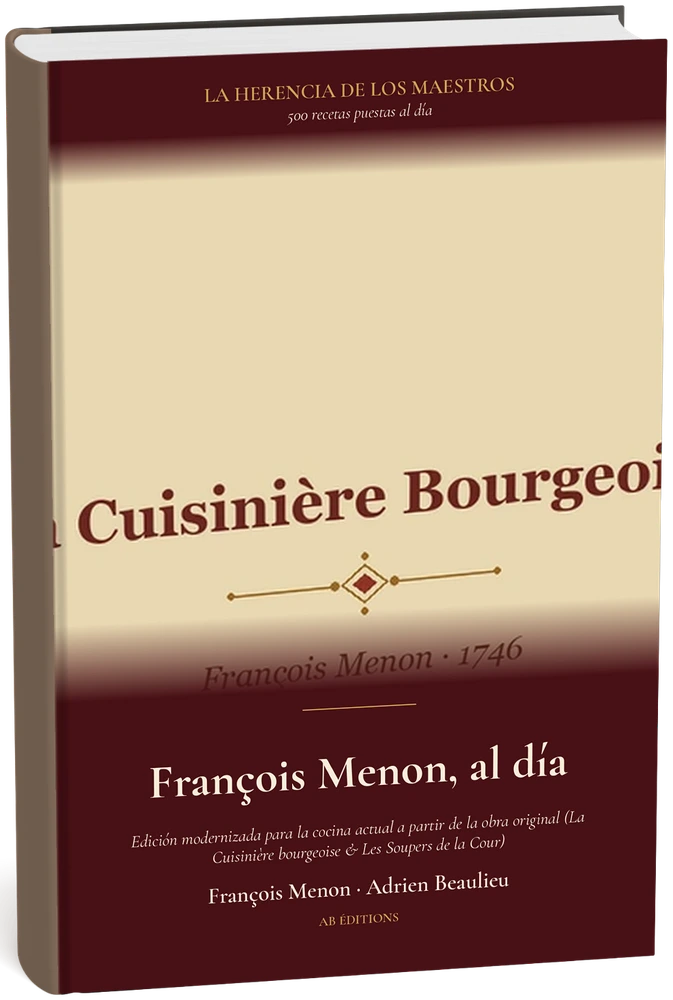
François Menon · Adrien Beaulieu
Édition internationale en Espagnol · L'Héritage des Maîtres
Découvrir l’ouvrage →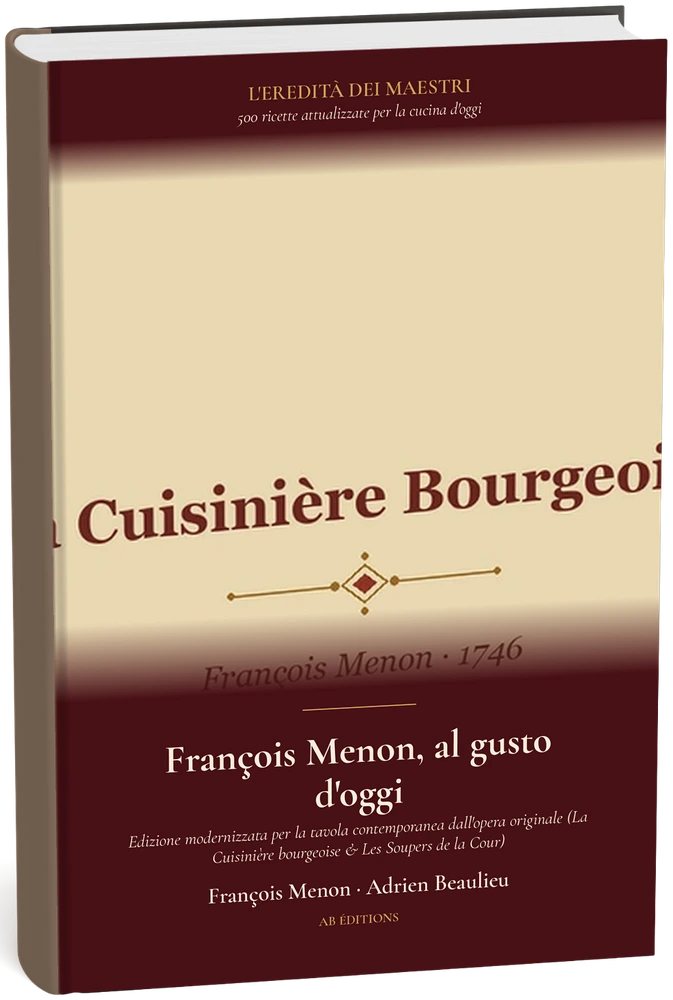
François Menon · Adrien Beaulieu
Édition internationale en Italien · L'Héritage des Maîtres
Découvrir l’ouvrage →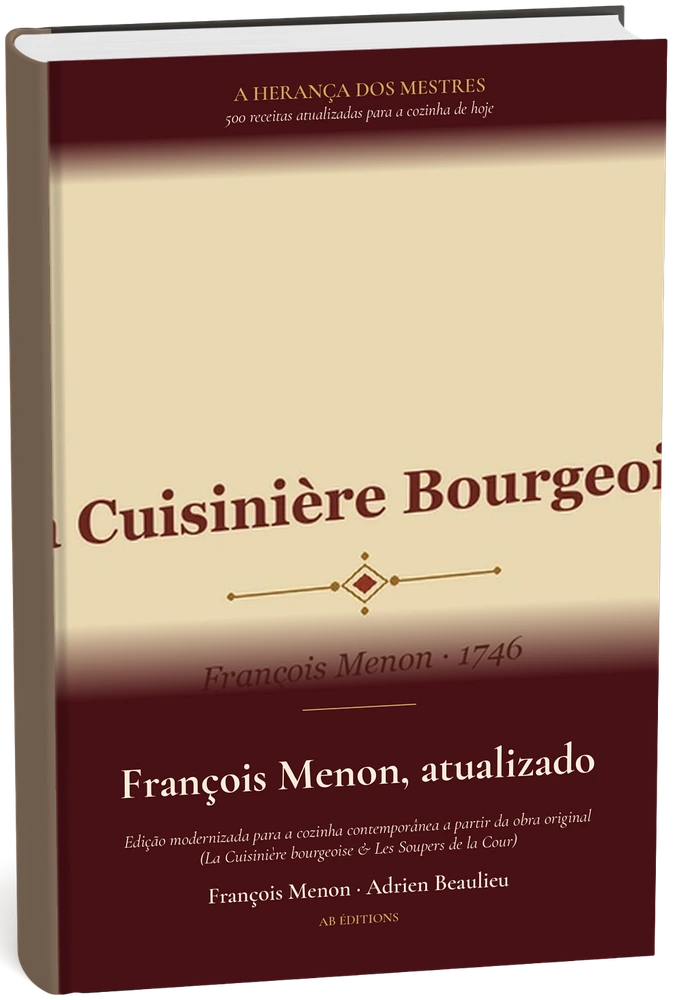
François Menon · Adrien Beaulieu
Édition internationale en Portugais · L'Héritage des Maîtres
Découvrir l’ouvrage →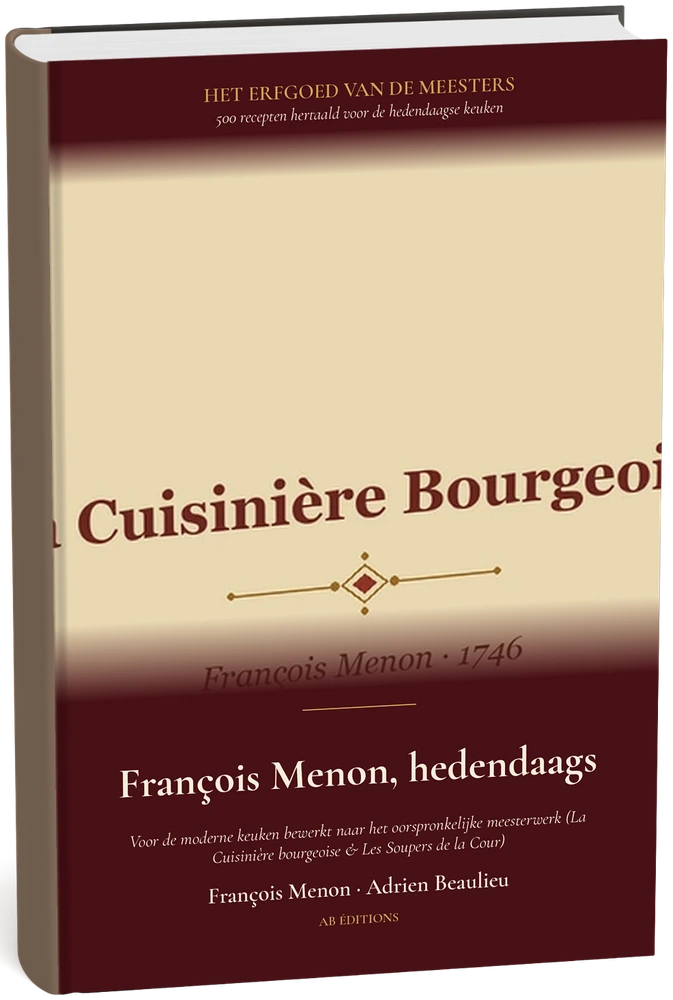
François Menon · Adrien Beaulieu
Édition internationale en Néerlandais · L'Héritage des Maîtres
Découvrir l’ouvrage →
François Menon · Adrien Beaulieu
Édition internationale en Suédois · L'Héritage des Maîtres
Découvrir l’ouvrage →
François Menon · Adrien Beaulieu
Édition internationale en Polonais · L'Héritage des Maîtres
Découvrir l’ouvrage →
François Menon · Adrien Beaulieu
Édition internationale en Japonais · L'Héritage des Maîtres
Découvrir l’ouvrage →
François Menon · Adrien Beaulieu
Édition internationale en Chinois · L'Héritage des Maîtres
Découvrir l’ouvrage →François Menon stands as the prolific author of numerous eighteenth-century culinary treatises, chief among them the celebrated corpus known as La Cuisinière Bourgeoise. He played a foundational role in codifying and disseminating French culinary recipes for the domestic sphere, bringing the graces of refined dining within reach of the modest households of his era.
François Menon, that preeminent culinary chronicler of the Age of Enlightenment, bequeathed a monumental legacy to French gastronomy, principally through the enduring triumph of his work La Cuisinière Bourgeoise. First published in 1746, this seminal manual marked a decisive turning point in the transmission of high culinary art to modest and bourgeois hearths, opening access to preparations that had hitherto remained the jealously guarded preserve of the aristocracy.
La Cuisinière Bourgeoise is justly regarded as one of the earliest culinary volumes explicitly conceived for an audience beyond aristocratic salons. Prior to Menon, gastronomic literature occupied itself almost exclusively with sumptuous feasts and extravagant confections destined for royal banquets or noble sideboards. Menon, by contrast, possessed the discernment to advocate a more approachable table, attuned to the modest revenues of bourgeois households and the bounty of regional markets, without ever compromising elegance or discernment. His volume met with unprecedented acclaim, becoming the most frequently reprinted cookbook in France prior to the Revolution.
• Democratisation of French Cuisine: In rendering sophisticated recipes accessible, La Cuisinière Bourgeoise enabled bourgeois homemakers to dress an exquisite table without recourse to ruinous or exotic provisions. This democratisation elevated the everyday culinary standards of French homes and firmly anchored gastronomy as a cornerstone of bourgeois culture.
• Clarity and Simplicity of Method: Menon set forth his instructions with crystalline brevity and lucid precision, thereby permitting his readers to execute intricate preparations with dependable success. In standardising fundamental kitchen procedures, he facilitated their transmission and study, pioneering a pedagogical approach that would permanently inspire subsequent culinary manuals.
• Codification of Culinary Technique: Within his pages, Menon assembled and formalised techniques that would become cardinal principles of French gastronomy. His formulas established lasting canons of preparation and presentation that endured across generations of domestic kitchens. This monumental effort of codification likewise informed the culinary academies of the nineteenth century, where the fundamentals of the French repertoire were imparted to young women of the bourgeoisie.
• Elevation of the Domestic Cook: La Cuisinière Bourgeoise brought the vital role of women in domestic cookery into luminous relief, conferring newfound dignity upon feminine culinary stewardship. In addressing his treatise directly to the mistress of the house and her cook, Menon ennobled the craft of the table and urged women to attain mastery in an art that reshaped the cultural perception of the domestic hearth.
The influence of François Menon reached far beyond his own century, leaving an indelible imprint upon French gastronomy. Through his pen, bourgeois cooking transformed into an emblem of attainable refinement, embodying a social identity that prized the dignity and quality of the daily repast. By naturalising sophisticated culinary methods and championing an elegant yet unpretentious table, Menon laid the very foundations of modern French culinary identity.
Today, La Cuisinière Bourgeoise is celebrated for its decisive contribution to the culinary emancipation of the French middle classes and for having carried the genius of French culinary savoir-faire across international borders, continuously inspiring chefs, discerning amateurs, and epicures across the generations.
Recettes, histoires, parutions et éditions de collection — quelques lettres par an, jamais davantage.