L’Art du Cuisinier — Édition Intégrale (Tomes I & II, 1814)
Antoine Beauvilliers
Les Grands Classiques (Originaux) · 424 pages · 1 113 recettes d'époque
Découvrir l’ouvrage → MAISON BEAULIEUAB ÉDITIONS · CUISINE & LETTRES
La Maison Beaulieu présente l’œuvre de Antoine Beauvilliers selon son architecture éditoriale complète : d’abord I. Les Grands Classiques (les textes originaux d’époque), puis II. L’Héritage des Maîtres (l’édition française modernisée — 500 recettes mises au goût du jour), et enfin III. Le Rayonnement International (l’édition modernisée traduite en 10 langues). Tarif officiel Cuisine AB Éditions : Ebook · 9,90 € · Broché (PB) · 24,90 € (+ port réel) · Relié Collector (HC) · 34,90 € (+ port réel).
Le texte historique intégral de Antoine Beauvilliers, établi et restauré dans sa typographie et sa langue d’origine, avec ses couvertures de collection originales.
Antoine Beauvilliers
Les Grands Classiques (Originaux) · 424 pages · 1 113 recettes d'époque
Découvrir l’ouvrage →
Antoine Beauvilliers
Les Grands Classiques (Originaux) · Tome I · 254 pages · Texte intégral
Découvrir l’ouvrage →
Antoine Beauvilliers
Les Grands Classiques (Originaux) · Tome II · 244 pages · Texte intégral
Découvrir l’ouvrage →Pour cuisiner réellement Antoine Beauvilliers aujourd’hui chez soi sans brigade : chaque recette est codifiée et structurée selon le protocole de la Maison (Ingrédients calibrés en grammes pour 4 personnes · Préparation pas à pas avec temps et températures exacts · Conseil du Chef), dans le respect absolu du goût et de l’esprit du Maître.
Conformément à la doctrine éditoriale de la Maison, ce n’est jamais le français archaïque d’époque qui est traduit, mais notre édition française modernisée (L’Héritage des Maîtres — 500 recettes au goût du jour), afin d’offrir aux lecteurs du monde entier des recettes claires, précises et immédiatement réalisables en 10 langues (EN, DE, ES, IT, PT, NL, SV, PL, JA, ZH) :
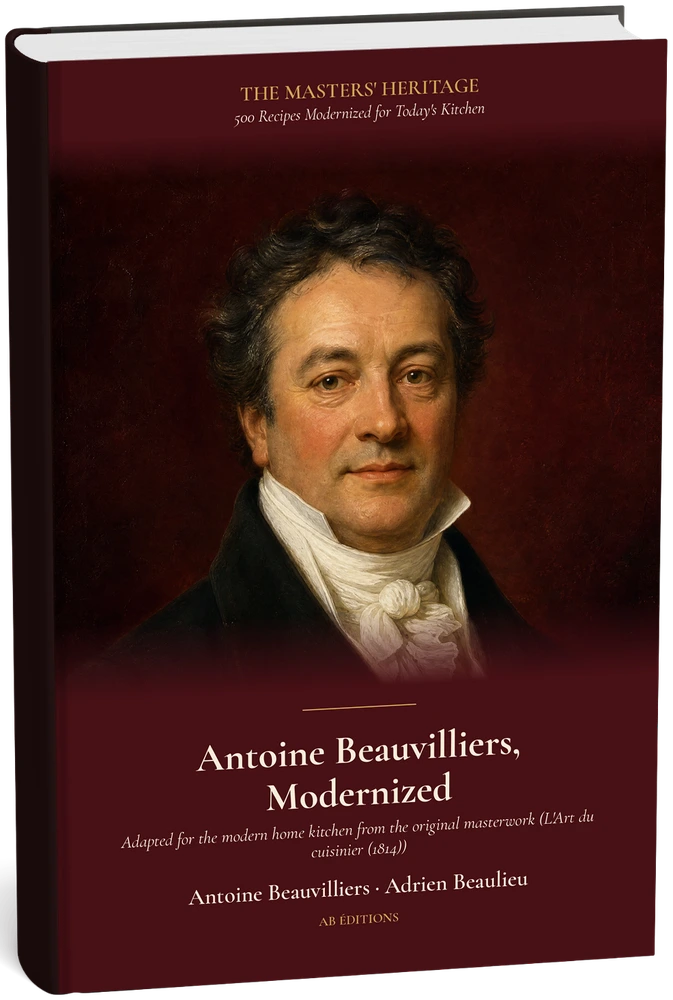
Antoine Beauvilliers · Adrien Beaulieu
Édition internationale en Anglais · L'Héritage des Maîtres
Découvrir l’ouvrage →
Antoine Beauvilliers · Adrien Beaulieu
Édition internationale en Allemand · L'Héritage des Maîtres
Découvrir l’ouvrage →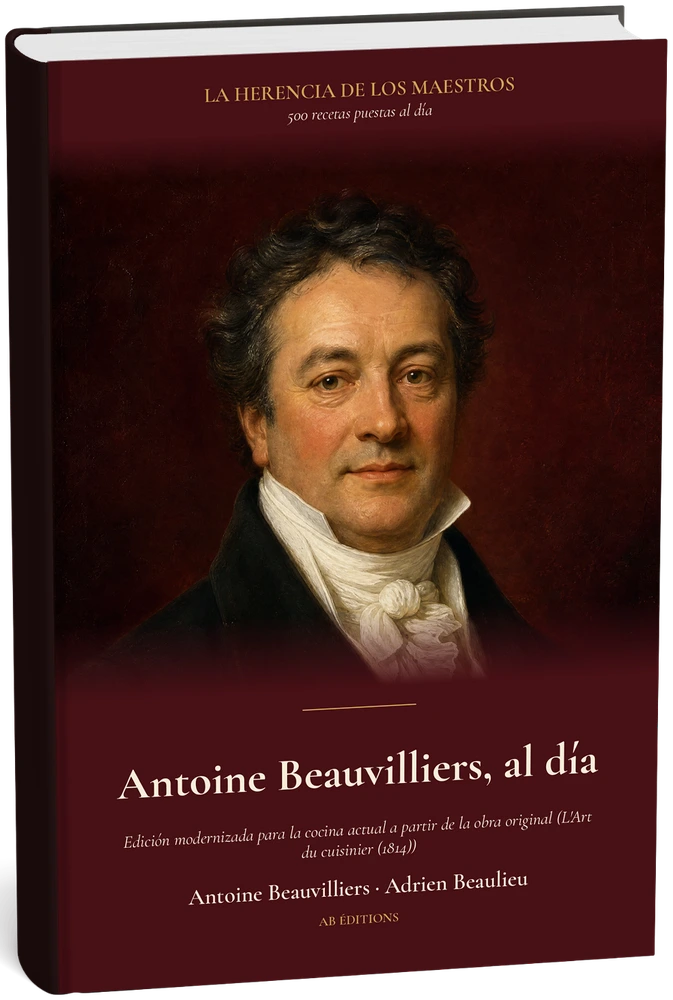
Antoine Beauvilliers · Adrien Beaulieu
Édition internationale en Espagnol · L'Héritage des Maîtres
Découvrir l’ouvrage →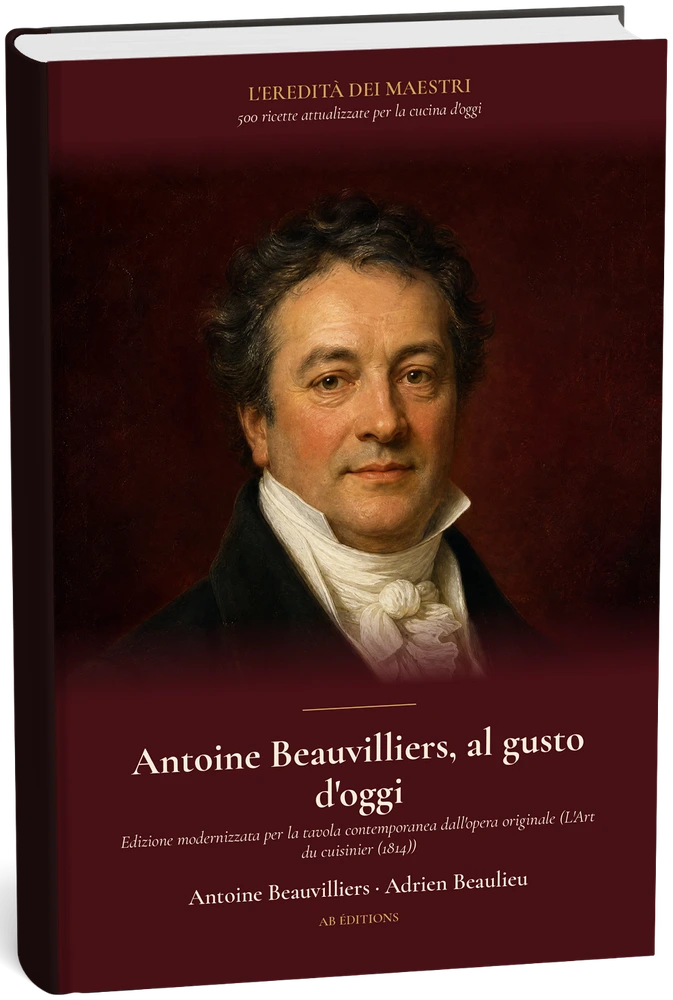
Antoine Beauvilliers · Adrien Beaulieu
Édition internationale en Italien · L'Héritage des Maîtres
Découvrir l’ouvrage →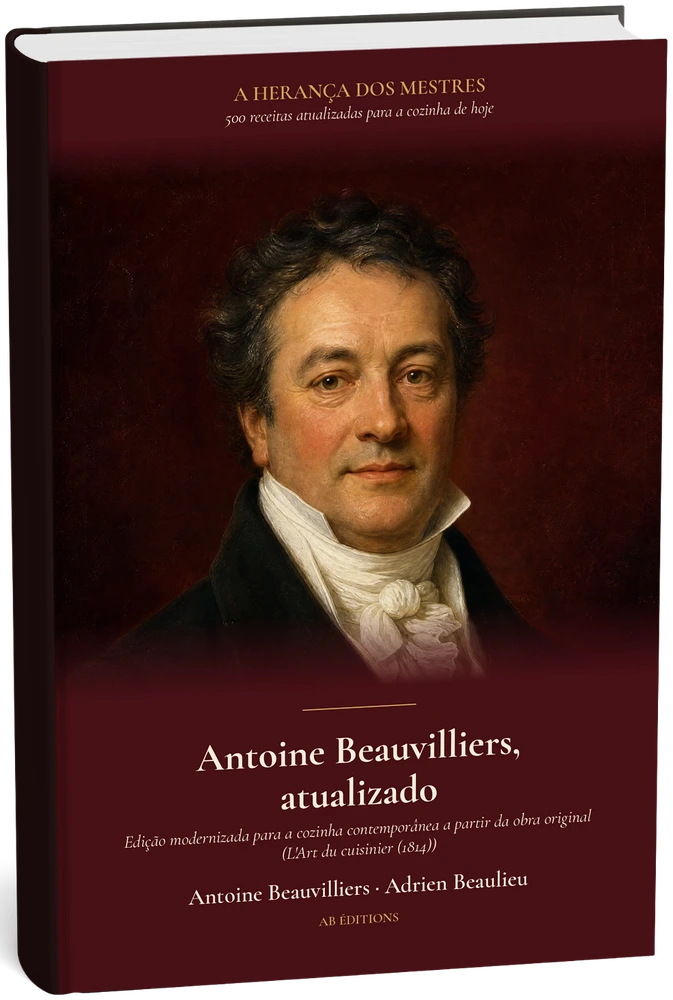
Antoine Beauvilliers · Adrien Beaulieu
Édition internationale en Portugais · L'Héritage des Maîtres
Découvrir l’ouvrage →
Antoine Beauvilliers · Adrien Beaulieu
Édition internationale en Néerlandais · L'Héritage des Maîtres
Découvrir l’ouvrage →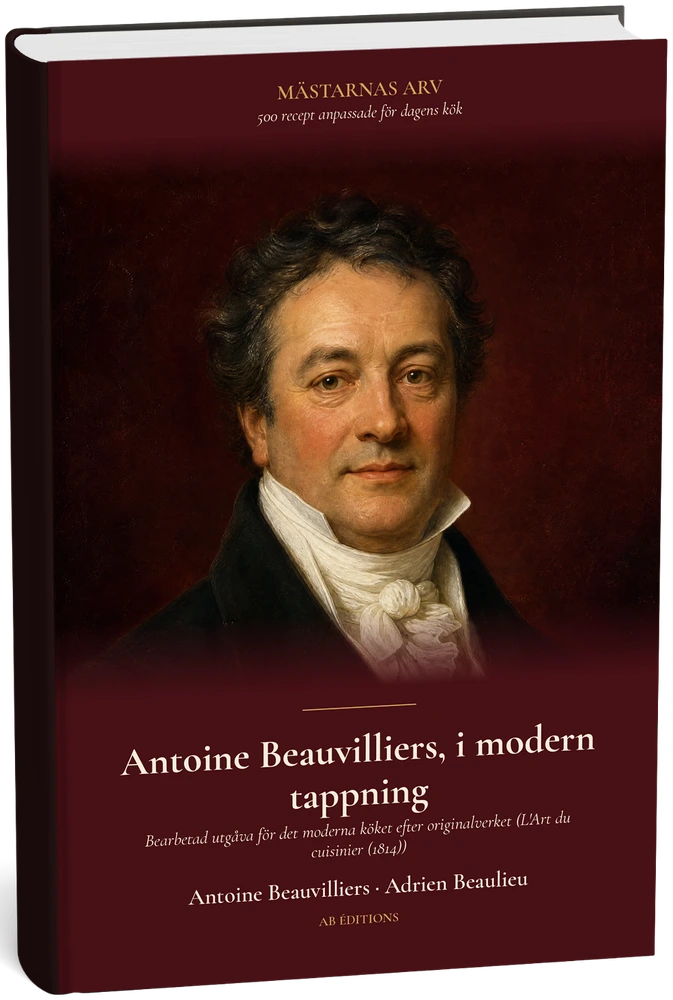
Antoine Beauvilliers · Adrien Beaulieu
Édition internationale en Suédois · L'Héritage des Maîtres
Découvrir l’ouvrage →
Antoine Beauvilliers · Adrien Beaulieu
Édition internationale en Polonais · L'Héritage des Maîtres
Découvrir l’ouvrage →
Antoine Beauvilliers · Adrien Beaulieu
Édition internationale en Japonais · L'Héritage des Maîtres
Découvrir l’ouvrage →
Antoine Beauvilliers · Adrien Beaulieu
Édition internationale en Chinois · L'Héritage des Maîtres
Découvrir l’ouvrage →Antoine Beauvilliers was born in Paris in 1754. His family is described as modest; one source suggests his father was a vintner, though this remains unverified. Around 1770, he entered into his culinary apprenticeship. He entered the household of the Comte de Provence—brother to Louis XVI and the future Louis XVIII—where he rose through the ranks to become an officier de bouche. Such an office entailed directing the kitchens and orchestrating the repasts of an eminent scion of the royal house. In this service he acquired an intimate mastery of the tastes and exacting standards of the aristocracy, along with a rare authority that set him apart from the common caterers and innkeepers of the town. Another account mentions an earlier period in the kitchens of the Prince de Condé, though prudence dictates caution on this point.
Around 1782, while the monarchy still stood firm, he departed the court to open a restaurant on the Rue de Richelieu. He thus anticipated by several years the great exodus of noble cooks that the Revolution would soon unleash. In 1788, he removed his establishment to the Palais-Royal, within the Galerie de Valois. There, he took his place at the very vortex of Parisian social, political, and gastronomic life, precisely where the prosperous society he courted gathered daily.
In 1793, the Revolution shattered his enterprise. Historical accounts tell of persecutions, likely imprisonment, and the confiscation of his original establishment, brought on almost certainly by his monarchist sympathies. The precise details of these dark years remain fragmentary. Yet he rebuilt his fortunes: in 1795, he opened the Grande Taverne de Londres at No. 26 Rue de Richelieu. This house established him definitively among the most celebrated dining tables in Paris, and there he remained until the close of his days. The title page of his book in 1814 still proclaimed him former officer to Monsieur, Comte de Provence, attached to the extraordinary service of the royal households, and now restaurateur: he was determined that the world should remember his origins. In 1814, he gave to the press L'Art du cuisinier. He died in Paris on January 31, 1817, and was laid to rest in Père-Lachaise Cemetery.
His life’s work resolves itself into two monuments: a dining room and a treatise.
First, the dining room. His sign, the Grande Taverne de Londres, elevated the establishment far above ordinary taverns and bouillon-houses. The name evoked the British capital, standing less as a tribute to English cooking than as a declaration of cosmopolitan ambition. Beauvilliers sought to transplant the splendour of ancestral mansions—Versailles chief among them—into a public commercial space, throwing its doors wide to anyone with the means to pay. It was an early incarnation of a "total environment": an elegant salon glistening with mirrors and crystal chandeliers, private tables and intimate alcoves replacing the communal table d'hôte, a printed menu offering a vast choice of dishes, well-dressed and meticulously schooled waiters, a cellar of unprecedented depth and discernment, and a host who recognized his guests. Possessed of a prodigal memory, Beauvilliers welcomed patrons in person, lavishing counsel and compliments, appearing before them, as chronicle has it, in full ceremonial dress with sword at his side.
His cuisine was that of the great châteaux, adapted to the public dining room. It gave pride of place to feathered game and poultry, exalted pristine raw ingredients, and was refined through proven, rigorous techniques. Brillat-Savarin pronounced it superior, affirming that Beauvilliers was the first to unite "an elegant salon, well-dressed waiters, a choice cellar, and an elevated cuisine." Common lore attributes to Beauvilliers the invention of the soufflé. Following his death, his name was also bestowed upon a classical garnish reserved for large braised joints.
Then came the book. L'Art du cuisinier was published in Paris in 1814 by Pilet, in two octavo volumes. Every copy of the first edition was authenticated by the author's hand or bore a dry embossed stamp upon the title page. The work was graced with engraved vignettes and nine folding plates illustrating table settings. It treated of soups, sauces, garnishes, ragouts, butcher's meats, and game, but extended also to the proper order of courses, the purchase and preservation of foodstuffs, kitchen economy, the choice and decanting of wines, and the distillation of liqueurs. Beauvilliers addressed it equally to professionals—maîtres d'hôtel, chefs de cuisine, and officers of the pantry—and to gentlemen of means wishing to oversee their tables and draw the best from the produce of their estates.
He presented his work as the fruit of long experience. He claimed to have collected the methods of the greatest masters of his day, offering innovations only after subjecting them to extensive trial. The book encompassed cooking, estate management, economy, and presentation alike. This sweeping scope separated it fundamentally from earlier collections of recipes.
The book enjoyed a second edition with a posthumous supplement in 1821, followed by an 1824 printing by Pillet aîné and Colnet. In 1824, it was translated into English in London under the title The Art of French Cookery.
Before 1789, haute cuisine was practiced behind closed doors in the private kitchens of aristocracy, princes, financiers, and high prelates, its secrets passed down without being committed to paper. The concept of the "restaurant" did exist: a certain Boulanger around 1765, followed by Mathurin Roze de Chantoiseau from 1766 onwards, served restorative broths—bouillons restaurants—to patrons seated at individual tables. Yet the surroundings remained spartan, without pretension to elegance or intimacy.
The Revolution overturned this order. The emigration of the nobility and the ruin of princely fortunes cast legions of skilled cooks onto the street. In 1791, the dissolution of the trade guilds swept away the ancient barriers that had partitioned the culinary crafts—traiteurs, rotisseurs, and pastry cooks. These masters were now free to establish their own houses, and a rising bourgeois clientele, eager to taste the splendours of the old regime, stood ready to pay. Grimod de La Reynière observed that the number of Parisian restaurants quintupled in a matter of years. The Palais-Royal became their beating heart.
Beauvilliers was by no means alone. Méot, Robert, the Frères Provençaux (Maneille), and Véry were his rivals and contemporaries in and around the Palais-Royal. What distinguished him, by all contemporary accounts, was the harmonious union of opulent décor, attentive service, cuisine of the highest order, and a definitive text in which he codified his craft. One question remains debated by historians: did his tables offer a fixed-price meal, an à la carte selection, or both, served at fixed hours or at any time? The sources diverge, suggesting that these practices may have coexisted or evolved over time.
This was likewise the dawn of gastronomic criticism. Grimod published his Almanach des gourmands between 1803 and 1812, steering epicures toward the finest tables of the capital. In 1825, Brillat-Savarin gave the world his Physiologie du goût, devoting several pages to Beauvilliers. While he discerned a measure of "commercial cynicism" in the enterprise, Brillat-Savarin underscored that the restaurant preserved the genuine spirit of noble hospitality from which it sprang. No direct quotation from Grimod on Beauvilliers survives; yet it is all but certain that he held him in high esteem, for the house on the Rue de Richelieu ranked among the most celebrated in Paris throughout the publication of the Almanach.
Beauvilliers bequeathed, first and foremost, a model. He is celebrated as the founder of the first true gastronomic restaurant in Paris, or at the very least as the first restaurateur to define its essential characteristics: the elegant salon, the drilled brigade of waitstaff, the extensive menu, individual tables, and an exceptional wine cellar. These elements, gathered under a single roof, became the enduring cornerstones of fine dining throughout France and across the Western world.
He also left behind an indispensable book. Brillat-Savarin regarded it as the first truly methodical treatise on the art, unsurpassed by any that followed. Carême cited it as an authority. It stands historically as the bridge spanning the kitchen traditions of the Ancien Régime and the nineteenth-century haute cuisine codified by Carême. Writing before Carême and long before Escoffier’s brigade system, Beauvilliers did not formally theorize the kitchen hierarchy; yet the scale of his establishment clearly necessitated a formidable and rigorous kitchen organization. Without Beauvilliers’ model and without his book, the destiny of haute cuisine might well have taken a profoundly different course.
Finally, his name endures in the culinary lexicon through the classical garnish that bears his name, and his book remains an essential landmark of gastronomic literature, available today in modern, multilingual editions.
To open L'Art du cuisinier without guidance is a formidable undertaking. The work comprises some 1,100 articles arranged into sixty chapters. Beauvilliers wrote for the kitchens of a great aristocratic mansion or an ambitious restaurant equipped with an office, a vast masonry hearth, and an extensive brigade; he employed units of measure and implements long banished from modern memory: the livre, once, pinte, chopine, paillasse, Dutch oven, and salbotière. Quantities are given by piece count (three partridges, twenty-four larks) or omitted altogether, particularly for garnishes and ragouts. Many articles refer back to others: some 280 recipes rely on phrases like "as described in the preceding article" or "see chapter…", quickly bewildering the hurried reader.
The Master's Heritage edition revives these historic recipes without altering the spirit of the dishes. We preserve the original names Beauvilliers bestowed upon them, the sequence of culinary operations, his authoritative imperative tone, his transitional phrasings ("that done," "once their cooking is finished," "at the moment of serving"), and his characteristic concluding flourish, "and serve." We maintain the classical kitchen verbs of the French brigade (singer, suer, faire partir, tomber à glace, vanner, masquer, dresser), elucidating each upon its first appearance in a chapter. What required modernization has been judiciously adjusted: quantities are scaled for four covers, weights and volumes converted, times and temperatures supplied where the original remained silent, and obsolete implements replaced by the Dutch oven, the sauté pan, or the modern oven. Where a cross-reference pointed to a fundamental technique—such as a blond roux—it has been written out in full on the page.
Yet we have observed strict fidelity. We have invented no omitted steps, altered no finished flavour profiles, added no herbs, garlic, or wines not cited in the original text, nor sought to lighten preparations for modern fads. Dishes that are impossible to execute today—for want of cockscombs, calf's lung, or river lamprey—have not been substituted: they have simply been set aside.
Beauvilliers' distinctive "Observe that…" notices—those parenthetical remarks offering advice on purchasing, touch, or remedies for mishaps—form the essence of the "Chef's Counsel" concluding each recipe. Where none existed in the text, we have supplied a practical culinary rule strictly compatible with the preparation.
To explore this volume, begin with the sauces and stocks, upon which the rest of the chapters depend; then proceed to the fish, an exceptionally rich section (commanding some twenty chapters in the original work), followed by poultry, game, and the pantry office. Read each recipe through entirely before setting to work, and trust your senses—the aroma of a roux, the yield beneath your thumb, the rich cast of a glaze—as much as the timer, precisely as the master did. The result is the authentic grandeur of late eighteenth-century cuisine: assured in its foundations, rich in reductions, and untainted by the confectionery excesses of later theatrical architecture.
1754 — Birth of Antoine Beauvilliers in Paris.
circa 1770 — Beginning of his culinary apprenticeship.
Before 1782 — Serves as officier de bouche to the Comte de Provence, the future Louis XVIII (one source also notes an earlier period in the household of the Prince de Condé).
circa 1782 — Opens his first restaurant on the Rue de Richelieu in Paris.
1788 — Moves his establishment to the Palais-Royal, within the Galerie de Valois.
1791 — Dissolution of the trade guilds: barriers separating the culinary trades are abolished.
1793 — His business is interrupted by the Revolution; suffers persecution, probable imprisonment, and the confiscation of his first establishment.
1795 — Opens the Grande Taverne de Londres at 26 Rue de Richelieu.
1803–1812 — Grimod de La Reynière publishes the Almanach des gourmands (with an interruption).
1814 — Publication of L'Art du cuisinier in two octavo volumes by Pilet.
January 31, 1817 — Death of Beauvilliers in Paris; he is buried in Père-Lachaise Cemetery.
1820 — Death of his wife, Marie Élisabeth René Françoise Cheron.
1821 — Second edition of L'Art du cuisinier, augmented with a supplement.
1824 — Edition dated 1824 published by Pillet aîné and Colnet; first English translation, The Art of French Cookery, published in London.
1825 — Brillat-Savarin publishes the Physiologie du goût, praising Beauvilliers and his treatise.
• L'Art du cuisinier, Paris: Pilet, 1814, 2 volumes in-octavo. A comprehensive treatise on the art: soups, sauces, garnishes, ragouts, butcher's meats, game, fish, pastry, pantry office, liqueurs, the ordering of courses, table settings (nine folding plates), and guidance on purchasing, cellar craft, and kitchen economy.
• L'Art du cuisinier, second edition with supplement, Paris, 1821 (posthumous).
• L'Art du cuisinier, Paris: Pillet aîné and Colnet, 1824 (edition recorded by contemporary booksellers).
• The Art of French Cookery, London, 1824: English translation of L'Art du cuisinier (posthumous).
• La Cuisine ordinaire, a work reported to have been co-authored with Carême to render fine cooking more accessible (date uncertain; subject to verification).
Recettes, histoires, parutions et éditions de collection — quelques lettres par an, jamais davantage.