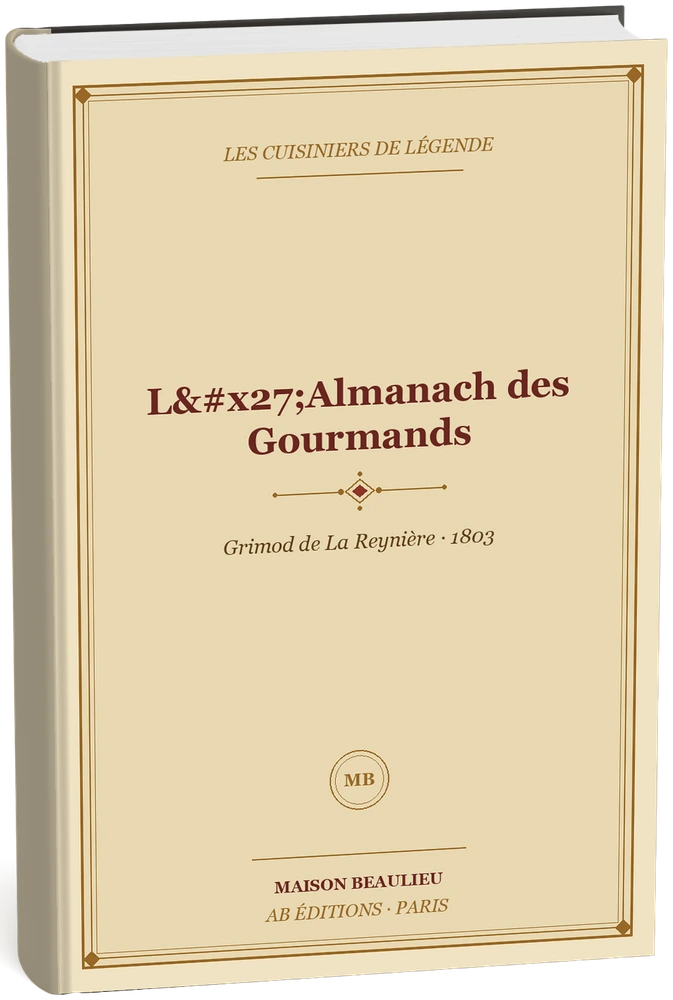
L’Almanach des Gourmands (1803–1812)
Grimod de La Reynière
Les Originaux · Les 8 années de l’Almanach · Édition en préparation
Découvrir l’ouvrage → MAISON BEAULIEUAB ÉDITIONS · CUISINE & LETTRES
Retrouvez ci-dessous l’ensemble des traités originaux, volumes réunis, éditions L’Héritage des Maîtres (500 recettes au goût du jour) et ouvrages au programme de Grimod de La Reynière. Choisissez votre format (Ebook · 9,99 €, Broché · 33,00 € ou Relié Collector · 79,00 €) et cliquez sur « ➕ Inclure à ma commande » pour composer votre sélection.
Grimod de La Reynière
Les Originaux · Les 8 années de l’Almanach · Édition en préparation
Découvrir l’ouvrage →Grimod de La Reynière · Adrien Beaulieu
L’Héritage des Maîtres · Code GRI · 500 recettes mises au goût du jour
Découvrir l’ouvrage →Grimod de La Reynière
Programme Patrimonial · Dissection des viandes à table, nomenclature des menus et politesse gourmande
Découvrir l’ouvrage →Alexandre Balthazar Grimod de La Reynière is widely regarded as the first true gastronomic critic and one of the founding fathers of modern culinary journalism. Born in 1758 into an opulent family of fermiers généraux (tax farmers), he leveraged his station to become an indispensable luminary in the world of gastronomy. In an era when French cuisine was evolving at a feverish pace—spurred by the dramatic rise of the public restaurant following the French Revolution—Grimod de La Reynière observed and analyzed the cultural and culinary upheavals that were reshaping the palate of the emergent bourgeoisie.
His masterwork, the Almanach des Gourmands, was published in successive volumes between 1803 and 1812. This groundbreaking guide reviewed Parisian dining rooms and dissected the culinary fashions of the age. Through this almanac, Grimod de La Reynière laid the foundations of a gastronomic critique that reached far beyond the mere listing of dishes. He wove into its pages reflections on taste, the integrity of ingredients, table aesthetics, and the encompassing theater of the meal. Through his writings, Grimod inaugurated a new epoch in the appreciation of dining, establishing gastronomy as an autonomous cultural art.
1. The Institution of Tasting Juries
Among Grimod de La Reynière’s most seminal contributions was the establishment of formal tasting juries composed of seasoned gourmets. These tribunals convened to sample and deliberate upon the dishes submitted by various restaurateurs, subsequently awarding distinctions based on rigorous criteria such as ingredient quality, recipe originality, and visual refinement. This process introduced an unprecedented form of public validation for restaurateurs, offering chefs a grand stage upon which to demonstrate their talent.
These juries advanced the revolutionary idea that the culinary arts could be discussed and debated with intellectual rigor, on equal footing with the fine arts. By formalizing gastronomic evaluation, Grimod de La Reynière helped organize the culinary sphere, reinforcing the perception of gastronomy as a serious and noble discipline.
2. A Sparkling and Instructive Literary Style
Grimod de La Reynière cultivated a light, educational, and spirited style that set him apart from dry, academic critics. His dry humor and flair for the dramatic captivated readers while schooling them in sound culinary practices and dining etiquette. He offered sage counsel on how to appreciate a meal and orchestrate a successful dinner party, transforming food writing into an entertaining and accessible genre. This singular voice helped popularize his treatises and sparked a fervent public interest in the gastronomic arts.
3. The Codification of Gastronomy as a Cultural Art
Grimod de La Reynière was a trailblazer in establishing gastronomy as an essential facet of culture. In another of his major works, Le Manuel des Amphitryons, he developed a philosophy of the table and of savoir-vivre that transcended the simple act of eating. He celebrated the figure of the "amphitryon"—the host who receives his guests and dispenses the hospitality of the board—demonstrating that gastronomy is not confined to the kitchen, but encompasses the entire social and sensory orchestration of the feast.
This holistic vision, treating the meal as a shared aesthetic experience, did much to elevate gastronomy to the pantheon of the beaux-arts. Grimod de La Reynière championed the belief that dining is a profound cultural act—an expression of taste worthy of being cultivated and revered.
4. The Enrichment of a Gastronomic Lexicon
Grimod de La Reynière also made enduring contributions to the lexicon of the table. He popularized the term gastronomie to denote the art of fine dining, and he rehabilitated the word gourmand to describe an enlightened connoisseur of good food. Prior to his work, the label was often burdened with a pejorative connotation, tied to coarse gluttony. Grimod transformed it into an emblem of discernment and culture, turning gourmandise into a virtue to be cultivated.
Through this linguistic enterprise, Grimod de La Reynière structured the vocabulary of culinary appreciation, shaping terms and turns of phrase that remain in common currency throughout modern gastronomy.
Though Grimod de La Reynière was not a professional cook, his documentation and promotion of the period's culinary achievements exerted a lasting influence on recipes and kitchen practices. His writings stand out for their detailed depictions of the specialties of the finest establishments, thereby democratizing access to haute cuisine by guiding enthusiasts toward exceptional ingredients and virtuoso techniques.
In the Almanach des Gourmands, for example, he celebrated dishes such as the bouchée à la reine—a delicate puff pastry vol-au-vent filled with morsels of poultry and mushrooms in a velvety sauce, which went on to become an eternal classic of French cooking. His almanacs also praised monumental pâtés en croûte and exquisite desserts, commending not only their flavor, but their architecture and the artful dressing of the platter.
1. The Blueprint of Modern Gastronomic Criticism
Grimod de La Reynière’s legacy remains undeniable, and his innovations continue to underpin modern restaurant criticism. The formalization of tasting panels, the invention of a dedicated critical lexicon, and the definition of exacting standards of quality are all enduring achievements that shaped the way we evaluate and appreciate the dining experience.
Grimod blazed the path for subsequent authors, notably Jean Anthelme Brillat-Savarin, who would carry forward the mission of celebrating gastronomy as a cultural and intellectual pursuit. Through his pioneering endeavors, Grimod forged culinary critique into a recognized literary genre, permanently reshaping the contours of food journalism.
2. Gastronomy as a Cultural Experience
By venerating the art of dining well, Grimod de La Reynière contributed decisively to the rise of French gastronomy as an enduring symbol of refinement and national pride. By turning the review of a meal into a serious and esteemed practice, he demonstrated that dining is far more than a bodily necessity: it is an aesthetic and cultural phenomenon, a universal language reflecting the identity and values of society.
Through his comprehensive approach—embracing savoir-vivre, the choreography of courses, and the social grace of the host—Grimod de La Reynière influenced not merely how dishes were prepared, but how they were savored, understood, and shared.
Grimod de La Reynière remains an indelible figure in French gastronomic history, having transformed how the world thinks, speaks, and writes about the kitchen. Through his works, he forged an unshakeable bond between cuisine and culture, revealing that every meal is a celebration of the senses, of beauty, and of civilized fellowship. His influence is felt to this day in every restaurant review, every dining guide, and every moment when the merit of a dish is debated, appraised, and savored.
By elevating gastronomic critique to the dignity of literature, Grimod de La Reynière helped define French culinary art not merely as a catalog of kitchen techniques, but as a living heritage shared across generations of fine food lovers. Thanks to his vision, gastronomy became a sphere where the pursuit of flavor is an authentic quest for pleasure, a creative endeavor, and an immortal cornerstone of human culture.
Recettes, histoires, parutions et éditions de collection — quelques lettres par an, jamais davantage.

