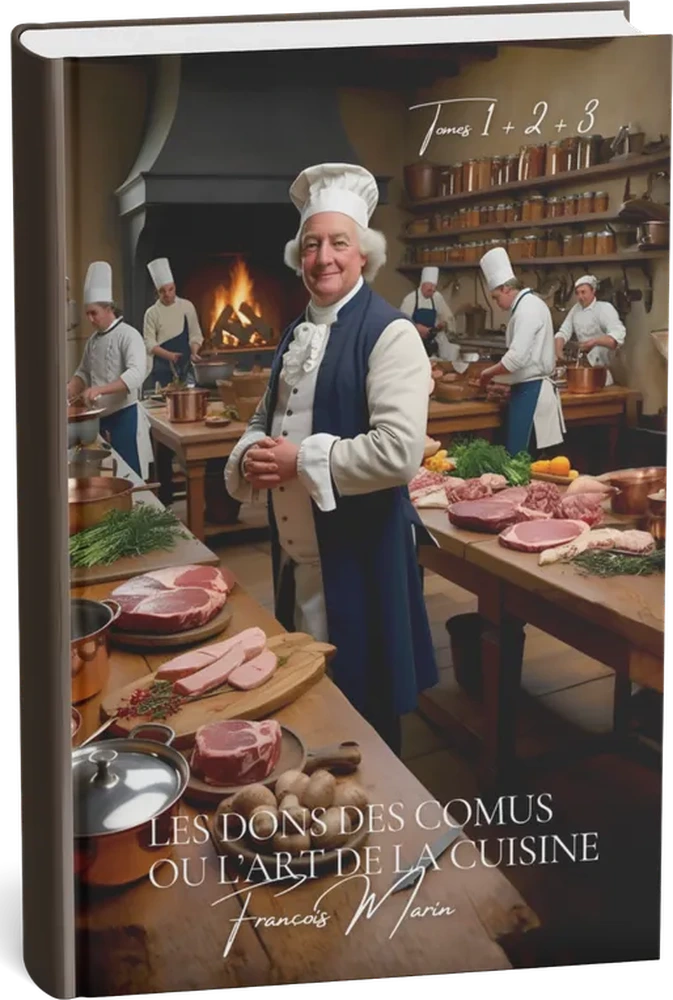
Les Dons de Comus, ou l’Art de la Cuisine (Tomes I, II & III réunis, 1739–1758)
François Marin
Les Grands Classiques (Originaux) · Le manifeste de la cuisine moderne des Lumières
Découvrir l’ouvrage → MAISON BEAULIEUAB ÉDITIONS · CUISINE & LETTRES
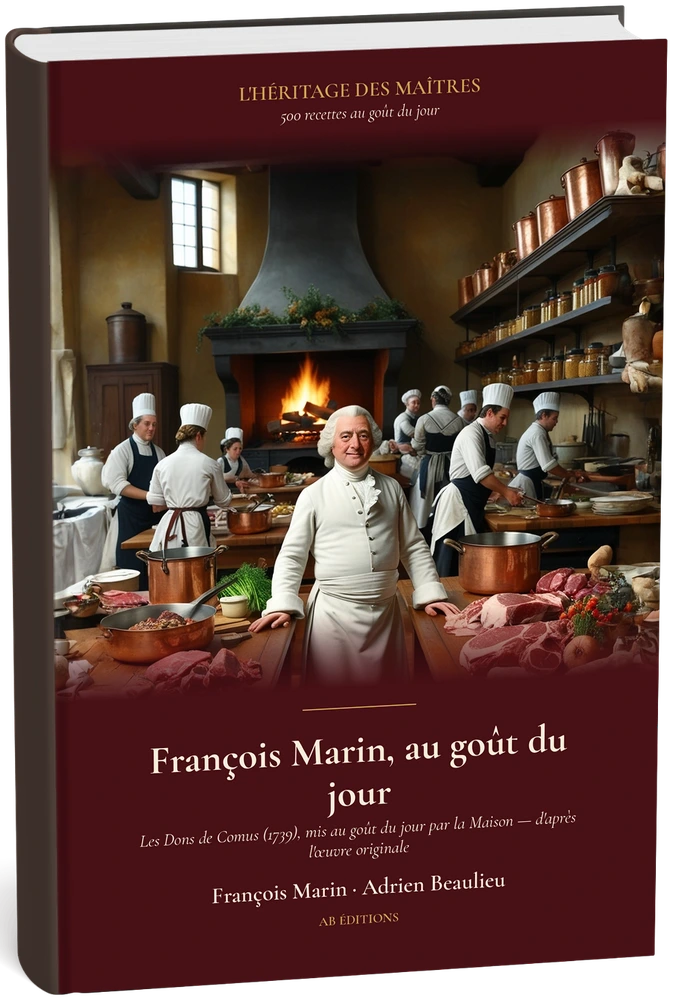
La Maison Beaulieu présente l’œuvre de François Marin selon son architecture éditoriale complète : d’abord I. Les Grands Classiques (les textes originaux d’époque), puis II. L’Héritage des Maîtres (l’édition française modernisée — 500 recettes mises au goût du jour), et enfin III. Le Rayonnement International (l’édition modernisée traduite en 10 langues). Tarif officiel Cuisine AB Éditions : Ebook · 9,90 € · Broché (PB) · 24,90 € (+ port réel) · Relié Collector (HC) · 34,90 € (+ port réel).
Le texte historique intégral de François Marin, établi et restauré dans sa typographie et sa langue d’origine, avec ses couvertures de collection originales.
Pour cuisiner réellement François Marin aujourd’hui chez soi sans brigade : chaque recette est codifiée et structurée selon le protocole de la Maison (Ingrédients calibrés en grammes pour 4 personnes · Préparation pas à pas avec temps et températures exacts · Conseil du Chef), dans le respect absolu du goût et de l’esprit du Maître.
Conformément à la doctrine éditoriale de la Maison, ce n’est jamais le français archaïque d’époque qui est traduit, mais notre édition française modernisée (L’Héritage des Maîtres — 500 recettes au goût du jour), afin d’offrir aux lecteurs du monde entier des recettes claires, précises et immédiatement réalisables en 10 langues (EN, DE, ES, IT, PT, NL, SV, PL, JA, ZH) :
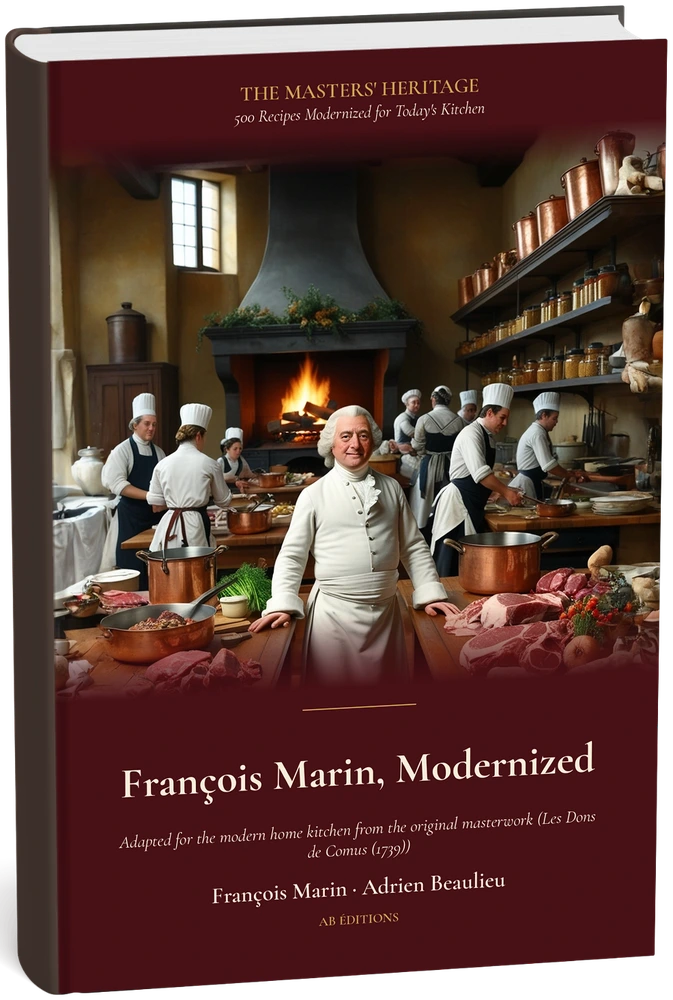
François Marin · Adrien Beaulieu
Édition internationale en Anglais · L'Héritage des Maîtres
Découvrir l’ouvrage →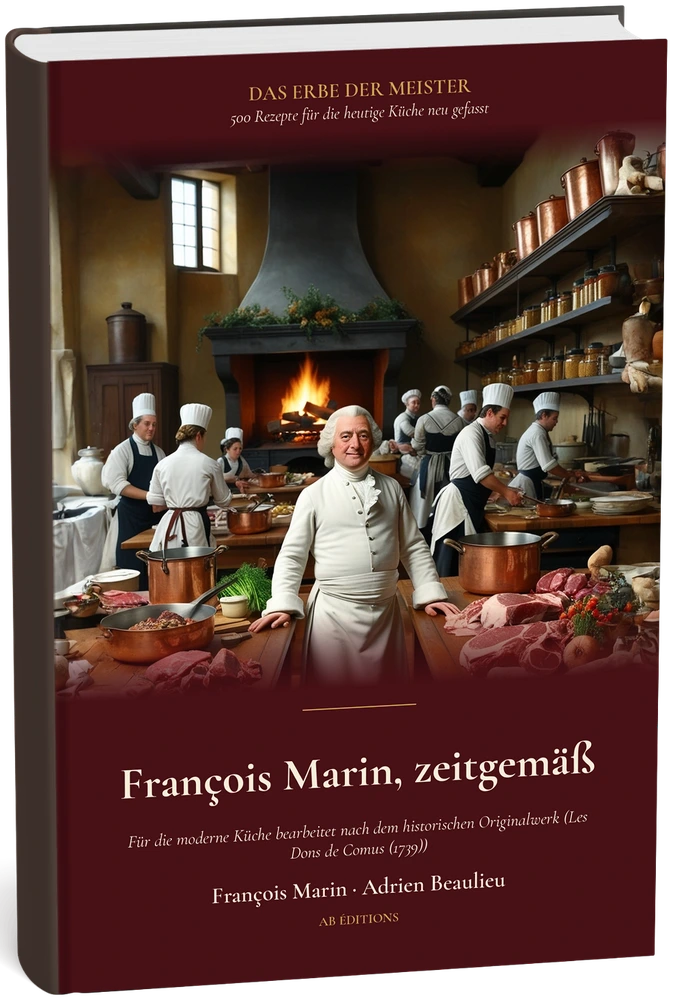
François Marin · Adrien Beaulieu
Édition internationale en Allemand · L'Héritage des Maîtres
Découvrir l’ouvrage →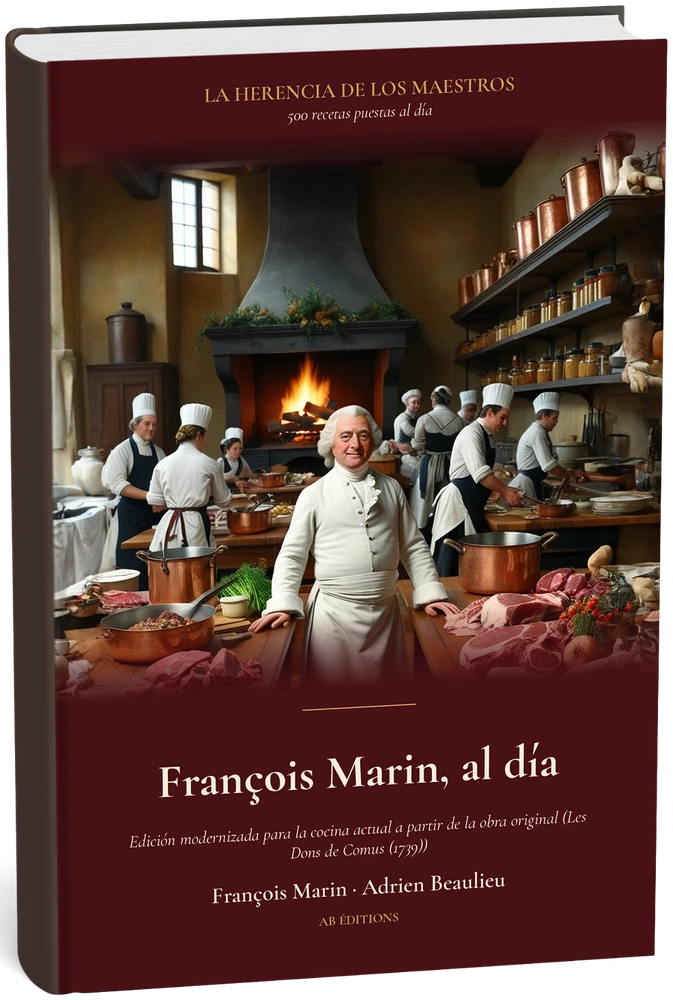
François Marin · Adrien Beaulieu
Édition internationale en Espagnol · L'Héritage des Maîtres
Découvrir l’ouvrage →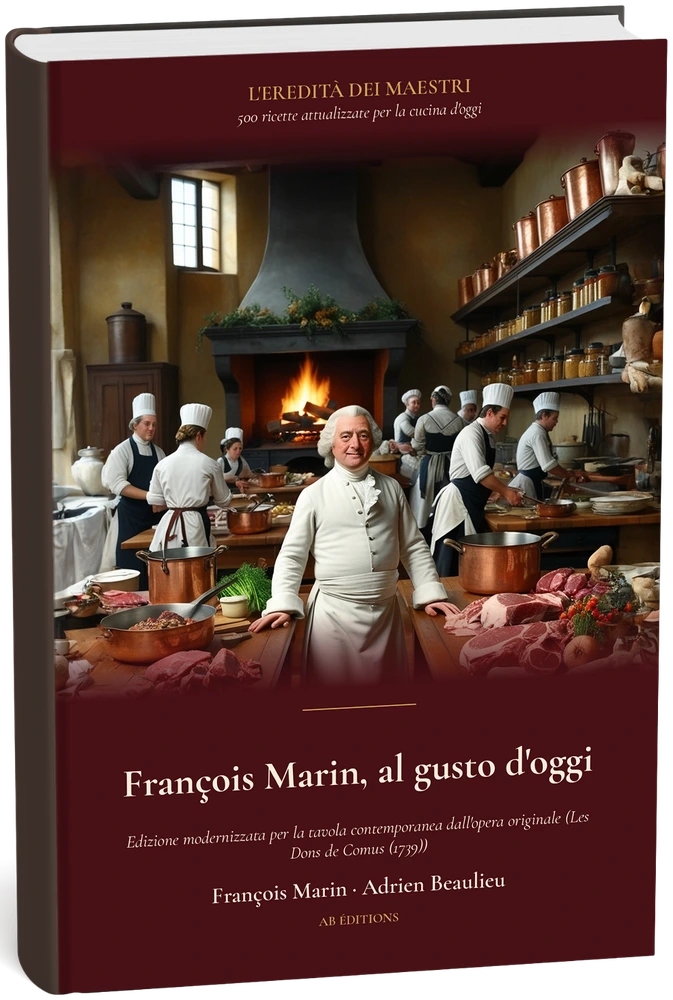
François Marin · Adrien Beaulieu
Édition internationale en Italien · L'Héritage des Maîtres
Découvrir l’ouvrage →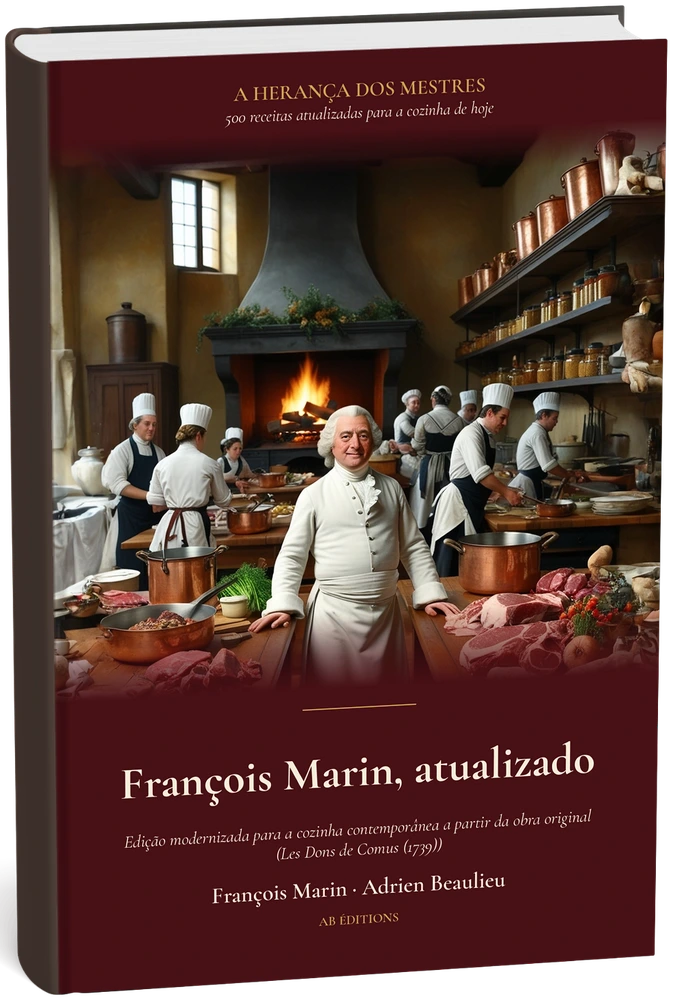
François Marin · Adrien Beaulieu
Édition internationale en Portugais · L'Héritage des Maîtres
Découvrir l’ouvrage →
François Marin · Adrien Beaulieu
Édition internationale en Néerlandais · L'Héritage des Maîtres
Découvrir l’ouvrage →
François Marin · Adrien Beaulieu
Édition internationale en Suédois · L'Héritage des Maîtres
Découvrir l’ouvrage →
François Marin · Adrien Beaulieu
Édition internationale en Polonais · L'Héritage des Maîtres
Découvrir l’ouvrage →
François Marin · Adrien Beaulieu
Édition internationale en Japonais · L'Héritage des Maîtres
Découvrir l’ouvrage →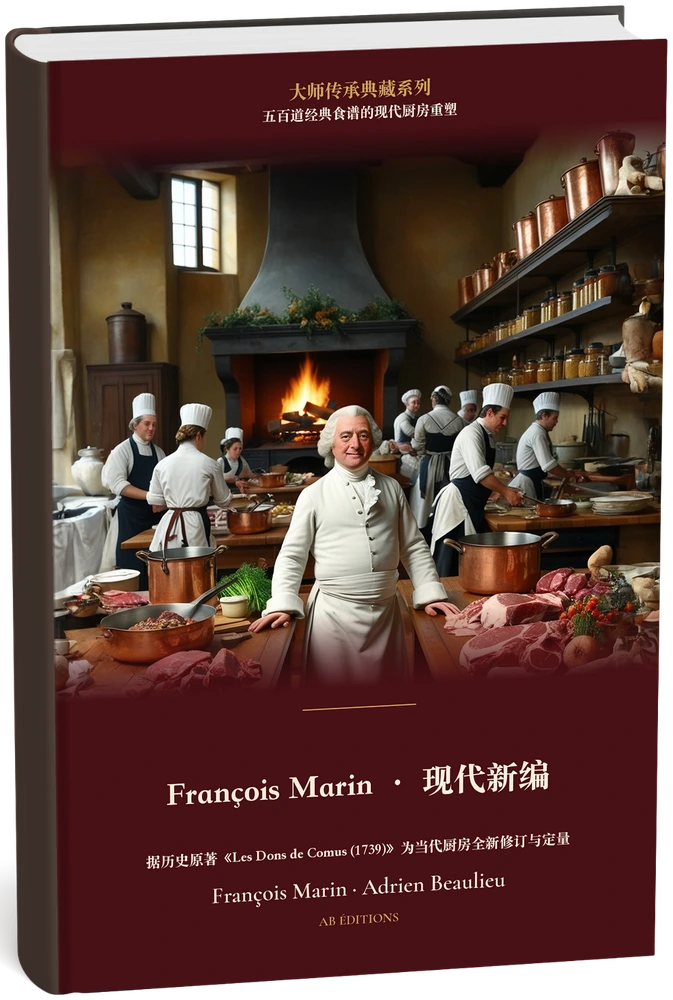
François Marin · Adrien Beaulieu
Édition internationale en Chinois · L'Héritage des Maîtres
Découvrir l’ouvrage →François Marin stands as one of the preeminent luminaries of eighteenth-century French gastronomy, celebrated for his doctrine of a culinary art at once unpretentious and supremely refined. Flourishing between 1730 and 1760, Marin plied his craft at an epoch when the French table began to transcend the cloistered confines of the aristocracy and address a broader commonwealth of epicures. In an era marked by an ever-escalating technical virtuosity within princely courts, Marin labored to democratize gastronomy, rendering its pleasures accessible to a wider swath of society. His seminal treatise, Les Dons de Comus, published in 1739, became an enduring lodestar for devotees of good cheer, offering preparations that were toothsome, practical, and well within modest reach.
Marin held the unwavering conviction that pristine ingredients and restraint in execution could yield dishes of the utmost sophistication. Where his contemporaries frequently indulged in labyrinthine techniques and the ostentation of exotic provender, Marin championed a return to first principles, exalting the freshness of the market garden and the unvarnished authenticity of native savors. To his mind, gastronomic triumph in no way demanded needless complication; he argued that the soul of any dish resides in the inherent nobility of its components and in an art of preparation that reveres their natural virtues.
His masterwork, Les Dons de Comus, perfectly mirrors this vision, presenting lucid, accessible recipes that permitted any earnest domestic cook to conjure delectable fare. The manual was, in truth, an impassioned manifesto for an egalitarian culinary culture—one in which the delights of the dining room ceased to be the private fiefdom of the peerage and became a joy shared by all.
Les Dons de Comus is far more than a mere miscellany of formulas; it is the living testament to Marin’s overarching endeavor to open the gates of gastronomic art to a wider public. The work unfolds an extensive panoply of seasonal receipts, placing pride of place upon regional provisions and techniques readily mastered. In marked contrast to the aristocratic kitchen compendia of the Grand Siècle, written primarily for the retinues of princes, Les Dons de Comus proffered culinary solutions accessible to ordinary households, capturing the spirit of an age wherein the culinary arts were undergoing a profound and salutary democratization.
The practical counsel Marin imparts extends from the discerning eye required in selecting raw provisions to ingenious artifices for heightening inherent savors without masking them. This didactic approach fostered a spirit of domestic conviviality, placing true gastronomic excellence within the grasp of households possessing neither the deep purses nor the vast brigades of the great seigneurial estates.
1. Simplicity as the Essence of the Culinary Art
Marin made an indelible contribution by enshrining simplicity as the cardinal virtue of the French kitchen. While rival masters overloaded their pots with costly spices and rare luxuries, Marin demonstrated that a dish’s true brilliance rests upon the freshness and intrinsic quality of its ingredients. For him, garden herbs, seasonal roots, and thoughtfully chosen meats and fish were amply sufficient to compose a table of the highest distinction.
2. Accessibility and the Democratization of the Kitchen
Conceived with clarity and unfussy directness, Marin’s recipes permitted an unprecedented audience to achieve culinary excellence at their own hearths. By promoting local, seasonal bounties, he proved beyond debate that cooking could be simultaneously delectable and economical. In so doing, Marin helped lay the enduring foundations of la cuisine bourgeoise—that felicitous marriage of modesty and elegance designed for a far broader citizenry than the courtly caste.
3. Innovation and the Principle of "Quintessence"
Marin was among the first theorists to articulate the concept of the "quintessence"—a culinary method dedicated to drawing out the purest, most concentrated essence of an ingredient. This procedure heralded the dawn of a more scientific and analytical approach to the stove, allowing flavors to be concentrated without recourse to heavy, muddying seasonings. By distilling the very soul of his provisions, Marin fashioned a lighter, more ethereal cuisine, setting the compass for the future trajectory of French cookery toward classical precision and clarity.
4. Championing an Inclusive Gastronomy
Throughout his career, Marin labored tirelessly toward an inclusive dining culture. He refused to look upon gastronomy as a privilege reserved exclusively for an anointed elite. Through his simplified methods and didactic clarity, he opened the refined pleasures of the palate to modest households, paving the way for a grand historical transformation that reconstituted cookery as a popular art belonging to the nation as a whole.
François Marin did not merely shape the emerging bourgeois table; his ideas penetrated the very redoubts of the aristocracy, which gradually relinquished its penchant for excess in favor of a newfound restraint. Hitherto, noble tables had groaned under heavy, overwrought contrivances, smothered beneath expensive oriental spices. Under the sway of Marin’s precepts, patrician households began to seek clearer flavors and an unaffected elegance of presentation. This philosophical shift directly prefigured the rise of the late-eighteenth-century nouvelle cuisine, which exalted lightness, unencumbered sauces, and an aesthetic of harmonious sobriety.
The legacy of François Marin remains vibrantly alive in contemporary French gastronomy, where simplicity and authenticity are held as paramount ideals. By urging the use of local produce harvested in its proper season, Marin shaped successive generations of culinarians who continue to honor the natural world through their craft. The modern celebration of terroir and farmstead ingredients is the direct intellectual heir to Marin’s enlightened philosophy.
In our present era, as global gastronomy turns with renewed urgency toward sustainability, provenance, and unadorned truth, Marin’s maxims possess a striking resonance. He demonstrated once and for all that fine dining relies not upon ruinous expense or ostentation, but upon a reverent understanding of the ingredient and an economy of gesture.
In the annals of French culinary history, François Marin endures as an authentic pioneer who reconciled simplicity with supreme elegance. By democratizing the cookery book and extending the refined pleasures of the table to the many, he helped elevate French gastronomy into a universal art. His treatise, Les Dons de Comus, continues to instruct and inspire both professional chefs and ardent amateurs; his imprint is discerned in every dish that honors the dignity of its ingredients and celebrates an honest, heartfelt approach to the stove.
Marin proved that the culinary art does not consist in the sheer complexity of its maneuvers, but rather in the sovereign gift of sublimating nature’s savors through unblemished simplicity. His name remains forever bound to the noble evolution of French cuisine—a tradition respectful of the earth, generous in spirit, and hospitable to all who gather around the shared table.
Recettes, histoires, parutions et éditions de collection — quelques lettres par an, jamais davantage.