The French Cook (Londres, 1813 — Édition Originale Anglaise VO)
Louis Eustache Ude
Les Grands Classiques (VO Anglaise) · Le premier grand traité de haute cuisine française publié à Londres
Découvrir l’ouvrage → MAISON BEAULIEUAB ÉDITIONS · CUISINE & LETTRES
La Maison Beaulieu présente l’œuvre de Louis Eustache Ude selon son architecture éditoriale complète : d’abord I. Les Grands Classiques (les textes originaux d’époque), puis II. L’Héritage des Maîtres (l’édition française modernisée — 500 recettes mises au goût du jour), et enfin III. Le Rayonnement International (l’édition modernisée traduite en 10 langues). Tarif officiel Cuisine AB Éditions : Ebook · 9,90 € · Broché (PB) · 24,90 € (+ port réel) · Relié Collector (HC) · 34,90 € (+ port réel).
L’œuvre historique de Louis Eustache Ude publiée dans sa langue d’origine (édition anglaise d’époque) accompagnée de sa première traduction française intégrale fidèle à la lettre par la Maison Beaulieu.
Louis Eustache Ude
Les Grands Classiques (VO Anglaise) · Le premier grand traité de haute cuisine française publié à Londres
Découvrir l’ouvrage →
Louis Eustache Ude
Les Grands Classiques (Traduction Française) · L'œuvre d'Ude restituée dans sa langue maternelle
Découvrir l’ouvrage →Pour cuisiner réellement Louis Eustache Ude aujourd’hui chez soi sans brigade : chaque recette est codifiée et structurée selon le protocole de la Maison (Ingrédients calibrés en grammes pour 4 personnes · Préparation pas à pas avec temps et températures exacts · Conseil du Chef), dans le respect absolu du goût et de l’esprit du Maître.
Conformément à la doctrine éditoriale de la Maison, ce n’est jamais le français archaïque d’époque qui est traduit, mais notre édition française modernisée (L’Héritage des Maîtres — 500 recettes au goût du jour), afin d’offrir aux lecteurs du monde entier des recettes claires, précises et immédiatement réalisables en 10 langues (EN, DE, ES, IT, PT, NL, SV, PL, JA, ZH) :
Louis Eustache Ude · Adrien Beaulieu
Édition internationale en Anglais · L'Héritage des Maîtres
Découvrir l’ouvrage →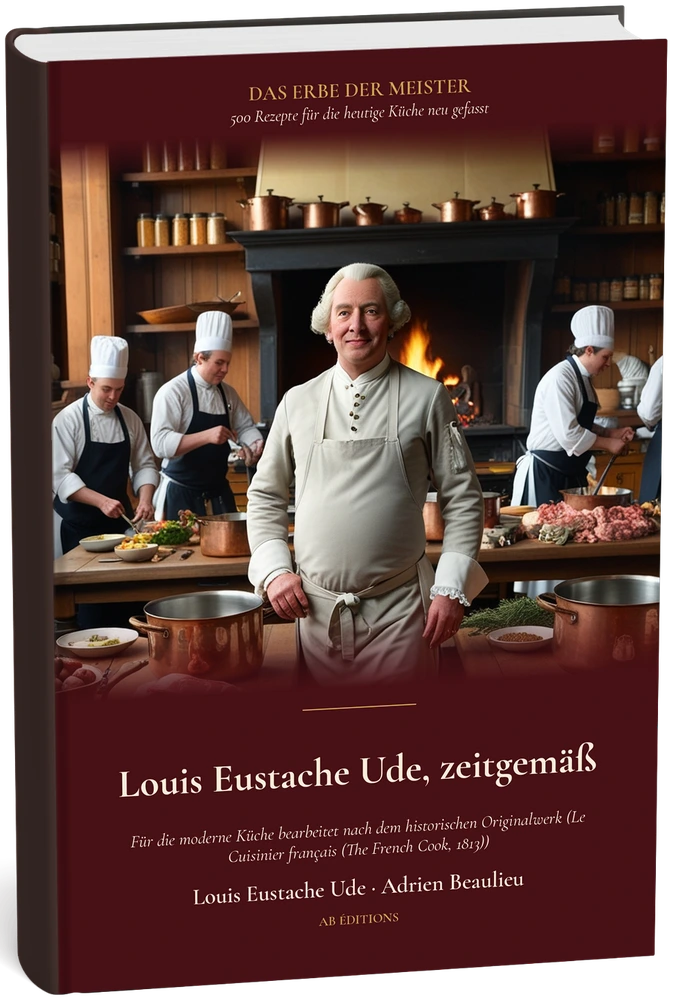
Louis Eustache Ude · Adrien Beaulieu
Édition internationale en Allemand · L'Héritage des Maîtres
Découvrir l’ouvrage →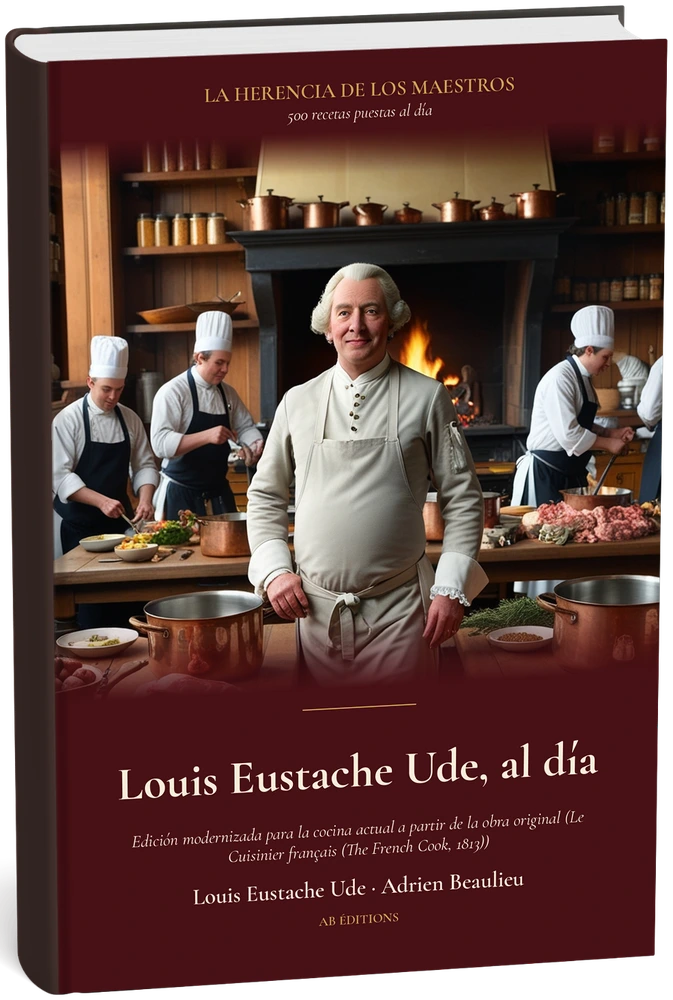
Louis Eustache Ude · Adrien Beaulieu
Édition internationale en Espagnol · L'Héritage des Maîtres
Découvrir l’ouvrage →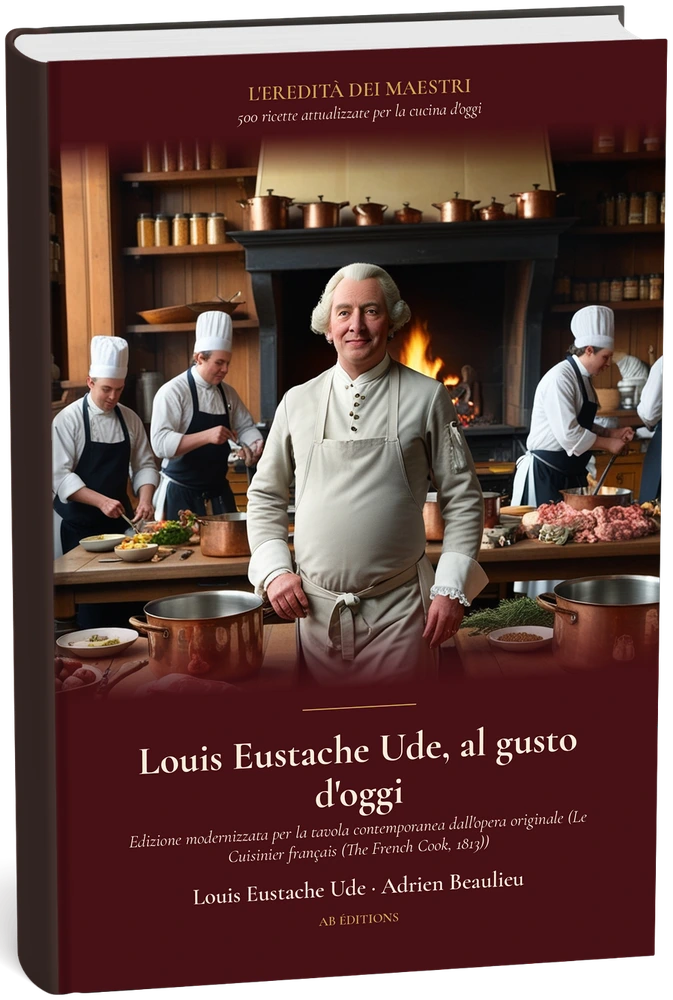
Louis Eustache Ude · Adrien Beaulieu
Édition internationale en Italien · L'Héritage des Maîtres
Découvrir l’ouvrage →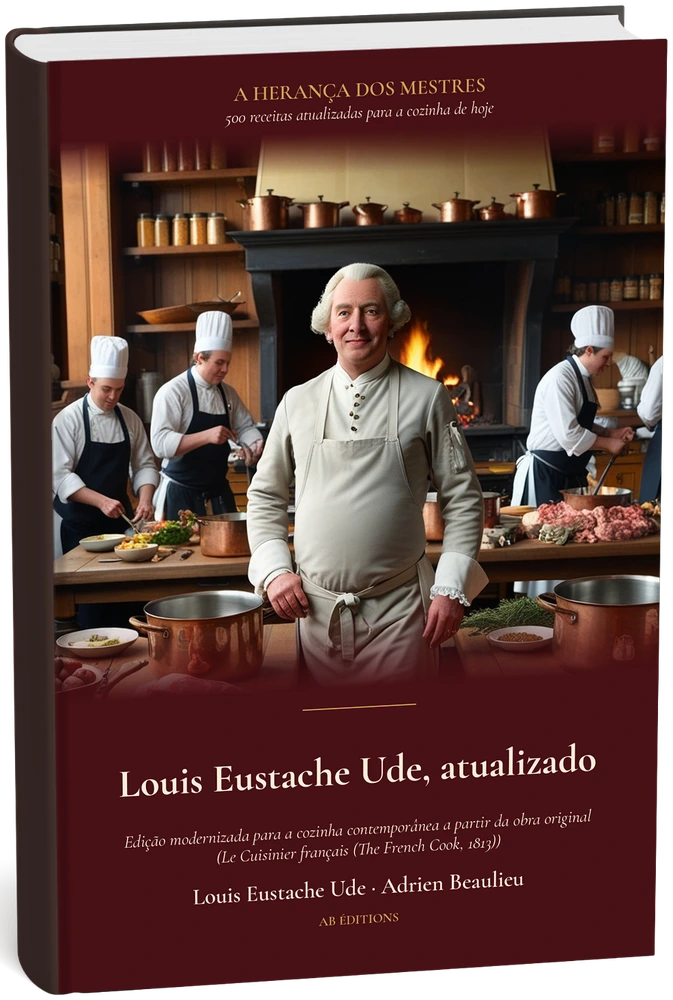
Louis Eustache Ude · Adrien Beaulieu
Édition internationale en Portugais · L'Héritage des Maîtres
Découvrir l’ouvrage →
Louis Eustache Ude · Adrien Beaulieu
Édition internationale en Néerlandais · L'Héritage des Maîtres
Découvrir l’ouvrage →
Louis Eustache Ude · Adrien Beaulieu
Édition internationale en Suédois · L'Héritage des Maîtres
Découvrir l’ouvrage →
Louis Eustache Ude · Adrien Beaulieu
Édition internationale en Polonais · L'Héritage des Maîtres
Découvrir l’ouvrage →
Louis Eustache Ude · Adrien Beaulieu
Édition internationale en Japonais · L'Héritage des Maîtres
Découvrir l’ouvrage →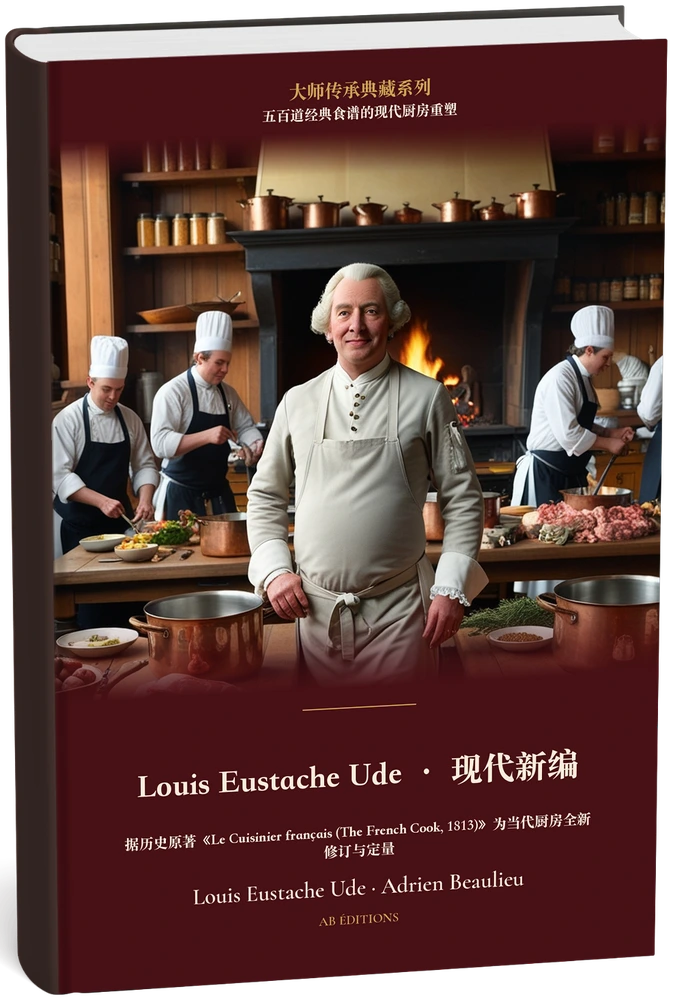
Louis Eustache Ude · Adrien Beaulieu
Édition internationale en Chinois · L'Héritage des Maîtres
Découvrir l’ouvrage →Louis Eustache Ude was born in France around 1768 or 1769. An account published in 1835 names him the son of a milliner and a cook in the royal kitchens of Versailles under Louis XVI, under whom the boy is said to have served a brief apprenticeship. He would later make of this a heraldic title: the title page of The French Cook styled him « ci-devant Cook to Louis XVI ». Scholars doubt he was ever more than a youthful scullion or apprentice boy, discerning in the boast that familiar culinary habit of embellishing one’s pedigree.
His youth resembles a picaresque catalog. Anecdote credits him with apprenticeships to a jeweller, an engraver, a printer, and a haberdasher; a stint as a commercial traveler in Lyon; several turns upon the theatrical stage; and interludes as a stockbroker, a clerk in the revenue office, and a croupier in a gaming house. One may perceive here either a tardy sense of vocation or the turbulent reflection of revolutionary France, where a young man of modest means struggled to carve out his place. He returned to the hearth as maître d'hôtel to Letizia Buonaparte, mother of Napoleon, serving her for some two years. He departed her household, it was whispered, over a « slight difference of opinion on matters of arithmetic ».
He crossed the English Channel at a date lost to history. One tradition has him fleeing the Reign of Terror; another places his arrival later, upon quitting the service of Madame Mère. His exile, like that of so many French culinary artists of the era, appears to have been guided by pragmatism rather than politics: better prospects, greater political stability, and an affluent aristocracy eager for refined tablecraft. He entered the service of William Philip Molyneux, second Earl of Sefton—a noted epicure and sportsman—and remained in his employ for nearly twenty years, dividing his time between Croxteth Hall and Arlington Street. There he earned 300 pounds or guineas per annum, and the Earl, in his final testament, bequeathed him an annuity of 100 pounds, even though Ude had left his service more than two decades earlier.
He parted ways with the Earl between 1815 and 1818. Two anecdotes profess to explain his abrupt resignation: either an errant guest had dared to add pepper to his soup, or the Earl’s eldest son had ventured to add salt. Whether apocryphal or true, both tales bespeak the same temper: the intractable pride of a creator who could not brook having his compositions altered. Following an alleged brief engagement at the United Service Club, he was appointed steward and master cook to the Duke of York, second son of George III—a post he occupied from around 1818 until the royal duke’s death in 1827.
In 1827, Ude was engaged as the founding chef of Crockford’s Club, at No. 50 St James’s Street, established by the gaming magnate William Crockford. His announced salary of £1,200 a year caused a sensation in London society. He presided over the kitchens for eleven or twelve seasons, departing in late 1838 or early 1839 after purportedly informing the committee that a man of his genius was worth £4,000. Charles Elmé Francatelli was appointed to succeed him.
In 1821, he had wed (Camille) Barbe Lucot. The furious tenor of their domestic disputes became the gossip of the town; nevertheless, his widow would survive him until 1862. Ude succumbed to a fever in London on April 10, 1846, at his residence in Albemarle Street, aged 76, 77, or 78, according to conflicting authorities. A solemn requiem mass was celebrated at the French Chapel in Little George Street, after which he was laid to rest at Kensal Green Cemetery.
His life's monument rests upon a single volume, and upon an ephemeral art of which nothing survives save the printed page and the lingering legend of his banquets.
First, the treatise. The French Cook appeared for the first time in 1813. Successive editions followed in rapid succession: 1815 (the third), 1816 (the fourth), 1818 (the fifth), 1822 (the seventh), 1827 (the eighth), 1827 or 1829 (the ninth), and 1829 (the tenth), comprising, by bibliographical reckoning, at least thirteen or fourteen distinct impressions across three decades. Its title expanded steadily to become A System of Fashionable, Practical, and Economical Cookery, Adapted to the Use of English Families, a title betokening an audience reaching far beyond aristocratic ducal palaces. At Ude's death, the volume was revered as the canonical authority on the « science of cookery ».
In the preface to his first edition, Ude observed tartly that previous cookery manuals were altogether unintelligible and their receipts wholly impracticable. His mandate was lucid: precise, executable instructions that yielded infallible results. The contents were refined and enlarged through various editions, encompassing foundational sauces, broths, and potages; relevés of soups and fish; forcemeats; butchers' meats, mutton, veal, poultry, and feathered and furred game; sweet- and salt-water fish; eggs; and both savory vegetable and sweet entremets. The work further contained complete seasonal bills of fare designed for eight to twenty-four guests, engraved diagrams of table layouts, and a glossary of French culinary terms tailored for the English domestic. Moreover, it offered rigorous counsel upon the discipline of the kitchen brigade and the governance of formal dinners.
Among its most celebrated preparations were an entrée of mackerel roe stewed in butter and served with a delicate cream sauce; a « Bentinck cherry pudding »; a clear turtle soup so renowned that Mrs. Beeton later adopted it almost verbatim in her own work; minute instructions for baking petits choux; one of the very earliest descriptions in the English tongue of the soufflé; and his « wings of fowl à la Dauphine », for which Ude counseled selecting the breast fillets from the identical side of two birds, so that the symmetry of the plate might be impeccable. It also included precise instructions for making sandwiches—conceived, no doubt, to sustain the aristocratic gamblers at Crockford’s who refused to quit the hazard table for a seated supper.
The book enjoyed an influential life beyond the British Isles. It permanently introduced terms such as entrée and sauté into standard English usage. Lord Byron drew directly upon Ude's menus to describe the feast in Canto XV of Don Juan (stanzas 62 to 74). An American edition was published in Philadelphia in 1828, printed from the eighth London edition, which certain authorities cite as the first French cookery book printed in the United States; though it aroused little initial fervor and was not reprinted there, its historical priority remains intact.
A second treatise, La Science de Gueule, has occasionally been attributed to Ude, notably by the compiler E. Cobham Brewer. Yet no major library catalog preserves any trace of such a work, nor do the Dictionary of National Biography or contemporary obituaries cite it; it must almost certainly be considered a spurious attribution.
Lastly, there was the culinary style itself. Ude observed the strict canons of the service à la française: symmetrical waves of courses, comprising potages and poissons, dramatic relevés, intricate entrées, a roast course, and sweet and savory entremets. He attended with painterly precision to the architecture of the table. He pronounced sauces to be « the soul of cookery ». He was fond of remarking that true cooks are born, not made—a conviction he rendered as Coquus nascitur non fit—while insisting that the culinary art was an exact science demanding supreme devotion, sharp intellect, and absolute sobriety.
Ude belonged to that brilliant diaspora of French culinary masters who crossed the Channel after the Revolution, seduced by the wealth and political equilibrium of the British nobility, which had harbored a passion for French cuisine well before 1789. This movement constituted a true cultural dialogue: while the emigrant chefs adapted their repertory to local tastes (as evidenced by Ude’s pedagogical prefaces), they completely transformed aristocratic dining, leading certain historians to speak of a virtual « decapitation » of native English culinary traditions within the grand houses.
His domain was that of great stately seats and exclusive Mayfair clubs. In the household of the Earl of Sefton, he stood as both a lavishly recompensed officer and a symbol of prestige for a master celebrated as one of the finest palates of the age. In the employ of the Duke of York, he ministered to royalty. At Crockford’s, where gentlemen dined between half-past four and six o’clock before retiring to the gaming tables, his culinary artistry was transformed into the club’s paramount commercial asset—an astute promotional investment by William Crockford rather than a mere operational expense. A typical banquet prescribed in his manuals unfolded through majestic courses: soup, fish, relevés (a poularde, a Westphalian ham), an array of entrées (a fricassee, lamb cutlets, a sauté of chicken fillets, veal tendrons), a roast course (capon, quails), followed by delicate entremets (green peas, strawberry jelly, asparagus, puits d'amour), and finished with a redcurrant tart or a lemon soufflé.
A contemporary of Carême, Ude flourished just before Alexis Soyer and Charles Elmé Francatelli transformed French cuisine in London into a dramatic public spectacle. His style was less theoretical and pedantic than Carême’s architectural monuments, and less theatrical than Soyer’s flamboyant showmanship, yet it proved truly foundational in Britain. It was Ude who established the standards of executive prestige and professional autonomy from which his successors would reap the rewards. No evidence points to genuine enmity between Ude and Soyer; rather, their relationship was one of natural generational succession.
Ude acknowledged that English cookery, when properly executed, could be admirable; yet he bitterly lamented the hostility of English physicians toward delicate gastronomy, as well as the curious indifference of British ladies toward the nuances of haute cuisine. In such reproaches, one recognizes both professional pride and the characteristic exasperation of a Gallic artist in exile.
History attributes to Louis Eustache Ude three lasting contributions. The first was to establish and domesticate the techniques and exacting standards of French haute cuisine within British high society and London clubland, elevating French tablecraft into the universal hallmark of taste. The second was his landmark manual, which served as the bedside textbook for an entire generation of professional cooks, while imparting aristocratic culinary ambitions to the rising Victorian middle classes; it remains in print to this day. His third legacy was the profound elevation of the chef’s social status: by championing cookery as both fine art and exact science, by asserting that genuine talent was an innate gift, and by demanding princely sums for his services, he lifted the chef out of the ranks of mere domestic servitude and into the realm of the recognized artist. His imperious temperament and conspicuous eccentricities foreshadowed the modern celebrity chef, admired as much for his character as for his dishes.
His memory among the broader public may have been eclipsed by that of Carême the great codifier, or Soyer the tireless reformer. Yet his historic significance remains paramount: he inaugurated that illustrious dynasty of French masters in nineteenth-century London—from Ude to Soyer and Francatelli—and forged the golden path they would walk.
The French Cook stands as a vital work of transition. Less encyclopedic than the monumental compendia of Carême, it possesses one supreme virtue: it was composed expressly to be understood. Ude addressed himself directly to practicing professionals and to households aspiring to maintain an authentic table à la française. One enters his world through his foundational sauces, his broths, and his exquisite poultry entrées, which represent the beating heart of his culinary doctrine; his menus read like master architectural plans for the dining room.
For the modern reader, Ude occupies an intriguing vantage point. Though profoundly French, his book was shaped by the expectations of an adopted land: the names of the dishes remain French, yet their explanations are delivered with British practical cadence, viewed through the eyes of an emigré defending his native gastronomy upon a foreign shore. This subtle tension lends his writing enduring charm: here is classic French cuisine seen from without, articulated by an artist called upon to vindicate its excellence with every service.
In the L'Héritage des Maîtres collection, Ude’s recipes are painstakingly restored: the master's original designations are preserved, yields are calibrated for four guests, precise cooking times and temperatures are supplied where the Regency text merely indicated an artisan’s touch, and obsolete measurements are converted into grams and centiliters. The volume reads with the practical immediacy of a daily kitchen manual, yet retains every spark of the master’s genius: the sauce treated as a sacred mystery, the visual harmony of the dish, and each plate conceived as an indispensable note in a grand symphonic feast.
c. 1768–1769 — Birth of Louis Eustache Ude in France.
Before 1789 — Brief apprenticeship in the royal kitchens at Versailles alongside his father, according to an 1835 memoir.
Dates uncertain — A diverse early career (jeweller, engraver, printer, commercial traveler); serves for roughly two years as maître d'hôtel to Madame Mère, Letizia Buonaparte.
Date unknown — Emigration to England (either during the Terror or following his service to Madame Mère).
Before 1813 — Enters the service of the Earl of Sefton (at Croxteth Hall and Arlington Street), remaining for nearly two decades.
1813 — First edition of The French Cook published while still in Lord Sefton’s employ.
1815–1818 — Resigns from Lord Sefton's household; publication of the third (1815), fourth (1816), and fifth (1818) editions.
c. 1818–1827 — Serves as steward and cook to the Duke of York until the Duke's demise.
1821 — Marries (Camille) Barbe Lucot.
1822 — Seventh edition of The French Cook.
1827 — Appointed first chef of Crockford’s Club (£1,200 annual salary); publication of the eighth edition.
1828 — American edition published in Philadelphia, based upon the eighth London edition.
1829 — Tenth edition of The French Cook.
Late 1838 or early 1839 — Leaves Crockford’s following a salary dispute; Francatelli succeeds him.
August 1841 — Fabled birthday dinner recorded by Soyer (marked by domestic spats and pet dogs under the table).
April 10, 1846 — Dies at his home in Albemarle Street, London; buried at Kensal Green Cemetery.
1862 — Death of his widow, Barbe Ude.
• The French Cook (London, 1813; successive editions: 1815, 1816, 1818, 1822, 1827, 1829). A compendium of receipts and bills of fare of classical French haute cuisine adapted for English practitioners, complete with engraved diagrams of table layouts. Title expanded in later impressions to: A System of Fashionable, Practical, and Economical Cookery, Adapted to the Use of English Families.
• The French Cook (Philadelphia, 1828). First American edition, printed from the eighth London edition; considered by several bibliographers as the first manual of French cookery published in the United States.
• La Science de Gueule: Dubious attribution (see editorial notes); no bibliographical repository preserves any record of its existence.
• Modern facsimile reprints of The French Cook, notably within the Cambridge Library Collection and a 1978 edition (The French Cook, or The Art of Cooking) recorded by antiquarian booksellers.
Recettes, histoires, parutions et éditions de collection — quelques lettres par an, jamais davantage.