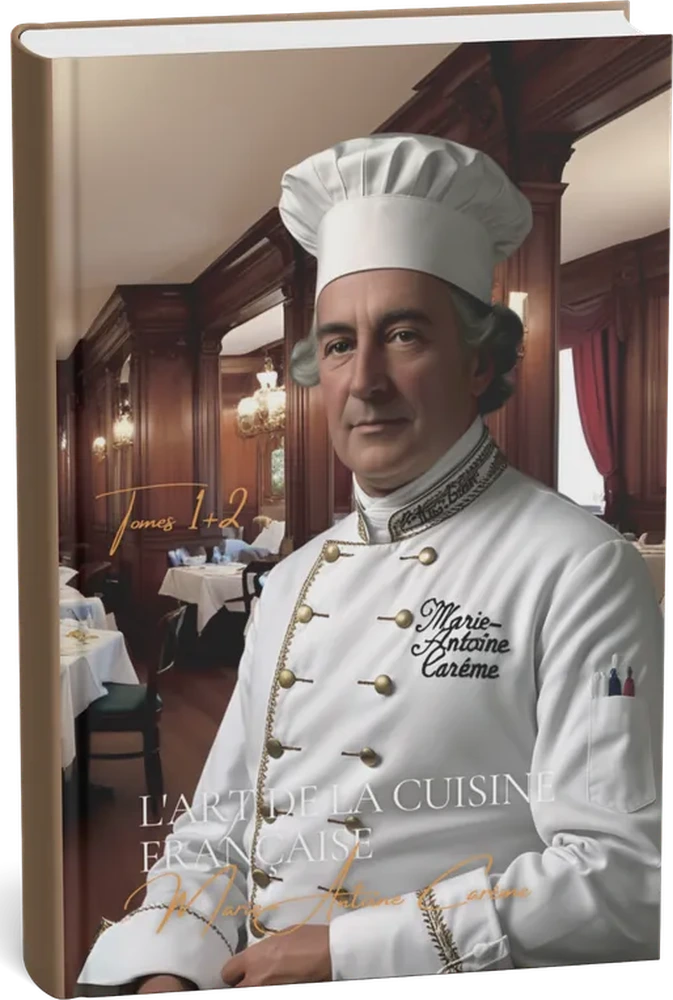
L’Art de la Cuisine Française au XIXe Siècle — Tomes I & II réunis
Marie-Antoine Carême
Les Grands Classiques (Originaux) · Le grand traité d'architecture culinaire de Carême
Découvrir l’ouvrage → MAISON BEAULIEUAB ÉDITIONS · CUISINE & LETTRES
La Maison Beaulieu présente l’œuvre de Marie-Antoine Carême selon son architecture éditoriale complète : d’abord I. Les Grands Classiques (les textes originaux d’époque), puis II. L’Héritage des Maîtres (l’édition française modernisée — 500 recettes mises au goût du jour), et enfin III. Le Rayonnement International (l’édition modernisée traduite en 10 langues). Tarif officiel Cuisine AB Éditions : Ebook · 9,90 € · Broché (PB) · 24,90 € (+ port réel) · Relié Collector (HC) · 34,90 € (+ port réel).
Le texte historique intégral de Marie-Antoine Carême, établi et restauré dans sa typographie et sa langue d’origine, avec ses couvertures de collection originales.
Marie-Antoine Carême
Les Grands Classiques (Originaux) · Le grand traité d'architecture culinaire de Carême
Découvrir l’ouvrage →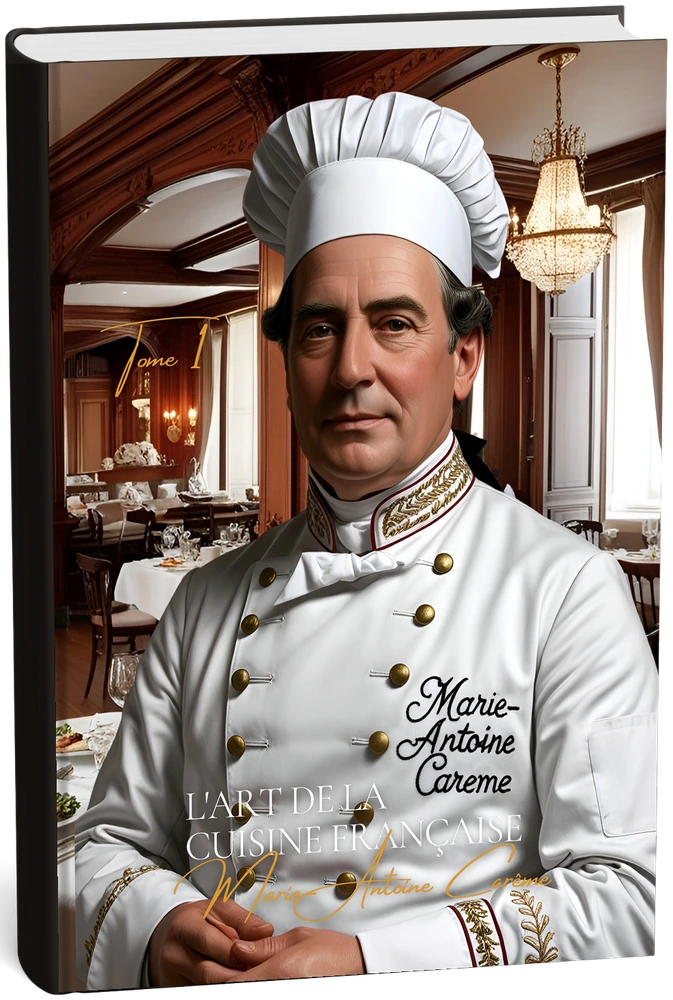
Marie-Antoine Carême
Les Grands Classiques (Originaux) · Bouillons, potages, sauces mères et relevés
Découvrir l’ouvrage →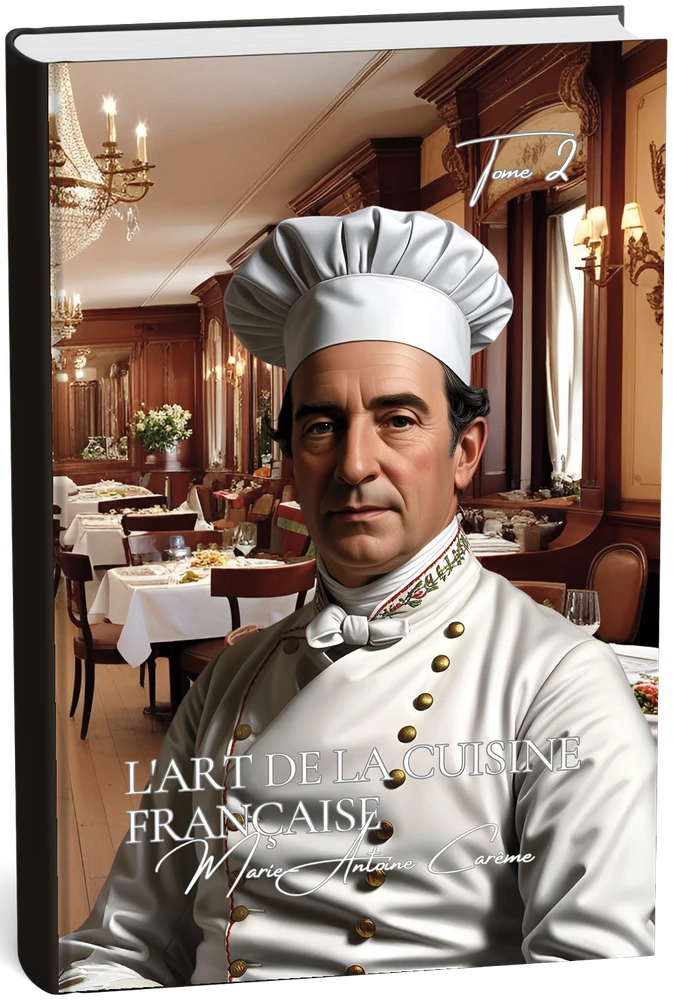
Marie-Antoine Carême
Les Grands Classiques (Originaux) · Entrées, rôtis, gibiers et entremets
Découvrir l’ouvrage →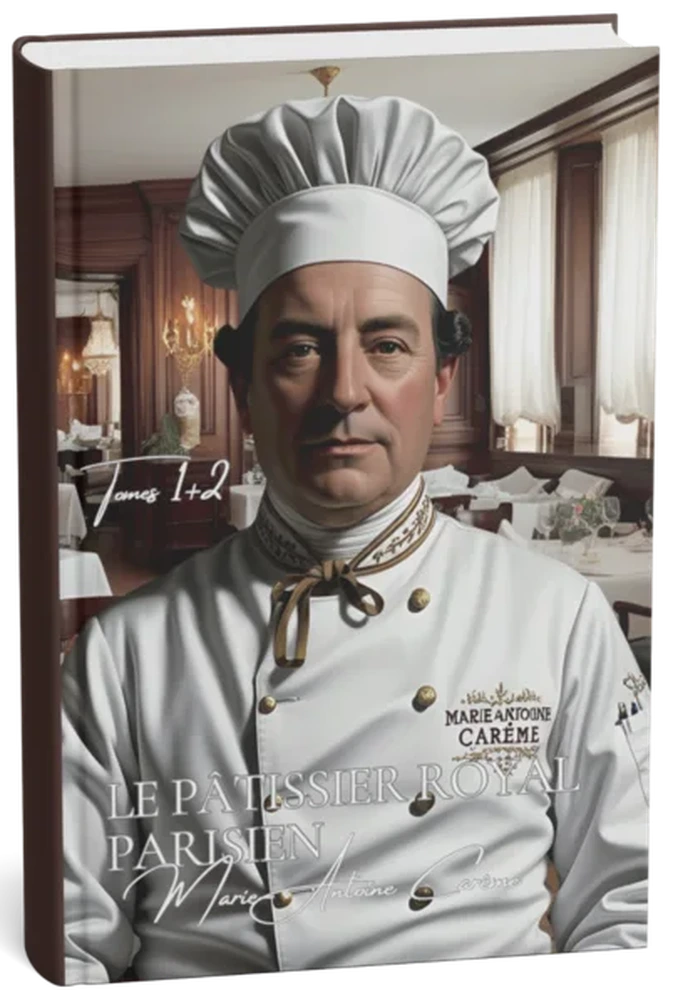
Marie-Antoine Carême
Les Grands Classiques (Originaux) · Traité élémentaire et pratique de la pâtisserie ancienne et moderne
Découvrir l’ouvrage →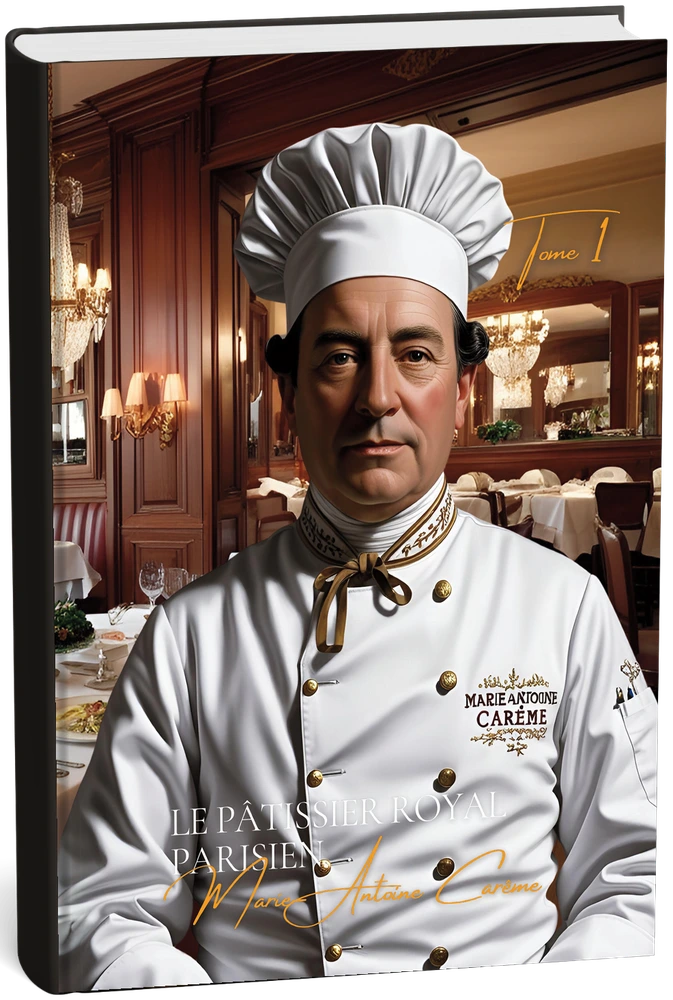
Marie-Antoine Carême
Les Grands Classiques (Originaux) · Pâtes, feuilletages, timbales et grosses pièces
Découvrir l’ouvrage →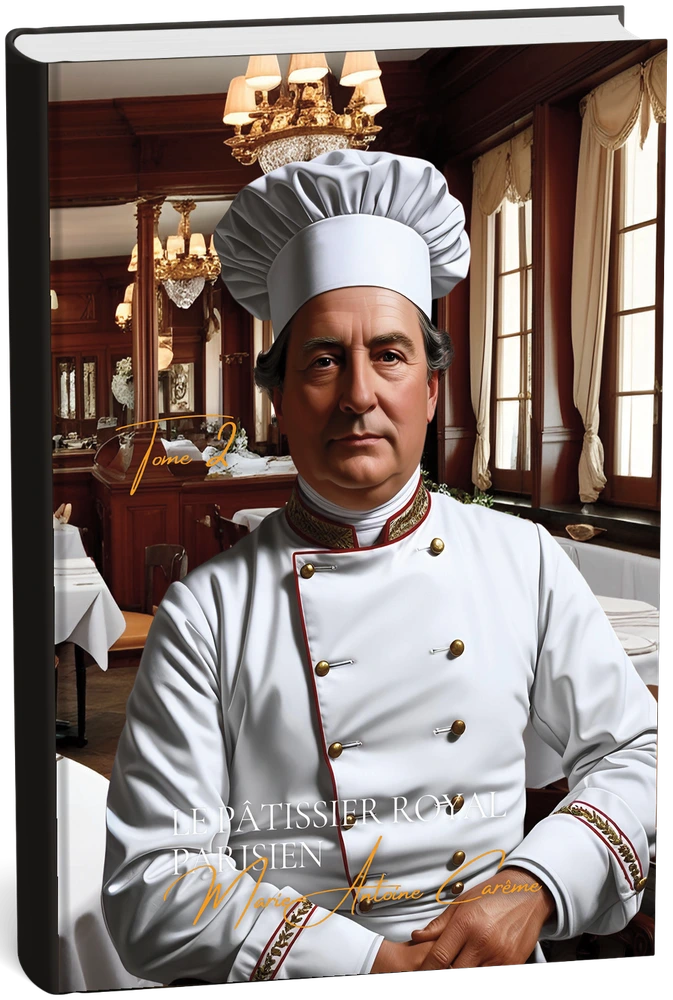
Marie-Antoine Carême
Les Grands Classiques (Originaux) · Entremets de sucre, croquembouches et pièces montées
Découvrir l’ouvrage →Pour cuisiner réellement Marie-Antoine Carême aujourd’hui chez soi sans brigade : chaque recette est codifiée et structurée selon le protocole de la Maison (Ingrédients calibrés en grammes pour 4 personnes · Préparation pas à pas avec temps et températures exacts · Conseil du Chef), dans le respect absolu du goût et de l’esprit du Maître.
Conformément à la doctrine éditoriale de la Maison, ce n’est jamais le français archaïque d’époque qui est traduit, mais notre édition française modernisée (L’Héritage des Maîtres — 500 recettes au goût du jour), afin d’offrir aux lecteurs du monde entier des recettes claires, précises et immédiatement réalisables en 10 langues (EN, DE, ES, IT, PT, NL, SV, PL, JA, ZH) :
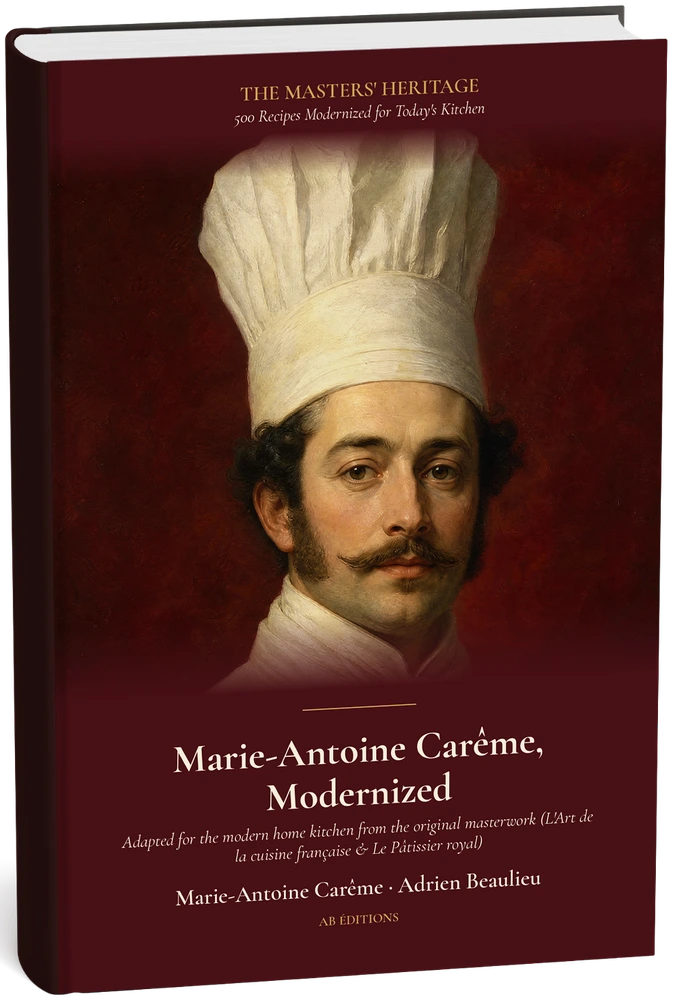
Marie-Antoine Carême · Adrien Beaulieu
Édition internationale en Anglais · L'Héritage des Maîtres
Découvrir l’ouvrage →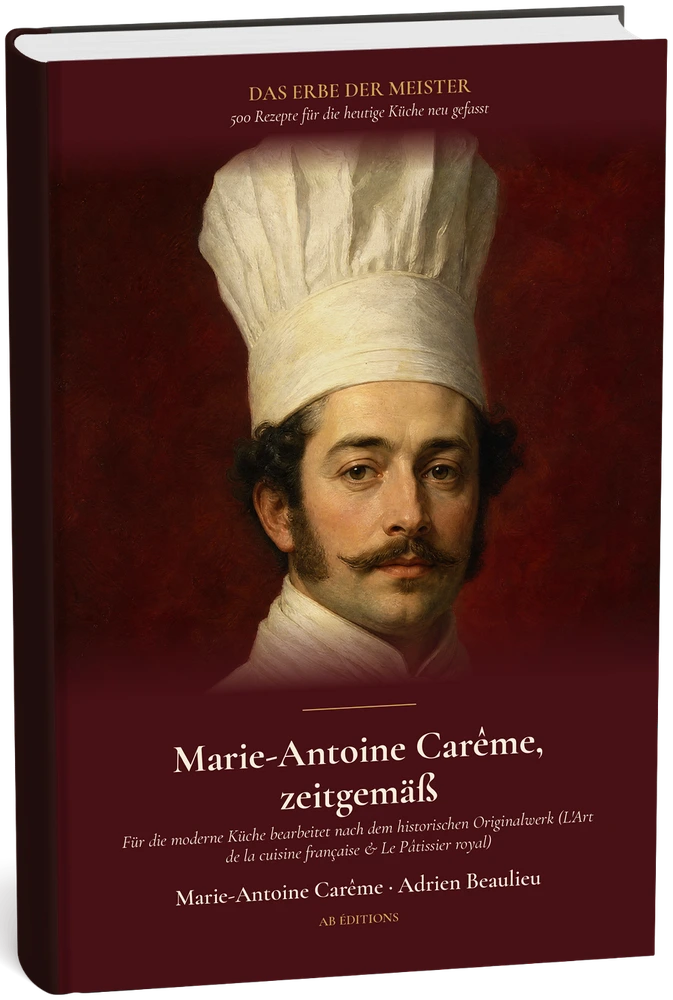
Marie-Antoine Carême · Adrien Beaulieu
Édition internationale en Allemand · L'Héritage des Maîtres
Découvrir l’ouvrage →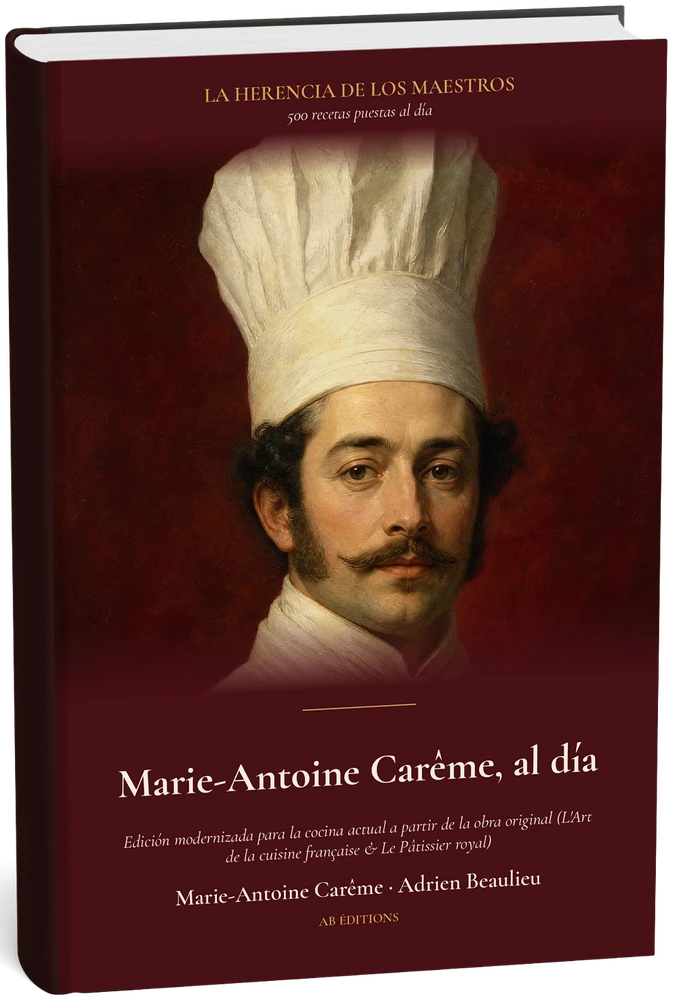
Marie-Antoine Carême · Adrien Beaulieu
Édition internationale en Espagnol · L'Héritage des Maîtres
Découvrir l’ouvrage →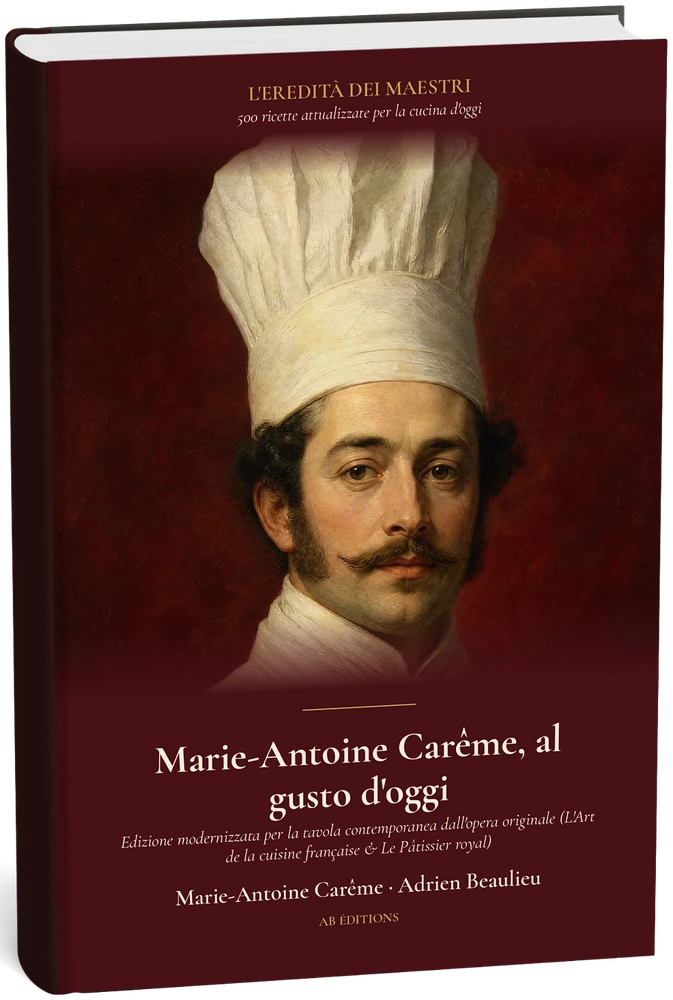
Marie-Antoine Carême · Adrien Beaulieu
Édition internationale en Italien · L'Héritage des Maîtres
Découvrir l’ouvrage →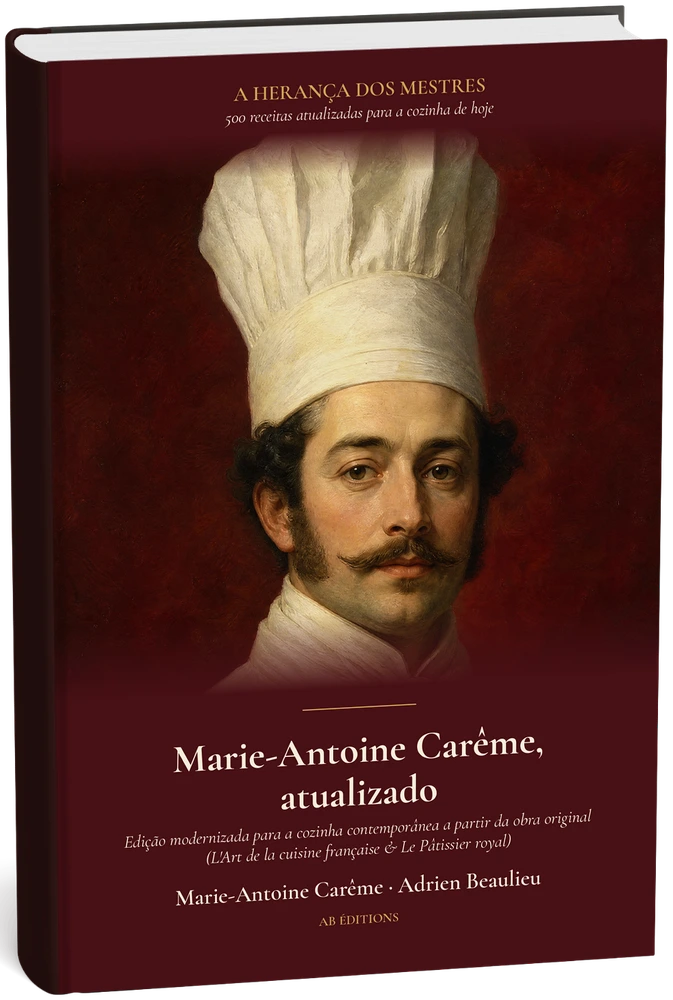
Marie-Antoine Carême · Adrien Beaulieu
Édition internationale en Portugais · L'Héritage des Maîtres
Découvrir l’ouvrage →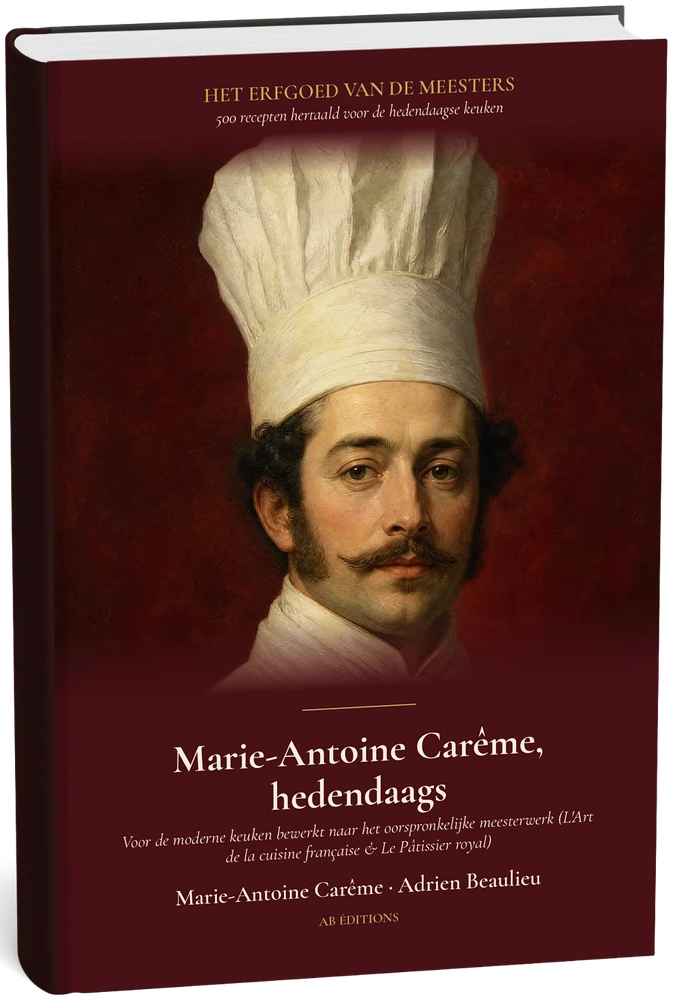
Marie-Antoine Carême · Adrien Beaulieu
Édition internationale en Néerlandais · L'Héritage des Maîtres
Découvrir l’ouvrage →
Marie-Antoine Carême · Adrien Beaulieu
Édition internationale en Suédois · L'Héritage des Maîtres
Découvrir l’ouvrage →
Marie-Antoine Carême · Adrien Beaulieu
Édition internationale en Polonais · L'Héritage des Maîtres
Découvrir l’ouvrage →
Marie-Antoine Carême · Adrien Beaulieu
Édition internationale en Japonais · L'Héritage des Maîtres
Découvrir l’ouvrage →
Marie-Antoine Carême · Adrien Beaulieu
Édition internationale en Chinois · L'Héritage des Maîtres
Découvrir l’ouvrage →Marie-Antoine Carême was born in Paris on the 8th of June, in either 1783 or 1784. In his own circle, he styled himself Antonin. His family was destitute; he would later recall five-and-twenty brothers and sisters, many of whom succumbed in their infancy. His father, Jean-Gilbert Carême, was a common day-labourer; his mother was Marie-Jeanne Pascal. In his posthumous memoirs, the Souvenirs inédits, he recounts being cast out by his father beside a toll-gate of Paris at the tender age of eight or ten, whereupon he found refuge in a modest chop-house in exchange for board and lodging. The historian Marie-Pierre Rey and other modern scholars have cast doubt upon this romanticized abandonment. The archival record remains fragmentary, as swathes of Parisian parish registers perished in the flames of the 1871 Commune. One piece of evidence, however, carries considerable weight: his marriage contract of 1808 mentions his father as still living. The prevailing view today is that the elder Carême secured an apprenticeship for his son, and that both remained in correspondence. In truth, Carême carefully burnished his own legend for posterity.
At around the age of thirteen, he entered the workshop of Sylvain Bailly in the rue Vivienne. In their agreement, Bailly went so far as to stipulate that his young apprentice should be free to take his leave if a more advantageous post presented itself. Above all, the master granted him permission to frequent the Cabinet des Estampes. There, Carême spent hours copying architectural engravings. In the evening, by candlelight, he recorded the trade secrets and dexterities acquired during the day. A tutor instructed him in reading and writing. He soon rose to the station of premier tourier under Jean Avice at the Hôtel de Galliffet, before opening his own pastry shop in the rue de la Paix, which he kept until 1813.
Around 1803, Talleyrand engaged him as his chef pâtissier. For eleven years, Carême presided over the kitchens of the Hôtel de Galliffet. It was here that he matured into a cuisinier in the fullest sense of the term: directing monumental banquets, mastering commissariat supplies, and marshalling a vast brigade. He orchestrated spectacles of breathtaking scope, notably the festivities for the nuptials of Jérôme Bonaparte. In 1808, he took to wife Henriette Sophie Mahy de Chitenay.
After 1814, his talents were courted by crowned heads across the Continent. Tsar Alexander I, lodged initially by Talleyrand during his Parisian sojourns of 1814 and 1815, was so captivated by the master’s table that he retained him as his personal chef at the Élysée Palace. Carême staged monumental banquets on his behalf. At Châlons-sur-Marne, during a grand review of the Russian forces, he was charged with the daunting task of dining three hundred noble guests on three successive occasions, amid severe logistical hardships. Carême contemplated following the Emperor to Saint Petersburg, but a preliminary journey disabused him of the notion. In 1816, he entered the service of the Prince Regent of England, dividing his labours between Carlton House and the Brighton Pavilion. The Prince compensated him handsomely. Yet Carême languished under the dreary climate and the bitter isolation of the English court, and took his leave of Britain in late 1817, after some eighteen months.
In 1823, he assumed the direction of the kitchens of Baron James de Rothschild, then the wealthiest financier in France. In the employ of this banking dynasty, he enjoyed an immense stipend and the leisure required to write. The receptions of the House of Rothschild drew the political, artistic, and literary elite of the age—Heine, Chopin, Hugo, and Rossini—and Carême’s name featured prominently in the public gazettes. By the late 1820s, however, his physical constitution began to fail him. He breathed his last on the 12th of January 1833, in his residence in the rue Neuve-Saint-Roch. His early demise was attributed to the lethal carbon-monoxide vapours of the charcoal ranges over which he had toiled all his life. He was laid to rest in the cemetery of Montmartre.
Regarding his private existence, he maintained an almost total silence, both in his Souvenirs and in his culinary treatises: neither kin, nor intimate friendships, nor romantic attachments ever pierce the veil of his prose. It may be that he sought to shield his domestic sanctuary, or perhaps merely to protect the noble persona he had so assiduously constructed.
Carême authored five seminal treatises. The first two, published in 1815, were devoted exclusively to the art of pastry. Le Pâtissier royal parisien constitutes an elementary and practical manual of pastry, ancient and modern. It covers the mastery of sugar, marzipan, and doughs, cold desserts and entremets, alongside a critical disquisition upon the great balls of the era. Le Pâtissier pittoresque brings together an extraordinary suite of designs and architectural models for pièces montées, establishing unequivocally the kinship between the craft of the pastry-cook and the discipline of architecture.
Le Maître d'hôtel français (1822) concerns itself with the grand ordering of repasts. Its subtitle, Parallèle de la cuisine ancienne et moderne, considérée sous le rapport de l'ordonnance des menus selon les quatre saisons, announces its ambitious design, offering seasonal bills of fare designed for Paris, Saint Petersburg, London, and Vienna. Le Cuisinier parisien (1828) was inscribed to the memory of his mentor Laguipière, who perished during the retreat from Moscow. This volume expanded his doctrine from the domain of pastry into the realm of grand cuisine.
L'Art de la cuisine française au XIXe siècle represents the crowning monument of his career. This five-volume compendium aimed to encompass the entire culinary domain: detailed recipes, menus for every imaginable circumstance, the logistical economy of professional kitchens, seating protocols, and the history of French cuisine. Carême therein asserted that the culinary art serves as an escort to European diplomacy. Publication commenced in 1833. Carême died before its completion, leaving Armand Plumerey to bring the vast enterprise to its conclusion. A modern reissue of the work was awarded a literary prize in 2016.
Examined closely, his doctrine rests upon three fundamental pillars. The first is the systematic taxonomy of sauces. Before his time, French sauces were legion and organized in a haphazard fashion. Carême identified four grand foundations, known as mother sauces: the Espagnole (brown stock and brown roux), the Velouté (white stock and blond roux), the Béchamel (milk and white roux), and the Allemande (veal velouté bound with egg yolks and cream). From these four archetypes, a cook could derive an infinity of small sauces. At long last, the practitioner could comprehend the inner logic and architectural hierarchy of the repertoire.
The second pillar is culinary purification. Carême campaigned against the excessive employment of spices and heavy fats. He proclaimed: “Nothing fatty: this vice has disappeared from French cooking.” He demanded fresh, seasonal produce, sourced locally wherever feasible. He claimed inspiration from Renaissance cuisine, holding up Catherine de' Medici as his guiding beacon.
The third pillar is architecture. To Carême’s mind, the fine art of pastry was the pre-eminent branch of architecture. He erected Greek temples, Chinese pagodas, Egyptian pyramids, classical ruins, and hermits’ grottos out of choux pastry, nougat, marzipan, spun sugar, pastillage, and meringues. At times, he juxtaposed disparate historical styles within a single piece, executing his visions within a restrained palette: three soft, muted tones deployed in subtle gradation.
Tradition likewise credits him with the invention of the Charlotte Russe, named in tribute to the Tsar, as well as the perfection of the mille-feuille, though such attributions remain matters of scholarly debate.
Carême came of age amid the turbulence of the Revolution and achieved maturity under the First Empire, before pursuing his zenith during the Bourbon Restoration. The cuisine of the Ancien Régime—ponderous, spiced, and heavily burdened—was yielding ground. The great diplomatic houses required magnificent banquets to project statecraft and power, and diplomacy itself was negotiated across the dining table. Talleyrand wielded his table as an instrument of statecraft. Carême marvelled at the impeccable order and regal majesty of the Prince’s household, contrasting it sharply with the ostentatious yet less refined splendour of other grand tables, such as that of Arch-Chancellor Cambacérès. Napoleon had commanded his ministers to entertain with boundless lustre, and Carême would famously observe in L'Art that the culinary art serves as an escort to European diplomacy.
The table of Carême remained that of the service à la française: all courses were displayed simultaneously upon the board. Yet he has often been credited with encouraging the transition toward service à la russe, wherein courses succeed one another in sequential order according to the bill of fare. His residence at the Russian imperial court may well have shaped this impulse. While historical consensus remains divided—and indeed, Russian service was already gaining ground in the Rothschild salons—Carême undoubtedly contributed to its general dissemination, even if he did not devise it single-handedly.
A meal composed by Carême was a theatrical spectacle. At the centre reigned the pièce montée, conceived far more for optical delight than for immediate consumption. The quantities required were tailored to entire services: twenty ortolans for an entrée, six sweetbreads, fourteen artichoke bottoms, sixty eggs, and four pounds of sugar for a solitary entremets. Individual diners are almost never mentioned in his texts; his recipes were penned directly for large kitchen brigades. Cooking times were specified only for long extractions and braises—five hours for a rich bouillon. In pastry, precise timings were frequently omitted, left instead to the trained glance of the eye: a “brisk oven,” a “pleasing colour.” Nowhere were temperatures recorded in degrees.
His direct disciples carried his work forward. Armand Plumerey brought L'Art de la cuisine française to completion. Jules Gouffé was among the first to introduce precise measurements, cooking durations, and calibrated oven heats into a printed manual. Urbain Dubois and Émile Bernard embraced his architectural rigor. Decades later, Auguste Escoffier erected his own codification upon Carême’s sauce system, substituting Hollandaise for Allemande and adding tomato sauce. This conceptual framework governed haute cuisine throughout the nineteenth and early twentieth centuries, until the advent of the Nouvelle Cuisine movement in the latter half of the twentieth century challenged and simplified its strictures. Today, Carême's profile remains stamped upon the gold medal of the Académie Culinaire de France.
Our debt to him lies, first and foremost, in structural order: sauces classified, menus methodically orchestrated, and culinary techniques committed to writing. Furthermore, he elevated the status of the practitioner, transforming the cook from a domestic drudge into a recognized artist. He is widely credited with the introduction of the tall chef’s toque. Through his grand set-pieces, he established the eye as an essential arbiter of fine dining. Finally, he became one of the first chefs whose name was celebrated throughout Europe, magnified by the fame of his patrons, the praise of the press, and the reach of his books.
There remains, however, a paradox. Carême sought to lighten the foundation of his cookery, yet he profoundly complicated its exterior form. He did not raze the past to the ground; rather, he organized, refined, and transfigured the existing tradition into an art form.
Carême is difficult to read cold. His treatises were drafted for seasoned chefs, composed in long, cascading periods filled with intricate cross-references. More than half of the entries in L'Art and Le Pâtissier refer the reader to an earlier preparation or instruct him to proceed “in the customary manner.” One must understand what it means to “reduce to a glaze,” or decipher historical units such as the litron, the ounce, or the imperial glass. The Héritage des Maîtres series undertakes this translation on behalf of the modern reader.
Within this edition, each recipe has been recalculated for four covers. Quantities are rendered in grams and centilitres, cooking times and temperatures are supplied, and historical utensils are aligned with modern equipment: an office skillet becomes a contemporary heavy saucepan. Yet the mathematical ratios remain inviolate. The classic titles of the dishes are preserved, as are the authentic technical verbs of the craft, for their precision cannot be surpassed. The reader learns how to mask a fowl with sauce, how to sauce properly, how to dress in a mound or pyramid, and how to mark a braise.
The recipes retain that indispensable touch of the grand manner: the true “physiognomy” of a sauce, the delicate golden bloom of a biscuit. Carême’s digressive Observations, wherever they appear, are adapted into practical Conseils, complete with their remedies. Should an ingredient have vanished from the modern market, its substitute is suggested strictly within the Advice, never within the body of the canonical text.
To approach this volume fruitfully, begin with the sauces and potages; they offer the clearest window into his method. Progress then to poultry and feathered game, before attempting the meringues, creams, jellies, and fritters. The colossal pièces montées and decorative skewers (hâtelets) are left in the original historical editions, accompanied by their original engravings.
8 June 1783 or 1784 — Birth in Paris
c. 1792–1794 — According to his Souvenirs, abandoned at a Paris toll-gate (a contested account)
c. 1796–1797 — Apprenticeship under Sylvain Bailly, rue Vivienne
Before 1803 — Premier tourier under Jean Avice at the Hôtel de Galliffet; operates a shop in the rue de la Paix until 1813
c. 1803 — Appointed chef pâtissier to Talleyrand (serving until 1814)
22 October 1808 — Marriage to Henriette Sophie Mahy de Chitenay
1814–1815 — Chef to Tsar Alexander I; directs the historic banquets of Châlons-sur-Marne
1815 — Publication of Le Pâtissier royal parisien and Le Pâtissier pittoresque
1816–1817 — In the service of the Prince Regent of England, divided between Carlton House and Brighton
1822 — Publication of Le Maître d'hôtel français
1823 — Appointed chef to Baron James and Baroness Betty de Rothschild
1828 — Publication of Le Cuisinier parisien
12 January 1833 — Dies in Paris, rue Neuve-Saint-Roch; interred in the Montmartre Cemetery
1833–1844 — Posthumous publication of L'Art de la cuisine française au XIXe siècle (5 volumes), completed by Armand Plumerey
2016 — Modern reissue of L'Art, honoured with a literary award
• Le Pâtissier royal parisien (1815): an elementary and practical treatise on pastry ancient and modern, treating sugar, pastes, and cold entremets.
• Le Pâtissier pittoresque (1815): a collection of architectural drawings and templates for monumental pièces montées.
• Le Maître d'hôtel français (1822): a parallel of ancient and modern cookery, setting forth seasonal bills of fare for Paris, Saint Petersburg, London, and Vienna.
• Le Cuisinier parisien (1828): a definitive treatise on grande cuisine, inscribed to the memory of Laguipière.
• L'Art de la cuisine française au XIXe siècle (1833–1844): a compendium in five volumes covering recipes, menus, kitchen organization, and culinary history; completed posthumously by Armand Plumerey.
• Souvenirs inédits (published posthumously): an autobiographical chronicle of his early years and culinary career.
Recettes, histoires, parutions et éditions de collection — quelques lettres par an, jamais davantage.


