Le Livre de Cuisine (1867 — Cuisine de Ménage & Grande Cuisine)
Jules Gouffé
Les Grands Classiques (Originaux) · Le premier traité doublant poids métriques et temps exacts
Découvrir l’ouvrage → MAISON BEAULIEUAB ÉDITIONS · CUISINE & LETTRES
La Maison Beaulieu présente l’œuvre de Jules Gouffé selon son architecture éditoriale complète : d’abord I. Les Grands Classiques (les textes originaux d’époque), puis II. L’Héritage des Maîtres (l’édition française modernisée — 500 recettes mises au goût du jour), et enfin III. Le Rayonnement International (l’édition modernisée traduite en 10 langues). Tarif officiel Cuisine AB Éditions : Ebook · 9,90 € · Broché (PB) · 24,90 € (+ port réel) · Relié Collector (HC) · 34,90 € (+ port réel).
Le texte historique intégral de Jules Gouffé, établi et restauré dans sa typographie et sa langue d’origine, avec ses couvertures de collection originales.
Jules Gouffé
Les Grands Classiques (Originaux) · Le premier traité doublant poids métriques et temps exacts
Découvrir l’ouvrage →
Jules Gouffé
Les Grands Classiques (Originaux) · L'orfèvrerie sucrée de l'élève préféré de Carême
Découvrir l’ouvrage →
Jules Gouffé
Les Grands Classiques (Originaux) · Viandes, poissons, légumes, fruits confits, liqueurs et sirops
Découvrir l’ouvrage →Jules Gouffé
Les Grands Classiques (Originaux) · Plus de 400 recettes de potages français et étrangers
Découvrir l’ouvrage →
Jules Gouffé
Les Grands Classiques (Originaux) · Les deux grands traités réunis en un volume
Découvrir l’ouvrage →Pour cuisiner réellement Jules Gouffé aujourd’hui chez soi sans brigade : chaque recette est codifiée et structurée selon le protocole de la Maison (Ingrédients calibrés en grammes pour 4 personnes · Préparation pas à pas avec temps et températures exacts · Conseil du Chef), dans le respect absolu du goût et de l’esprit du Maître.
Conformément à la doctrine éditoriale de la Maison, ce n’est jamais le français archaïque d’époque qui est traduit, mais notre édition française modernisée (L’Héritage des Maîtres — 500 recettes au goût du jour), afin d’offrir aux lecteurs du monde entier des recettes claires, précises et immédiatement réalisables en 10 langues (EN, DE, ES, IT, PT, NL, SV, PL, JA, ZH) :
Jules Gouffé · Adrien Beaulieu
Édition internationale en Anglais · L'Héritage des Maîtres
Découvrir l’ouvrage →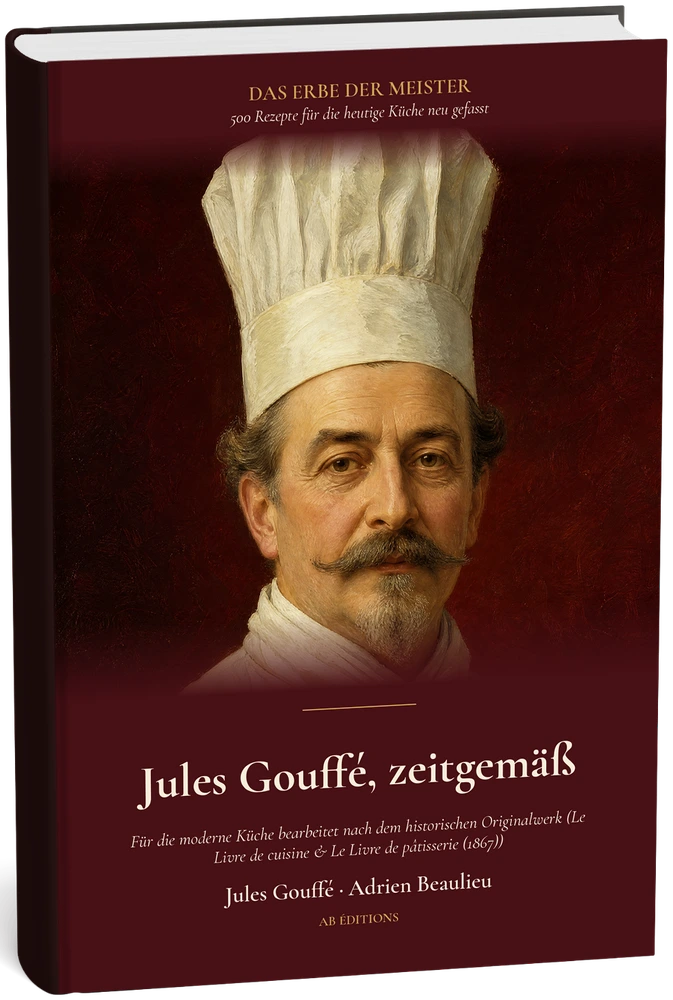
Jules Gouffé · Adrien Beaulieu
Édition internationale en Allemand · L'Héritage des Maîtres
Découvrir l’ouvrage →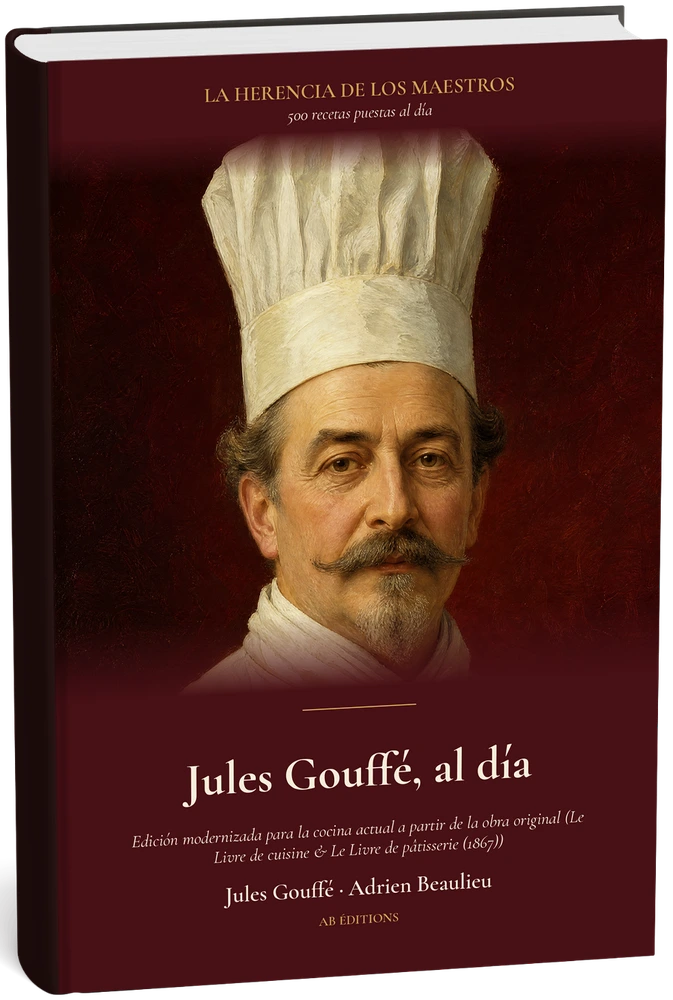
Jules Gouffé · Adrien Beaulieu
Édition internationale en Espagnol · L'Héritage des Maîtres
Découvrir l’ouvrage →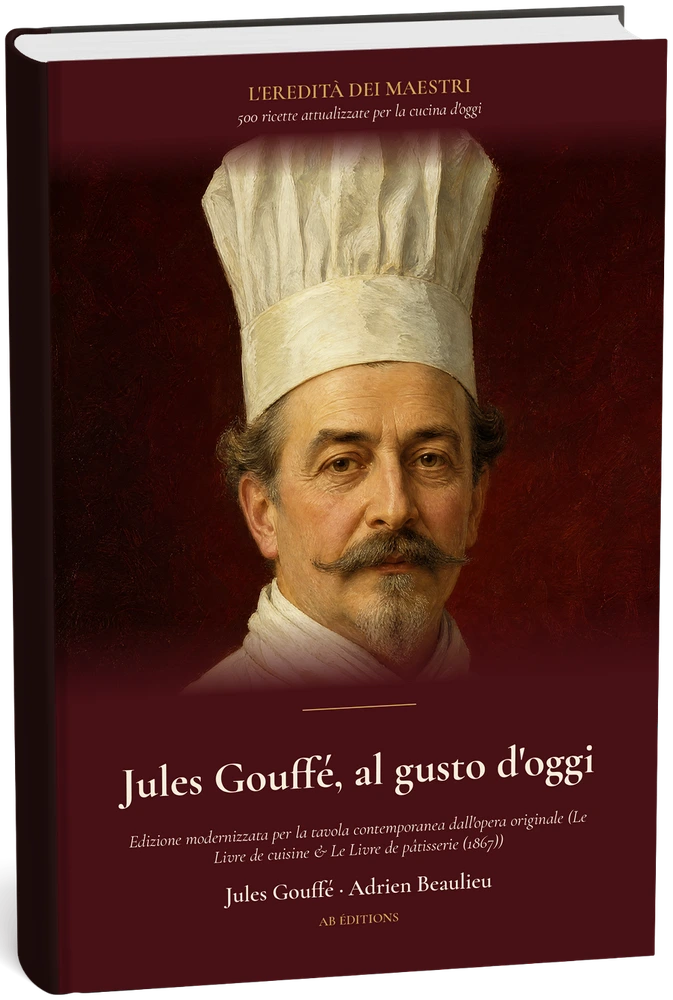
Jules Gouffé · Adrien Beaulieu
Édition internationale en Italien · L'Héritage des Maîtres
Découvrir l’ouvrage →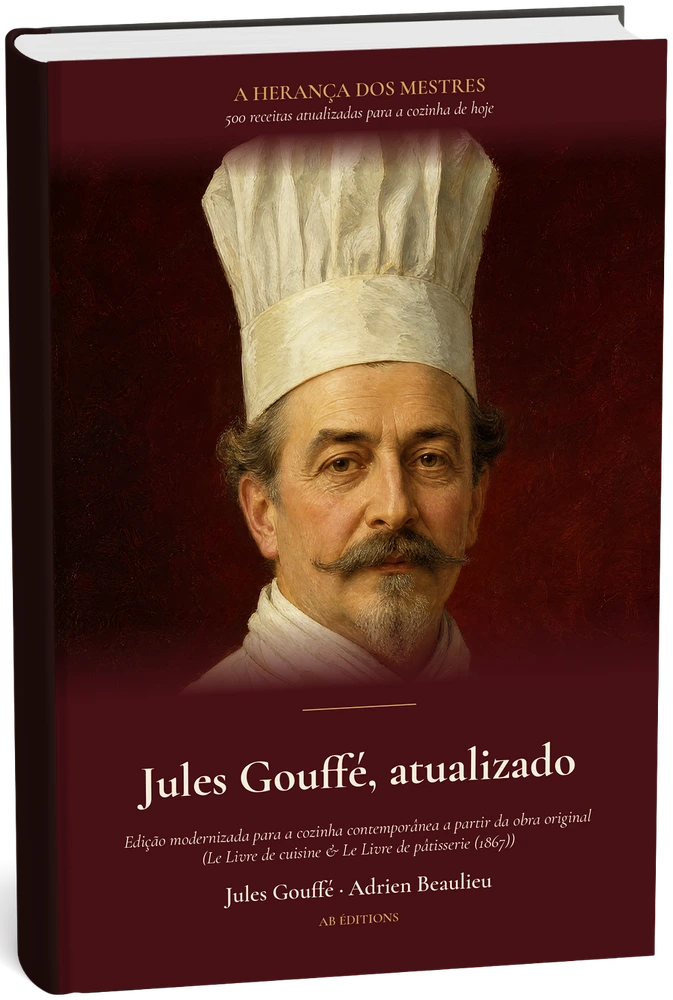
Jules Gouffé · Adrien Beaulieu
Édition internationale en Portugais · L'Héritage des Maîtres
Découvrir l’ouvrage →
Jules Gouffé · Adrien Beaulieu
Édition internationale en Néerlandais · L'Héritage des Maîtres
Découvrir l’ouvrage →
Jules Gouffé · Adrien Beaulieu
Édition internationale en Suédois · L'Héritage des Maîtres
Découvrir l’ouvrage →
Jules Gouffé · Adrien Beaulieu
Édition internationale en Polonais · L'Héritage des Maîtres
Découvrir l’ouvrage →
Jules Gouffé · Adrien Beaulieu
Édition internationale en Japonais · L'Héritage des Maîtres
Découvrir l’ouvrage →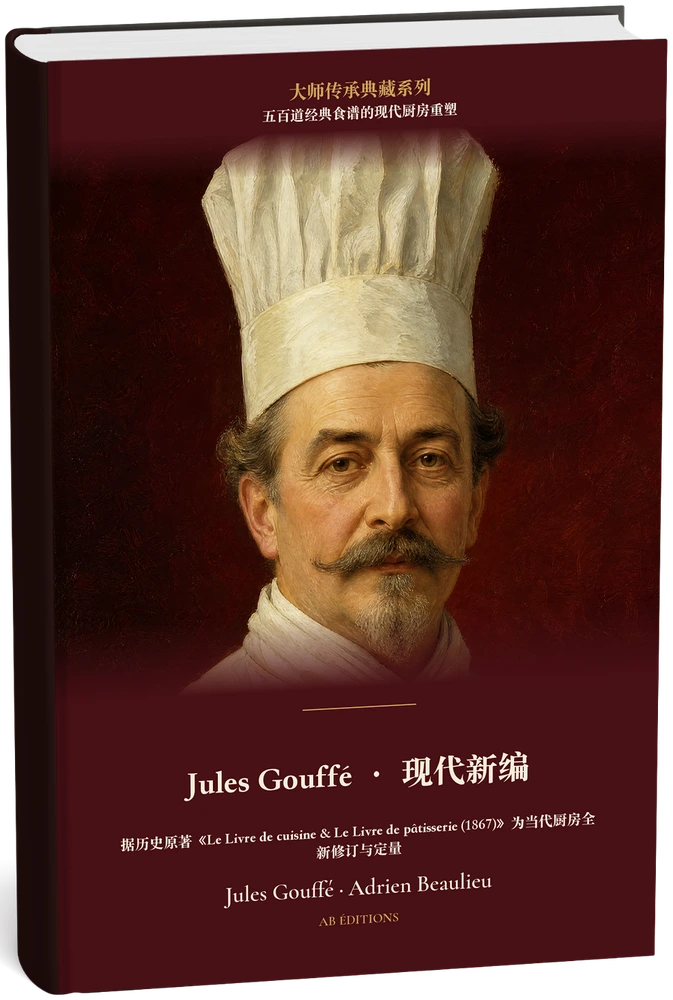
Jules Gouffé · Adrien Beaulieu
Édition internationale en Chinois · L'Héritage des Maîtres
Découvrir l’ouvrage →Jules Gouffé was born in Paris in 1807, the son of Pierre-Louis Gouffé, a pastry cook, and Madeleine-Jeanne Guilbert. The family shop stood on the Rue Saint-Merri, and it was beneath his father’s exacting eye that young Jules first took up the apron.
His father kept the establishment as a master of established standing, and the boy came of age steeped in the warm, yeasty scents of the bakehouse. Early on, he mastered the rigorous techniques and relentless demands of the craft. This unyielding foundation explains all that followed: Gouffé was, first and foremost, a man of the workshop before he was ever a man of letters.
The decisive turning point of his apprenticeship arrived around 1823, when Antonin Carême (1784–1833) took him on as a pupil. Gouffé was sixteen. According to one account, Carême was struck by the lad’s natural gifts; according to another, it was the towering pièces montées displayed in the elder Gouffé’s shopwindow that caught the master’s eye. The young man remained beside Carême for some seven years, notably laboring in the kitchens of the Austrian Embassy. Gouffé would later recall taking part, as one of a seventeen-man brigade, in preparing the grand ball offered by the City of Paris to the Duke of Angoulême in 1823. Seven thousand guests were expected; the cold buffet alone demanded four days of unremitting toil.
This stern schooling left an indelible mark. Carême was the great codifier of French taste, the author of Le Pâtissier royal parisien, and he instilled in his disciple an abiding passion for orderly, methodical knowledge. He also bequeathed to him an immutable hierarchy of the culinary arts, which Gouffé would later crystallize in a celebrated maxim: “A good pastry cook easily becomes a skillful cook, whereas one has never seen a cook become a great pastry chef.”
In 1840, Gouffé established his own house at No. 3, Rue du Faubourg-Saint-Honoré. His pastry shop, “À la Pensée”—which would later become the Maison Henri—swiftly acquired a brilliant reputation. By 1850, it employed twenty-eight journeymen, a formidable staff for the era. The chronicler Charles Monselet and Charles Vincent of the Caveau counted among his devoted friends.
Gout, however, brought this thriving career to a premature halt. Gouffé withdrew from trade in 1855. Several idle years ensued, a period of enforced rest that weighed heavily upon his restless spirit. In 1867, at the urgent entreaty of Alexandre Dumas père and the Baron Brisse, he consented to assume the post of officier de bouche to the Jockey-Club de Paris. That very year, he published his first monumental treatise.
He subsequently lived through the Siege of Paris in 1870–1871, when the city’s chefs were forced to bend their art to sheer privation: horsemeat, mule liver, and roast dog numbered among the era’s makeshift fare. Following his tenure at the Jockey-Club and the publication of his treatises, he retired to La Charité-sur-Loire. On February 28, 1877, he journeyed to Paris to sit upon the jury of a food exhibition at the Palais de l’Industrie, where an apoplectic stroke felled him at Neuilly-sur-Seine. The cruel affliction that had driven him from the oven had at least granted him the leisure to write.
Four volumes, published by Hachette over a span of six to eight years, constitute the core of his literary and culinary monument.
Le Livre de cuisine (1867) embraces both domestic household cooking (cuisine de ménage) and grand cuisine. Estimates of its contents vary, ranging from fifteen hundred to three thousand recipes. It offers, alongside its formulas, judicious counsel on the orchestration of feasts, the service of banquets, and the discerning choice of provisions. It is adorned with twenty-five chromolithographic plates and one hundred and sixty-one woodcuts engraved after designs by E. Ronjat. In The Oxford Companion to Food, the historian Alan Davidson lavishly praised its handsome typography, its plates, the crystalline lucidity of its prose, and its pioneering adoption of metric weights and measured cooking times.
Le Livre des conserves (1869) addresses the preservation of meats, salted and smoked fish, terrines, galantines, vegetables, and fruits, as well as the preparation of preserves, cordials, and syrups, founded upon the revolutionary appertisation process. It soon became an indispensable and fiercely sought-after manual.
Le Livre de pâtisserie (1873) is widely regarded as his masterpiece. Spanning more than five hundred pages, it progresses from fundamental rudiments—the handling of sugar, the working of almonds, lining paste, shortcrust, puff pastry, and sponge cake—to the most daring showpieces: classic cakes (the manqué, kouglof, savarin, and brioche), entremets, petits fours, ices, meringues, waffles, fritters, savory pastries such as the vol-au-vent and the pâté, and monumental architectural centerpieces. Enriched with ten chromolithographs and one hundred and thirty-seven engravings, its triumph was immediate.
Le Livre de soupes et des potages, dated 1872 or 1875 according to different sources, assembles more than four hundred soups, drawing from both French traditions and foreign shores.
The modern reader discovers across these pages four distinct manners of reckoning. In the domestic cookery, every measure is calculated strictly for four covers. In the grand cuisine, quantities reflect the scale of a professional brigade, leaving the precise number of guests unstated. In pastry, the minute hand is seldom invoked: the heat of the oven is gauged by the scorching of paper, sugar by its boiling stages, and resting periods by the hour. In the Conserves, durations are written out in full words (“twenty minutes,” “two hours in a water bath”). One must grasp which register is speaking to understand what Gouffé demands of the hands.
What sets these works apart is their unswerving method. Gouffé supplies exact weights, metric liquid measures, and timed cooking intervals. He elucidates fundamental acts with the same unyielding precision. For a simple soft-boiled egg, he directs the cook to bring a liter and a half of water to a boil in a two-liter saucepan, lower in the eggs, cover the vessel, keep it one minute over the flame, and then draw the pan off the fire to stand for five minutes. He admitted no instruction that had not been verified against the clock and the scales.
Gouffé wrote during the twilight of the Second Empire and the dawn of the Third Republic. Paris was then basking in the splendor of the 1867 Universal Exposition; grand Parisian restaurants were reaching their zenith, and the bourgeois dining table was gaining in opulent substance. Service à la française, wherein all dishes were placed simultaneously upon the board, was steadily yielding to service à la russe, wherein dishes succeeded one another in continuous courses. Exclusive circles like the Jockey-Club were seats of arbitrating power: here men dined, wrote, and pronounced artistic judgment.
The kitchen’s physical apparatus was likewise transformed. Kitchen ranges grew sophisticated; precision thermometers and balances made their entry into the culinary sanctum. Gouffé championed their use and hastened their adoption, earning himself the title of apostle of physical and chemical science in the kitchen.
The formal banquet of the day observed an intricate hierarchy reflected throughout Gouffé’s writings: soups, relevés, entrées, roasts, entremets, and desserts. The chef of an elite club had to orchestrate this stately progression for an immense assembly of diners. Having witnessed Carême’s monumental buffets, Gouffé understood the crushing weight of such organizational machinery.
His culinary world was inherently dual. There was the table of the modest household, for which Le Livre de cuisine provides portions for four—the hearty pot-au-feu, veal cutlets with carrots, golden crêpes. Then there was the table of the aristocratic mansion, where relevés, entrées, cold showpieces, and ornate garnishes were executed on a brigade scale: six chickens, five hundred grams of truffles. Gouffé wrote for both spheres, eager to instruct youths whom he wished “to teach swiftly,” as well as enlightened amateurs.
About him stood illustrious contemporaries like Urbain Dubois and celebrated gastronomic writers such as Monselet, Dumas, and Brisse. Gouffé’s work belongs entirely to this pivotal era of transition, anchoring and codifying the practices of nineteenth-century haute cuisine.
Gouffé is revered as one of the true architects of the modern recipe. His treatises served as definitive authorities in culinary academies and professional kitchens long after his death, and Le Livre de pâtisserie continues to be reissued in facsimile to this day. Many discern in him a pioneer of the scientific approach applied to cooking; contemporary chefs and culinary theorists, including Bernard Loiseau, Hervé This, and Thierry Marx, frequently invoke his name.
Yet his lasting influence rests not merely upon his recipes, which inevitably bear the palate of their period, but upon his method: exact weight, precise time, rational architecture, and illustrations that faithfully portray the expected result. He instructs as much as he records. His texts state not only what must be done, but what must never be done, and why: never to coat a chaud-froid in multiple successive layers, never to pour hot syrup over delicate fruit, never to beat an omelet of more than eight eggs (recommending two or three smaller ones instead). These concise admonitions, delivered directly alongside the physical gesture, read like an apprenticeship set down on paper. A young pastry cook, no less than an ambitious amateur, can unerringly reproduce what he describes. Gouffé thereby elevated the entire art of cooking, making it vastly more accessible to genuine learning.
His eminence in culinary literature owes an equal debt to his visual iconography. Ronjat’s chromolithographs portray the finished presentation of the dishes alongside crucial intermediate techniques. They transformed the beauty of a dish into an achievable goal made possible by method. The reader was no longer left with a mere passage of text; he was handed both a destination and the precise path to reach it.
Ultimately, he bequeathed an enduring, dual ideal shared by his master and himself: the visual grandeur of presentation allied to an unbending precision of execution. Gouffé proved once and for all that the latter is the indispensable pillar of the former.
How should one approach Gouffé today? As one would an authentic workshop manual. It is best to begin with his household cooking: here his recipes are proportioned for four, his techniques are most transparent, and his pedagogical voice rings clearest. One may then venture into his pastry, where one must learn to read the heat of the oven and the temper of boiling sugar. One concludes with his preserves, which demand patience and scrupulous order. His formulas must be read for what they reveal of execution: a single operation per sentence, exact measures, a stated duration, a tangible sign of doneness.
The difficulties encountered by a modern reader are well known. Many recipes cross-reference earlier preparations (“as previously directed…,” “finish in the manner of…”). Elaborate banquet dishes are scaled for an entire professional brigade. Other entries occupy a mere two lines, taking seasoned gestures for granted. Hydrometer degrees on the saccharometer and the “yellow paper” test for oven temperature are dead letters to modern cooks, and certain antiquated ingredients have vanished entirely.
The Heritage of the Masters collection resolves these difficulties without altering the authentic dish. Quantities are scaled to four servings for domestic recipes. For grand banquet cookery, a three-kilo roast is not unnaturally shrunk to four portions; it is presented straightforwardly “for eight persons.” Historical measures are translated into grams, centiliters, and modern degrees, with Gouffé’s original terms preserved in parentheses. The durations Gouffé provides are scrupulously maintained; those he omitted have been supplied with cautious restraint. His proportions are never tampered with, and the historic names of the dishes—whether a riz à l’impératrice or a homard à l’américaine—stand precisely as he wrote them.
Here the reader will encounter Gouffé’s unmistakable voice: “Assure yourself of the cooking,” “take good care,” “at the very first boil.” Here too are the practical observations that explain the reason behind the rule—that good puff pastry cannot be made in hot weather, or that hot syrup must never scald fresh fruit. Above all, the reader will discover a master who hides nothing: what he weighs, how long he cooks, and how he tests the result.
1807 — Born in Paris, the son of pastry cook Pierre-Louis Gouffé and Madeleine-Jeanne Guilbert.
c. 1823 — At sixteen, becomes the pupil of Antonin Carême, working notably at the Austrian Embassy.
1823 — Grand ball given by the City of Paris for the Duke of Angoulême: seven thousand guests, four days of preparation, a brigade of seventeen.
1833 — Death of Antonin Carême.
1840 — Opens his own pastry shop, “À la Pensée,” at No. 3, Rue du Faubourg-Saint-Honoré.
1850 — The establishment employs twenty-eight journeymen.
1855 — Retires from business due to severe gout.
1867 — Appointed officier de bouche to the Jockey-Club de Paris; publication of Le Livre de cuisine by Hachette; Paris Universal Exposition.
1869 — Publication of Le Livre des conserves.
1870–1871 — The Siege of Paris: menus adapted to severe wartime shortages.
1872 or 1875 — Publication of Le Livre de soupes et des potages (date uncertain).
1873 — Publication of Le Livre de pâtisserie.
1877 (February 28) — Dies in Neuilly-sur-Seine from an apoplectic stroke while en route to judge an exhibition at the Palais de l’Industrie.
• Le Livre de cuisine, comprenant la cuisine de ménage et la grande cuisine, Hachette, 1867: a comprehensive treatise on both domestic and haute cuisine, illustrated with 25 chromolithographic plates and 161 woodcuts by E. Ronjat.
• Le Livre des conserves, Hachette, 1869: the preservation of meats, fish, vegetables, and fruits, alongside jams, liqueurs, and syrups, according to the Appert method.
• Le Livre de pâtisserie, Hachette, 1873: fundamentals, cakes, entremets, petits fours, ices, savory pastries, and monumental centerpieces; featuring 10 chromolithographs and 137 engravings.
• Le Livre de soupes et des potages, 1872 or 1875 depending on sources: an exhaustive compilation of over 400 French and foreign soups.
Recettes, histoires, parutions et éditions de collection — quelques lettres par an, jamais davantage.


