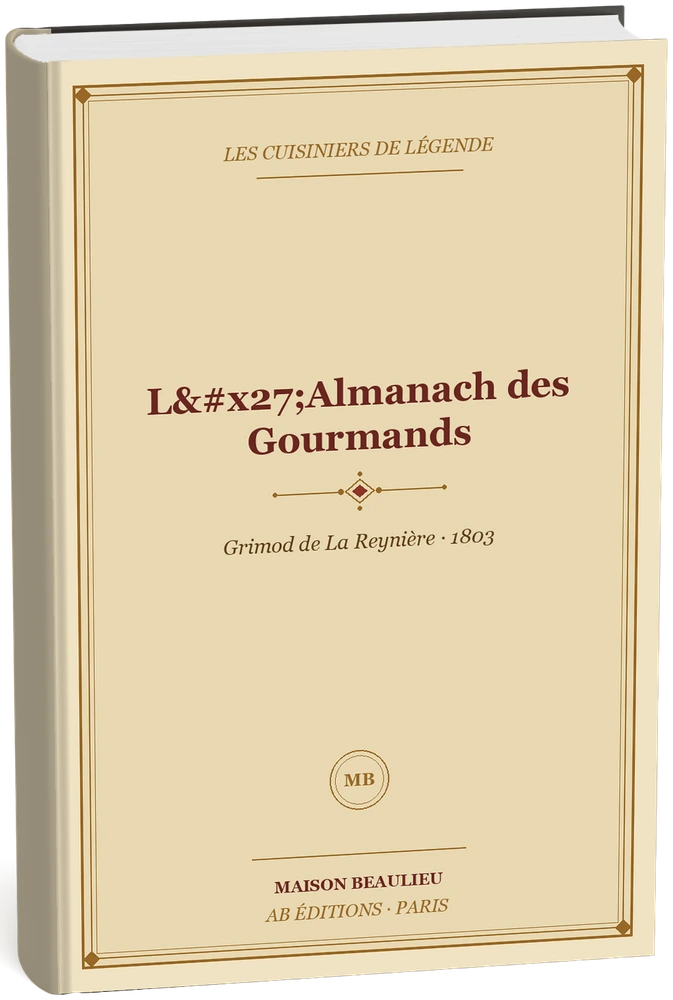
L'Almanach des Gourmands (1803)
Grimod de La Reynière
La naissance de la littérature gastronomique
Découvrir l’ouvrage → MAISON BEAULIEUAB ÉDITIONS · CUISINE & LETTRES
Born on the first of April 1755 in the mountain-girt town of Belley, nestled within the verdant province of Bugey, Jean Anthelme Brillat-Savarin was born to the robe. His family was an ancient dynasty of provincial jurists, civil servants, and landed gentry who balanced a solemn reverence for Roman law with a deep, ancestral devotion to the generous tables of southeastern France. The terroir of his youth was one of fat capons, plump thrushes, crayfish harvested from clear alpine torrents, and the crystalline vintages of the Rhône hillsides.
Trained in law, chemistry, and medicine at Dijon, young Brillat-Savarin returned to his native town to practice at the bar. When the seismic winds of 1789 swept through the kingdom, his peers elected him deputy for the Third Estate to the National Constituent Assembly. In the roaring assemblies of Versailles and Paris, the tall, imposing jurist proved himself a moderate constitutionalist, speaking with calm lucidity on criminal jurisprudence while observing with quiet irony the frantic passions of the nascent revolutionary state.
Returning to Belley as mayor and president of the civil tribunal, Brillat-Savarin’s steadfast rejection of Jacobin excesses soon marked him for the scaffold. In 1793, as the shadow of the Terror lengthened across the provinces, he was deposed and proscribed. Forced to flee his ancestral home, he slipped across the border into the canton of Vaud, finding temporary refuge in Lausanne and Basel, where he sustained his spirits with philosophy, chess, and the consolation of Swiss fondue.
By the autumn of 1794, Europe offered no enduring safety, and the magistrate took ship for the United States. In the bustling port of New York, he embraced exile with admirable stoicism and curiosity. He earned his daily bread by giving French lessons and playing the first violin in the orchestra of the John Street Theatre. Across the woods of Connecticut, he hunted the native wild turkey, delighting in preparing it with European subtlety for his American hosts, and observed with genuine fascination the rustic simplicity of New World taverns and the virtues of the colonial punch bowl.
The rise of the Directory permitted Brillat-Savarin’s repatriation in the late summer of 1796. After holding modest military posts, the establishment of the Consulate provided him with the definitive sanctuary of his career: in 1800, he was appointed counselor to the Court of Cassation, the supreme court of appeal of the French Republic, and later, the Empire. It was a dignity he would preserve through all subsequent convulsions of regime, serving with unblemished rectitude through the Napoleonic epic and into the Bourbon Restoration.
Unmarried, urbane, and blessed with robust health, the judge divided his life between the solemn deliberations of the Palais de Justice and the radiant dinner tables of the capital. He was not a glutton, but a discerning epicure who championed the sacred ritual of hospitality. In his bachelor apartments on the Rue des Enfants-Rouges and later the Rue de Richelieu, he entertained intimates with dishes executed to strict perfection, discoursing on the chemistry of broth, the virtues of truffle gravy, and the subtle mechanics of mastication with equal measures of erudition and merriment.
For more than three decades, in the margins of judicial decrees and during solitary vacations at his country estate in Vieu, Brillat-Savarin quietly compiled his masterpiece. He envisioned a work that would liberate the dining table from the narrow domain of the kitchen brigade, elevating it into a comprehensive study of humanity. In December 1825, mere weeks before his death, there appeared in the bookstalls of Paris an anonymous two-volume octavo bearing the title: Physiologie du Goût, ou Méditations de Gastronomie Transcendante.
The work was printed at the author’s own expense by the publisher Sautelet, yet its triumph was instantaneous. Readers of every station—from Balzac to the most modest provincial notary—were captivated by the author’s supple, musical prose, which sparkled with the dry wit of the siècle des Lumières. Interspersing scientific discourses on the organs of taste, digestion, and the dangers of corpulence with autobiographical anecdotes, historical sketches, and culinary recipes, the judge created an unclassifiable literary jewel that defied the arid pedantry of the academies.
At the core of the Physiologie lay the profound conviction that our relationship to food defines the nature of human civilization. In his celebrated opening aphorisms, Brillat-Savarin etched timeless truths into the collective consciousness: « Dis-moi ce que tu manges : je te dirai ce que tu es » (“Tell me what you eat, and I will tell you what you are”). Gastronomy, he proclaimed, is the intelligent knowledge of whatever concerns man as an eater, enlisting natural history, physics, chemistry, cookery, and commerce in the noble service of sustenance.
He analyzed the senses with physiological rigour, distinguishing direct taste from complete taste, championed the social civilizing power of the table d’hôte, and offered the earliest serious clinical analysis of obesity, advocating for a reduction in starches and flours a century before modern dietetics. Above all, Brillat-Savarin celebrated the table as a sanctuary of fellowship, memorably observing that the pleasure of eating is one we share with the beasts, but the pleasure of the table is peculiar to the human race, depending upon careful preparation, agreeable company, and the artful passage of time.
Brillat-Savarin was granted only a fleeting glimpse of the enduring fame his book would command. In January 1826, despite suffering from a severe chest cold, he attended the annual expiatory Mass for King Louis XVI at the Basilica of Saint-Denis in his capacity as supreme magistrate. The icy drafts of the royal crypt proved fatal to the septuagenarian jurist. Pneumonia ensued, and he expired peacefully on the second of February 1826, surrounded by his kin and his books, leaving behind a reputation of immaculate integrity and sunny wisdom.
Nearly two centuries later, Brillat-Savarin stands unassailable as the patron saint of culinary letters. He inspired generations of writers, from Alexandre Dumas to A.J. Liebling and M.F.K. Fisher, who sought in his pages the rare alloy of intellectual precision and sensual joy. Honored posthumously by the naming of one of Normandy’s most sumptuous triple-cream cheeses, his truest monument remains the enduring cadence of his prose—a monument to the civilized art of living well, savoring deeply, and thinking with generous clarity.
Découvrez dans la collection Les Cuisiniers de Légende les grands traités culinaires contemporains de son époque :
Grimod de La Reynière
La naissance de la littérature gastronomique
Découvrir l’ouvrage →
Antoine Beauvilliers
La grande table parisienne sous l’Empire et la Restauration
Découvrir l’ouvrage →
Marie-Antoine Carême
Le sommet de la gastronomie française du XIXᵉ siècle
Découvrir l’ouvrage →Recettes, histoires, parutions et éditions de collection — quelques lettres par an, jamais davantage.
