The Epicurean — Volume I of II (1894 — 1 770 recipes, VO Anglaise)
Charles Ranhofer
Les Grands Classiques (VO Anglaise) · Édition originale anglaise de Delmonico's, New York (Vol. I)
Découvrir l’ouvrage → MAISON BEAULIEUAB ÉDITIONS · CUISINE & LETTRES
La Maison Beaulieu présente l’œuvre de Charles Ranhofer selon son architecture éditoriale complète : d’abord I. Les Grands Classiques (les textes originaux d’époque), puis II. L’Héritage des Maîtres (l’édition française modernisée — 500 recettes mises au goût du jour), et enfin III. Le Rayonnement International (l’édition modernisée traduite en 10 langues). Tarif officiel Cuisine AB Éditions : Ebook · 9,90 € · Broché (PB) · 24,90 € (+ port réel) · Relié Collector (HC) · 34,90 € (+ port réel).
L’œuvre historique de Charles Ranhofer publiée dans sa langue d’origine (édition anglaise d’époque) accompagnée de sa première traduction française intégrale fidèle à la lettre par la Maison Beaulieu.
Charles Ranhofer
Les Grands Classiques (VO Anglaise) · Édition originale anglaise de Delmonico's, New York (Vol. I)
Découvrir l’ouvrage →
Charles Ranhofer
Les Grands Classiques (VO Anglaise) · Édition originale anglaise de Delmonico's, New York (Vol. II)
Découvrir l’ouvrage →
Charles Ranhofer
Les Grands Classiques (VO Anglaise) · Tous les menus historiques servis chez Delmonico's de 1862 à 1894
Découvrir l’ouvrage →
Charles Ranhofer
Les Grands Classiques Traduits (VF) · Première traduction française intégrale du monument de Delmonico's
Découvrir l’ouvrage →
Charles Ranhofer
Les Grands Classiques Traduits (VF) · Second tome de l'encyclopédie franco-américaine en français
Découvrir l’ouvrage →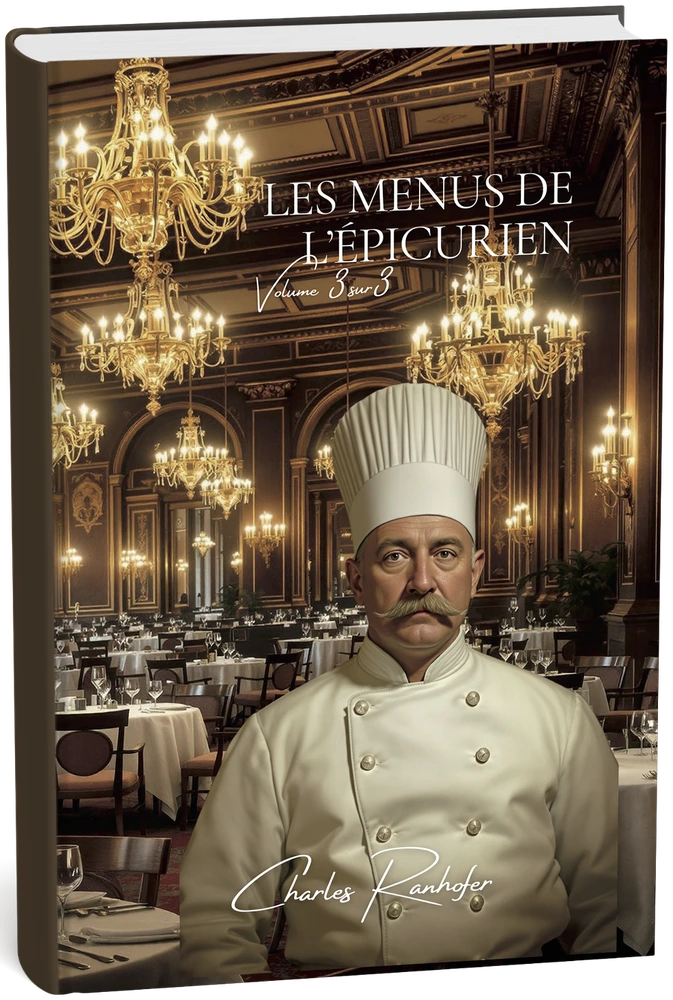
Charles Ranhofer
Les Grands Classiques Traduits (VF) · Les grands banquets et menus quotidiens de New York en français
Découvrir l’ouvrage →Pour cuisiner réellement Charles Ranhofer aujourd’hui chez soi sans brigade : chaque recette est codifiée et structurée selon le protocole de la Maison (Ingrédients calibrés en grammes pour 4 personnes · Préparation pas à pas avec temps et températures exacts · Conseil du Chef), dans le respect absolu du goût et de l’esprit du Maître.
Conformément à la doctrine éditoriale de la Maison, ce n’est jamais le français archaïque d’époque qui est traduit, mais notre édition française modernisée (L’Héritage des Maîtres — 500 recettes au goût du jour), afin d’offrir aux lecteurs du monde entier des recettes claires, précises et immédiatement réalisables en 10 langues (EN, DE, ES, IT, PT, NL, SV, PL, JA, ZH) :
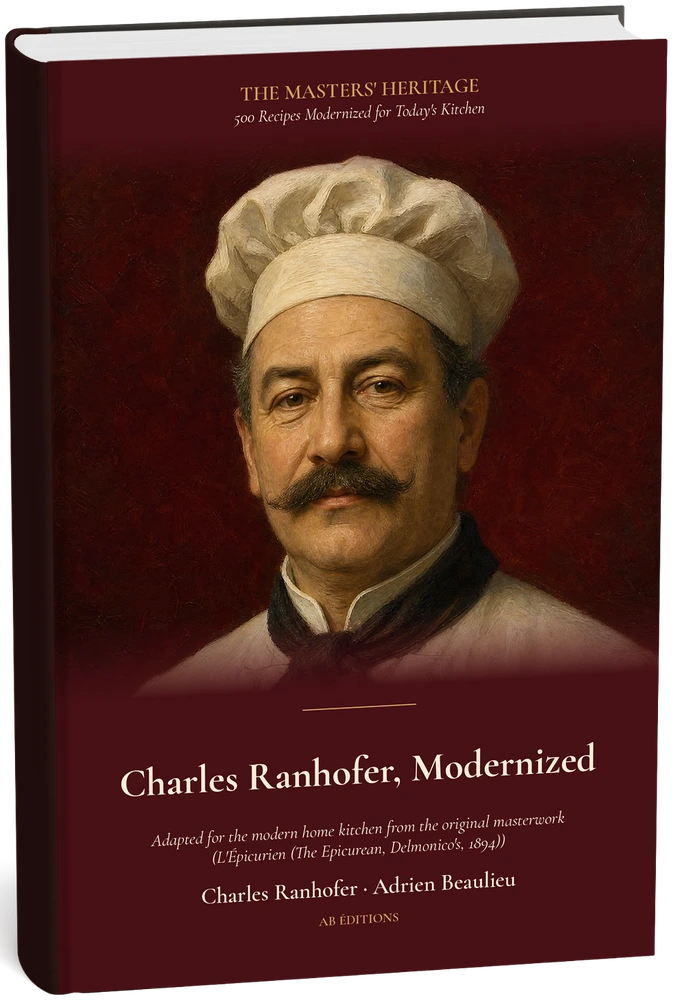
Charles Ranhofer · Adrien Beaulieu
Édition internationale en Anglais · L'Héritage des Maîtres
Découvrir l’ouvrage →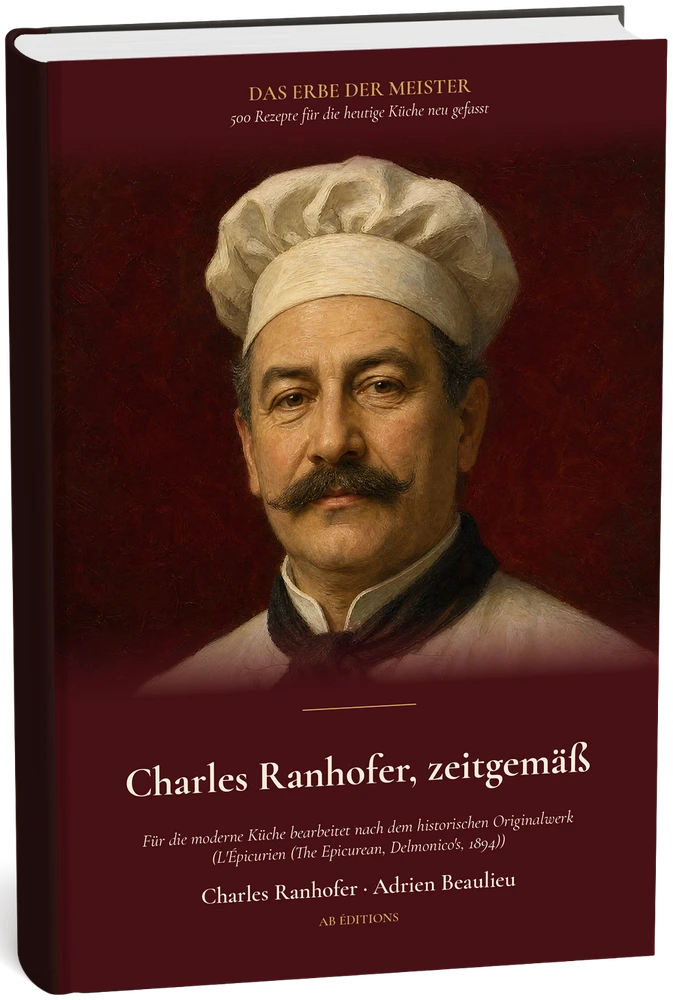
Charles Ranhofer · Adrien Beaulieu
Édition internationale en Allemand · L'Héritage des Maîtres
Découvrir l’ouvrage →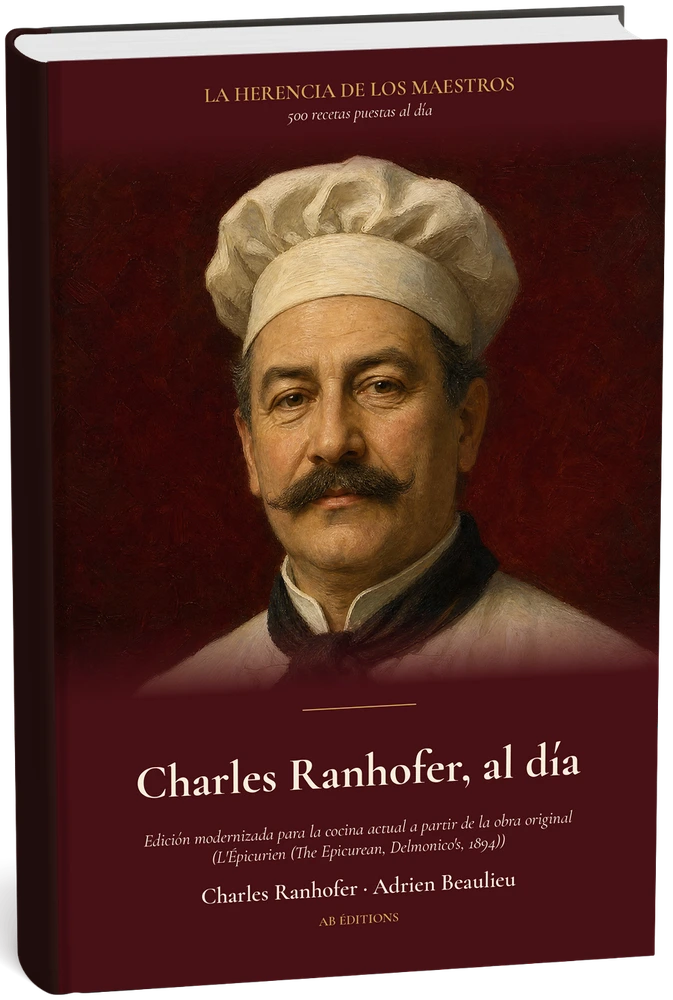
Charles Ranhofer · Adrien Beaulieu
Édition internationale en Espagnol · L'Héritage des Maîtres
Découvrir l’ouvrage →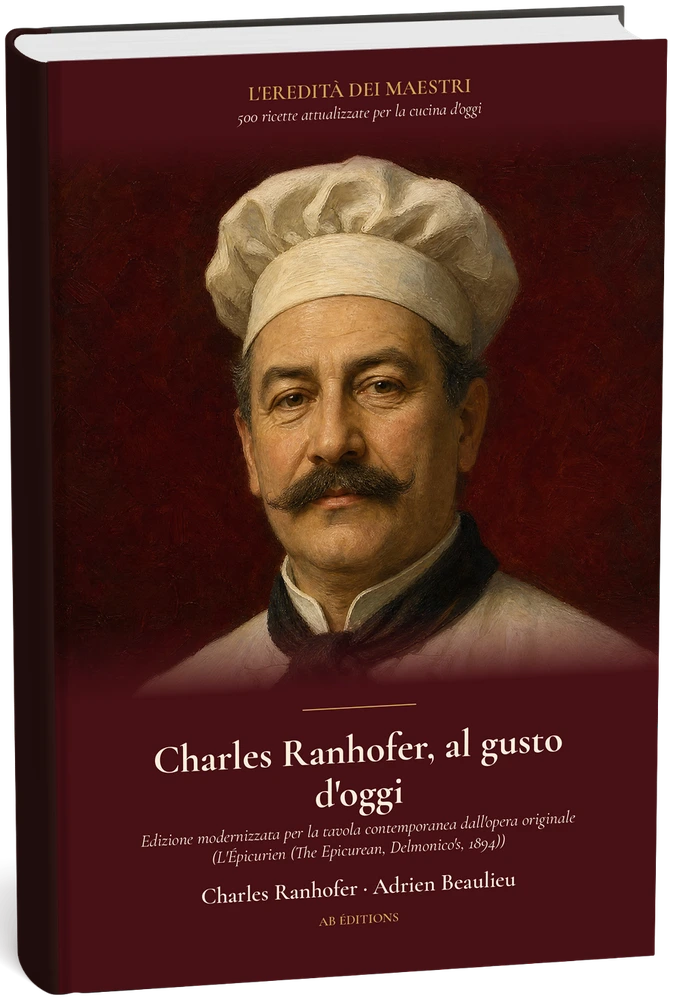
Charles Ranhofer · Adrien Beaulieu
Édition internationale en Italien · L'Héritage des Maîtres
Découvrir l’ouvrage →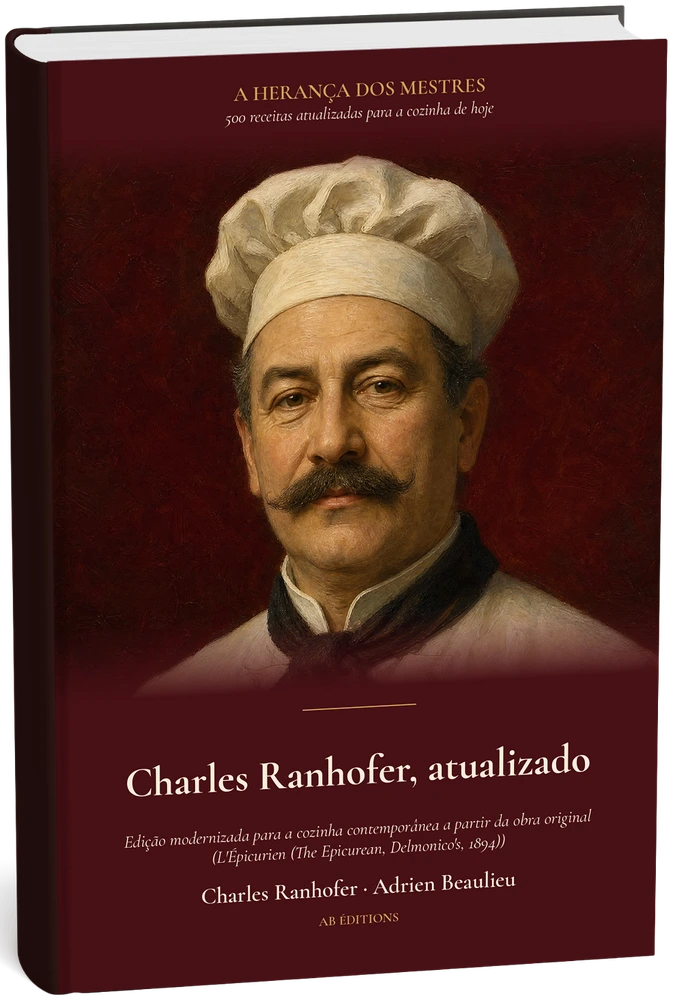
Charles Ranhofer · Adrien Beaulieu
Édition internationale en Portugais · L'Héritage des Maîtres
Découvrir l’ouvrage →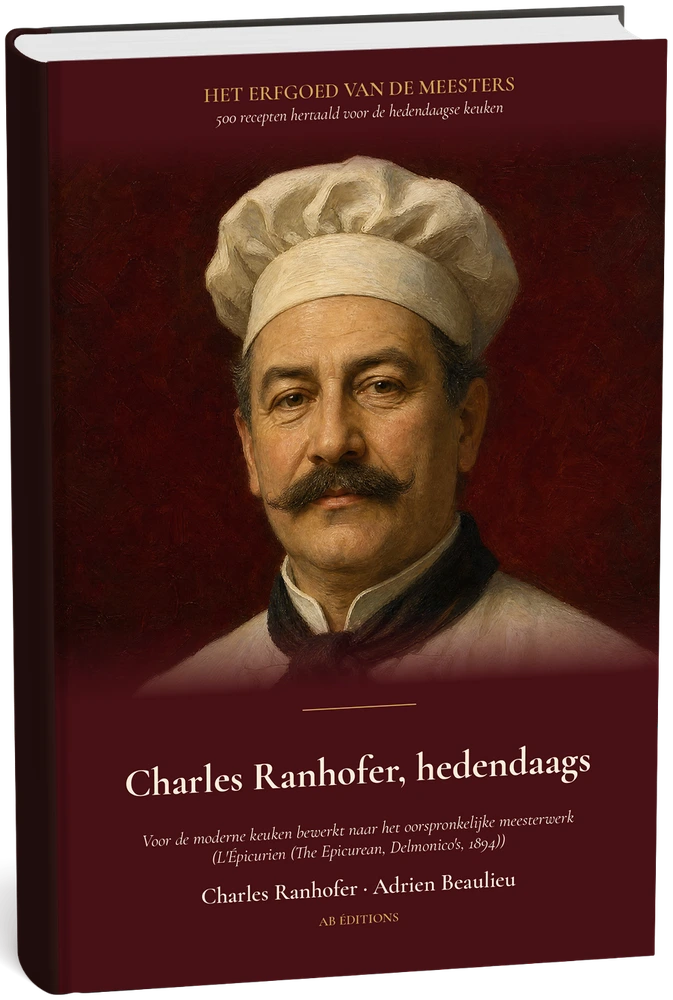
Charles Ranhofer · Adrien Beaulieu
Édition internationale en Néerlandais · L'Héritage des Maîtres
Découvrir l’ouvrage →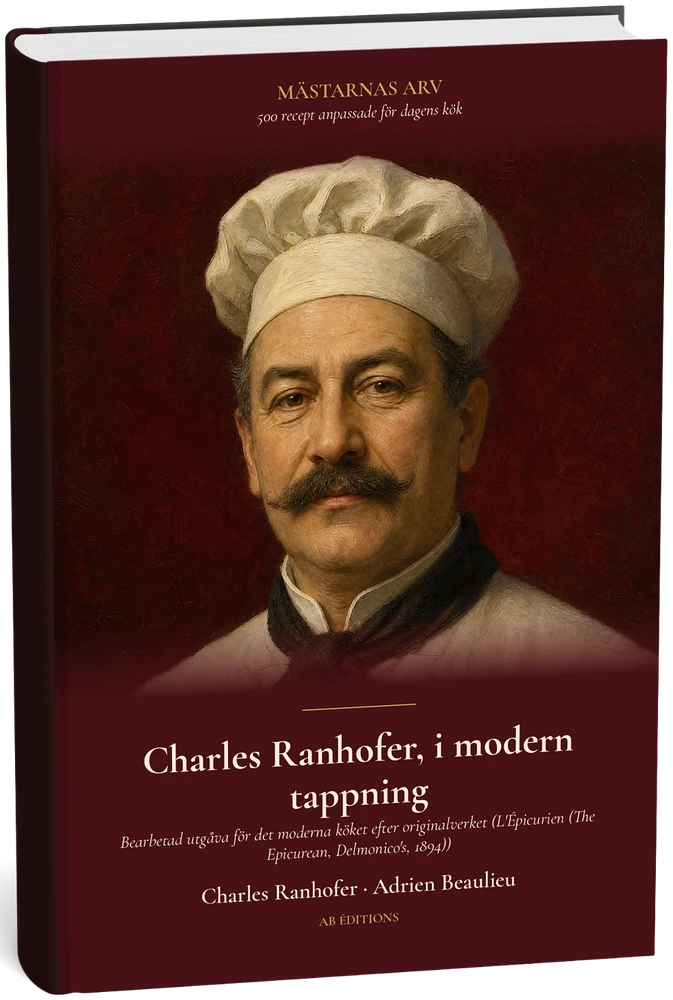
Charles Ranhofer · Adrien Beaulieu
Édition internationale en Suédois · L'Héritage des Maîtres
Découvrir l’ouvrage →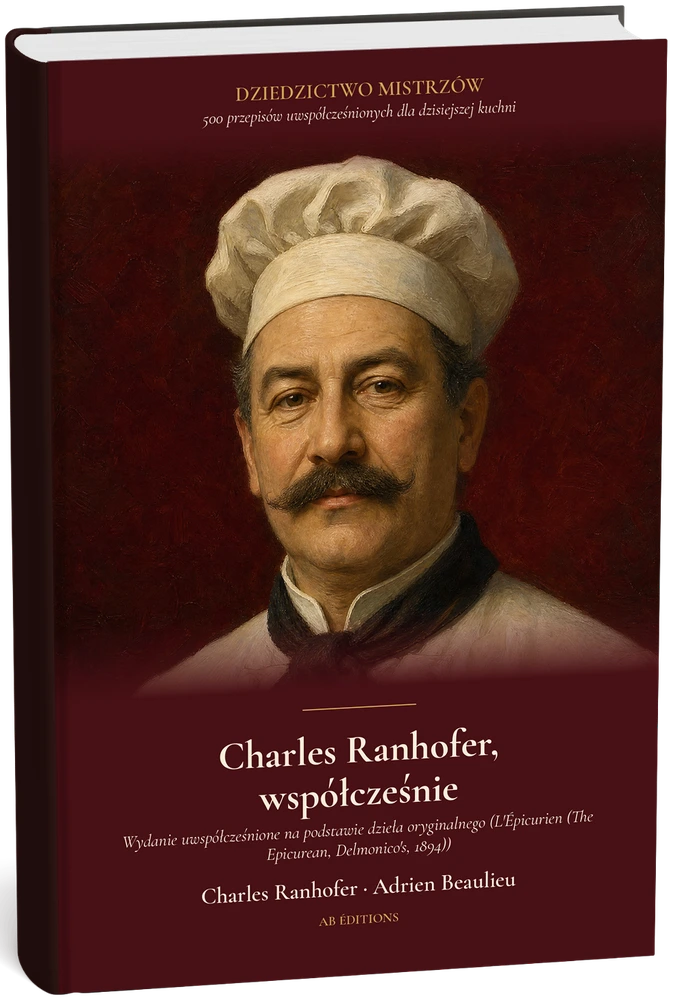
Charles Ranhofer · Adrien Beaulieu
Édition internationale en Polonais · L'Héritage des Maîtres
Découvrir l’ouvrage →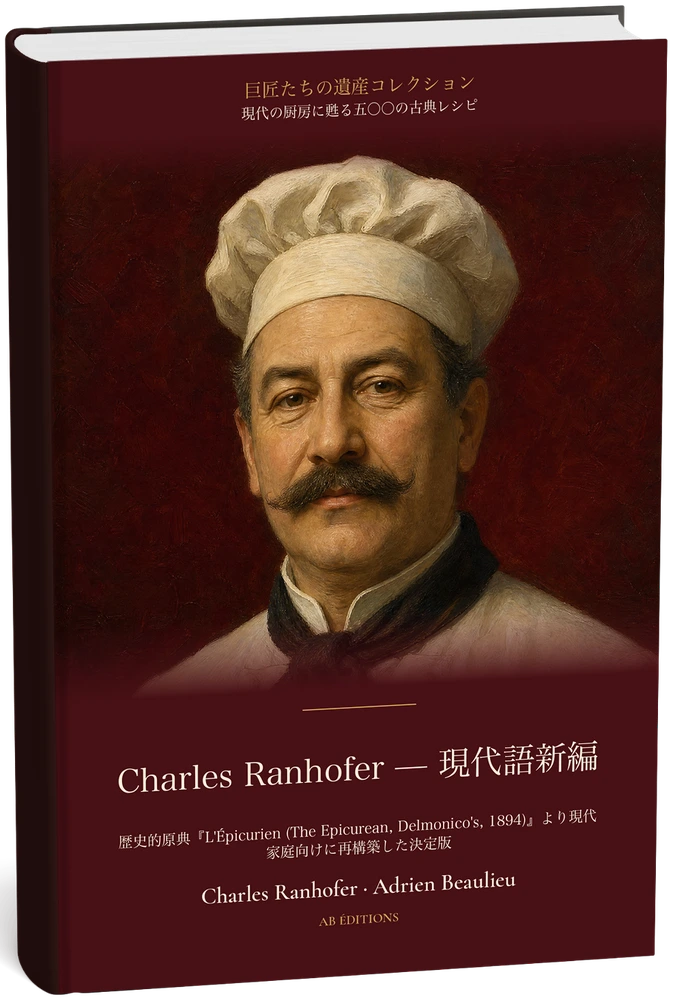
Charles Ranhofer · Adrien Beaulieu
Édition internationale en Japonais · L'Héritage des Maîtres
Découvrir l’ouvrage →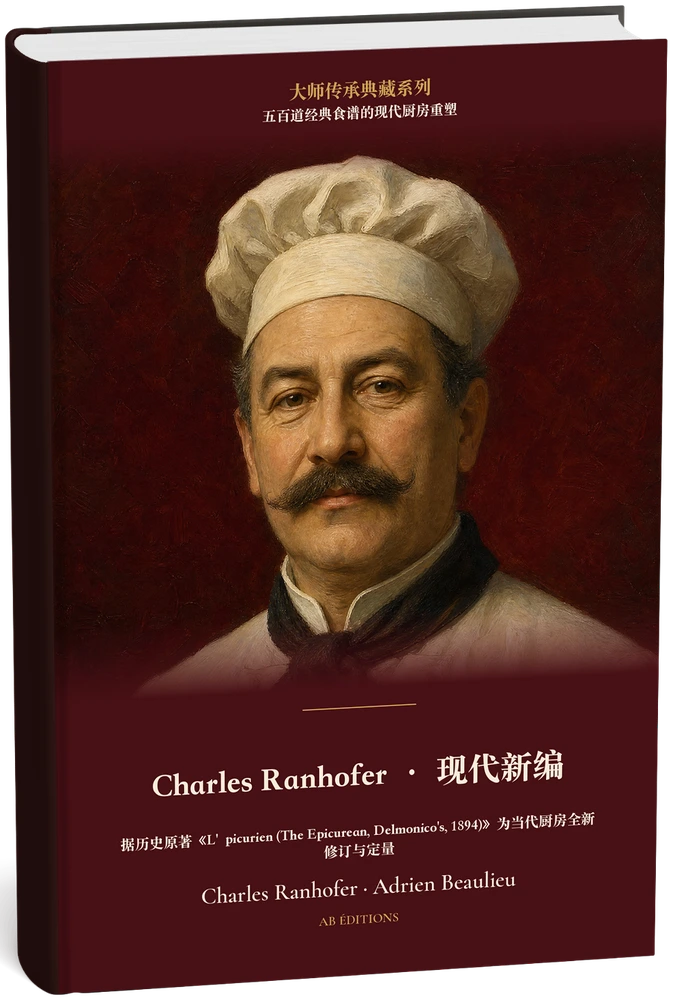
Charles Ranhofer · Adrien Beaulieu
Édition internationale en Chinois · L'Héritage des Maîtres
Découvrir l’ouvrage →Charles Ranhofer was born on November 7, 1836, in Saint-Denis. His father was a restaurateur and his grandfather a cook of notable repute; he thus came of age amidst the brotherhood of the table. Around 1848, at twelve years of age, he departed for Paris to learn the pastry-maker’s art. His apprenticeship proved remarkably swift. By 1851, at fifteen, he was already head pastry chef in a Parisian establishment. The following year, he entered the service of the Prince d’Hénin, whether as private chef or as a member of the kitchen brigade. There he mastered the orchestration of feasts and banquets on a grand scale. This double schooling—as both master pastry cook and chef to an illustrious noble house—prepared him admirably for the destiny awaiting him across the Atlantic.
In 1856, he took leave of France for New York. His first appointment was as chef to the Russian consul. He subsequently passed through Washington, and thence to New Orleans, where he became acquainted with Creole cookery. In 1860, he was once more in Paris, placing his talents at the service of Napoleon III’s court and orchestrating grand balls at the Tuileries. By 1861, he had returned to New York, assuming direction of the kitchens at the Maison Dorée, one of the most prominent restaurants in the city and the direct rival of Delmonico’s.
In May 1862, Lorenzo Delmonico engaged him as chef de cuisine of his Fourteenth Street establishment. Ranhofer was twenty-six years old. New York was then growing rich on the spoils of the Civil War, and a gilded clientele clamored for refined French cuisine. In 1876, as the restaurant removed from Union Square to Madison Square, he departed Delmonico’s and returned to France. There, for three years, he directed the Hôtel American in Enghien-les-Bains, near Paris. The reasons for his departure remain unrecorded. In 1879, he returned to Delmonico’s, summoned once more by Lorenzo Delmonico or drawn back by the prestige of an institution without equal.
Thereafter, he presided over the kitchens into the 1890s. His remuneration was handsome: three hundred dollars per month in 1890, supplemented no doubt by a share in the profits, which made him one of the highest-paid chefs in New York. He retired after superintending the transfer of the central kitchens to the new quarters on Forty-Fourth Street. Certain chronicles give the year as 1898, others as 1896. A Monsieur Grevillet succeeded him. Ranhofer belonged to several French and professional societies in New York, among them the Société Culinaire Philanthropique, the Cercle Français de l’Harmonie, the Société Française de Bienfaisance, and the French Orphanage. He was likewise an honorary member of gastronomic societies in Chicago and Boston.
He passed away at his home in New York on October 9, 1899, at sixty-two years of age, succumbing to Bright’s disease. He was laid to rest at Woodlawn Cemetery in the Bronx. His wife Rose, née Rosine Justine Guenee, survived him, along with their five children. When she died in 1925, the New York Times devoted an obituary to her memory. Concerning the man’s private character, his friendships, or his opinions, the historical record remains virtually silent: what we know of him is his work.
Ranhofer left behind but a single monumental book, yet it is a work of immense proportion. The Epicurean appeared in 1894, in New York. The original subtitle boldly announced its scope: a complete treatise of analytical and practical studies on the culinary art, including table and wine service, how to prepare and cook dishes, an index for marketing, a great variety of menus, and a selection of notable Delmonico bills of fare from 1862 to 1894, forming an encyclopedia of Franco-American cookery.
Figures vary slightly according to the bibliographies. The volume spans well over a thousand pages, most often cited as 1,183 or 1,200. It encompasses upwards of thirty-five hundred recipes, sometimes estimated at over three thousand. Nearly eight hundred illustrations display the utensils, carvings, table settings, and presentation of dishes. It was reprinted in 1912, 1920, 1971, 2011, and 2017.
Its architecture is that of an encyclopedia. The book opens upon dining service, menus, provisions, and fundamental culinary methods. There follow soups, hot and cold sauces, garnishes, hot and cold hors-d’œuvre, shellfish and crustaceans, fish, beef, veal, mutton, lamb, and pork, poultry, game, entrées, cold dishes, vegetables and grains, along with many other chapters. The receipts are set down in detailed, narrative prose. Ranhofer observed that he had simplified certain procedures to render them more accessible, though by no means simple.
The book possesses a dual character. It offers first and foremost the classical French cuisine as a Parisian chef of 1860 had learned it. To this, it joins dishes adapted to American produce and tastes: Boston brown bread, chicken jambalaya, Philadelphia-style clams, Saratoga potatoes, Manhattan striped bass, and apricots à la Jefferson. The word “Franco-American” in the subtitle was deliberate. This is the cardinal truth to grasp regarding his work.
The second lies in what it contains beyond the realm of recipes. The book is also a manual for the governance of a great establishment. Ranhofer treats of the mise en place, service, the purchase of provisions, wines, and sets forth bills of fare for every hour and occasion: breakfasts, luncheons, dinners, suppers, and collations. In the press interviews granted upon the book’s appearance, he laid great stress upon the clockwork synchronization between kitchen and dining room, the excellence of soups, and the visual elegance of the platters.
Upon its publication, the New York Times hailed it as “the king of cook-books” (May 18, 1894). At Ranhofer’s death, the same journal described it as one of the most comprehensive treatises of its kind ever published. It is often compared to Escoffier’s Guide Culinaire, which appeared a decade later: both stand as encyclopedias of the haute cuisine of their day—the one in France, the other in America.
Ranhofer flourished during what Americans call the Gilded Age, spanning the 1870s to the turn of the century. It was an era of colossal fortunes and of poverty no less staggering. Dining at a grand restaurant, or offering a sumptuous feast under one’s own roof, was a public ceremony: one asserted one’s rank and proclaimed one’s station. The dress coat and white gloves for gentlemen, evening gowns for ladies, the scrupulous adherence to the dinner hour—all were governed by inexorable codes.
Delmonico’s was the stage upon which this society played its part. There were held the most lavish balls, political banquets, and celebrations for visiting dignitaries. The house also played its part in the transformation of social customs. It admitted unaccompanied ladies as early as 1868, though without encouraging them to dine alone. Shortly thereafter, rival luxury establishments arose, such as Sherry’s, and restaurants vied fiercely for the patronage of the wealthy.
Ranhofer’s table was that of a French master: opulent, laborious, ornate. The dishes were intricate, the presentations meticulously constructed, and visual splendor counted for as much as savor. At Delmonico’s, the menu was printed in French and English, the French tongue lending aristocratic gravity to the names of the dishes. Ranhofer’s most renowned creations were each bound to a name, an anecdote, or an illustrious guest.
Among the most celebrated: the Alaska Florida (Baked Alaska), said to have been created in 1867 to commemorate the United States’ purchase of Alaska; Lobster Newberg, bathed in cream, sherry, cognac, and egg yolks; Eggs Benedict, for which Ranhofer published the earliest known recipe in 1894; Chicken à la Keene, widely regarded as the forerunner of Chicken à la King; and the Delmonico steak, whose preparation he codified without necessarily being its sole originator. Concerning every one of these creations, paternity remains disputed, and we do not presume to arbitrate: we state the historical facts as they stand.
This custom of christening dishes after celebrated personages was central to his art. In wedding his culinary inventions to the names of Dickens, Melville, Mozart, Paganini, Sarah Bernhardt, or Mademoiselle Rachel, Ranhofer wove them directly into the cultural discourse of his day. Dishes became emblems of status, and the restaurant reaped an immense aura of distinction. It was, in truth, an early and brilliant form of publicity by association.
His foremost legacy remains his book. The Epicurean endures as an indispensable source for comprehending the gastronomy, techniques, and professional practices of the Gilded Age. Chefs, historians, and bibliophiles consult it to this day. Several of his dishes—Eggs Benedict, Lobster Newberg, Baked Alaska—remain staples of the classical repertoire, often adapted to modern tastes, and the modern Delmonico’s continues to honor this lineage.
His second legacy is the modern model of the grand restaurant. The à la carte menu, private dining salons, curated wine cellars, and a dedicated farm supplying the kitchen—innovations nurtured and brought to life by Ranhofer—profoundly shaped the American dining landscape. The farm in Brooklyn was not born of today’s “farm-to-table” movement, which emerged much later, yet it bore witness to the very same devotion to freshness and provenance.
The third is more subtle: Ranhofer was a cultural bridge. The historical record reveals no direct influence on the French chefs of his homeland, for his career unfolded almost entirely upon American soil. Yet he transplanted, adapted, and codified classical French haute cuisine for the New World, giving birth to the first great Franco-American culinary tradition.
Finally, the contribution of Filippini must be recalled. Recent scholarship has shown that Alessandro Filippini, who entered Delmonico’s in 1849 and authored The Table in 1889, was largely eclipsed by Ranhofer’s renown. These scholars contend that the creation of the house’s grand dishes was most likely a collective endeavor. They observe that neither Ranhofer nor Oscar Tschirky, the famed maître d’hôtel of Delmonico’s and later the Waldorf, acknowledged Filippini’s contributions. This historical reality counsels prudence, inviting us to view Delmonico’s as an institution rather than the work of a single man.
The Epicurean had never been translated into French before Maison Beaulieu undertook the task. The omission is striking: Ranhofer was born in Saint-Denis, trained in Paris, and his masterwork is replete with French culinary nomenclature, terms of art, and classical formulas. Yet he composed it in New York, in the English tongue, for American practitioners, and it was never rendered into French. To our eyes, he was a French master who had never been read in his native tongue. We have therefore translated the work in its entirety, with absolute fidelity, across three volumes: L’Épicurien I, II, and III. This represents the first French translation of the work, appearing in our collection Les Ressuscités, dedicated to restoring to their mother tongue those French masters who spent their careers abroad.
This translation provides a complete, authoritative working text. It preserves Ranhofer’s structural design, his menus, and his receipts. It forms the bedrock of our entire engagement with his oeuvre: one may read it, study it, or consult it to trace a dish or an ancient custom. Yet it does not render the recipes simple to execute. His proportions belong to a massive brigade, his preparations require extensive kitchen staff, and many ingredients are no longer obtainable.
Here our collection L’Héritage des Maîtres takes up the torch. The volume devoted to Ranhofer is drawn directly from our French translation, rather than the English. From it, we extract the recipes suitable for modern domestic kitchens, adapting them to the Maison’s signature format: code, category, difficulty, preparation and cooking times, scaled for four persons, followed by Ingredients, Method, and the Chef’s Council. Quantities are converted into grams and centiliters. Temperatures and cooking durations are supplied whenever Ranhofer left them unspecified, and internal cross-references are resolved. We scrupulously preserve the historic titles, the classical technical terminology that remains intelligible, the sequence of operations, and the ultimate result. We invent not a single step.
We set aside that which has no place in a domestic kitchen: banquet centerpieces, architectural tallow ornaments, towering pièces montées, and obsolete ingredients. Whenever an ingredient is no longer to be found, the Chef’s Council suggests an authentic substitute, while the recipe proper preserves Ranhofer’s exact words. For this master, for whom we lack an intimate stylistic brief as we possess for others, we remain faithful to what the archives establish: an exhaustive narrative style, an uncompromising eye for presentation, and a profound reverence for soups and eponymous creations.
To approach his recipes, three recommendations will serve. Begin with the soups, which Ranhofer considered the true touchstone of a restaurant and which he frequently prepared with his own hands. Turn then to the dishes that established the glory of Delmonico’s, bearing in mind that their attribution remains debated. Lastly, read the Chef’s Council, which brings to light all that the nineteenth-century text left implicit. And if you wish to behold the work in its complete majesty, with its bills of fare and historical splendor, open L’Épicurien, of which this practical volume is the natural companion.
November 7, 1836 — Born in Saint-Denis to a family of restaurateurs and cooks
circa 1848 — Sent to Paris to learn the pastry-maker’s trade
circa 1851–1852 — Head pastry cook in a Parisian restaurant, then enters the service of the Prince d’Hénin
1856 — Crosses the Atlantic; serves as chef to the Russian consul in New York, followed by stays in Washington and New Orleans
1860 — Brief return to France; orchestrates court balls at the Tuileries under Napoleon III
1861 — Returns to New York; assumes leadership of the kitchens at the Maison Dorée
May 1862 — Engaged by Lorenzo Delmonico as chef de cuisine at Fourteenth Street
1867 — Said to have created the Alaska Florida (Baked Alaska)
1868 — Delmonico’s admits unaccompanied ladies
1876–1879 — Returns to France; manages the Hôtel American in Enghien-les-Bains
1879 — Returns to Delmonico’s
1889 — Alessandro Filippini publishes The Table, Delmonico’s first cookbook
1894 — Publication of The Epicurean; praised by the New York Times on May 18
1896 or 1898 — Retires following the removal of the kitchens to Forty-Fourth Street; succeeded by M. Grevillet
October 9, 1899 — Dies in New York; interred at Woodlawn Cemetery in the Bronx
• The Epicurean: A Complete Treatise of Analytical and Practical Studies on the Culinary Art, Including Table and Wine Service, How to Prepare and Cook Dishes, an Index for Marketing, a Great Variety of Bills of Fare... Making a Franco-American Culinary Encyclopedia (New York, 1894): his only monumental work, over a thousand pages, more than thirty-five hundred recipes, nearly eight hundred illustrations, featuring a selection of Delmonico menus from 1862 to 1894. Reprinted in 1912, 1920, 1971, 2011, and 2017.
• L’Épicurien I, II, and III (Maison Beaulieu translation): the first French translation of The Epicurean, in three volumes; collection Les Ressuscités.
Recettes, histoires, parutions et éditions de collection — quelques lettres par an, jamais davantage.