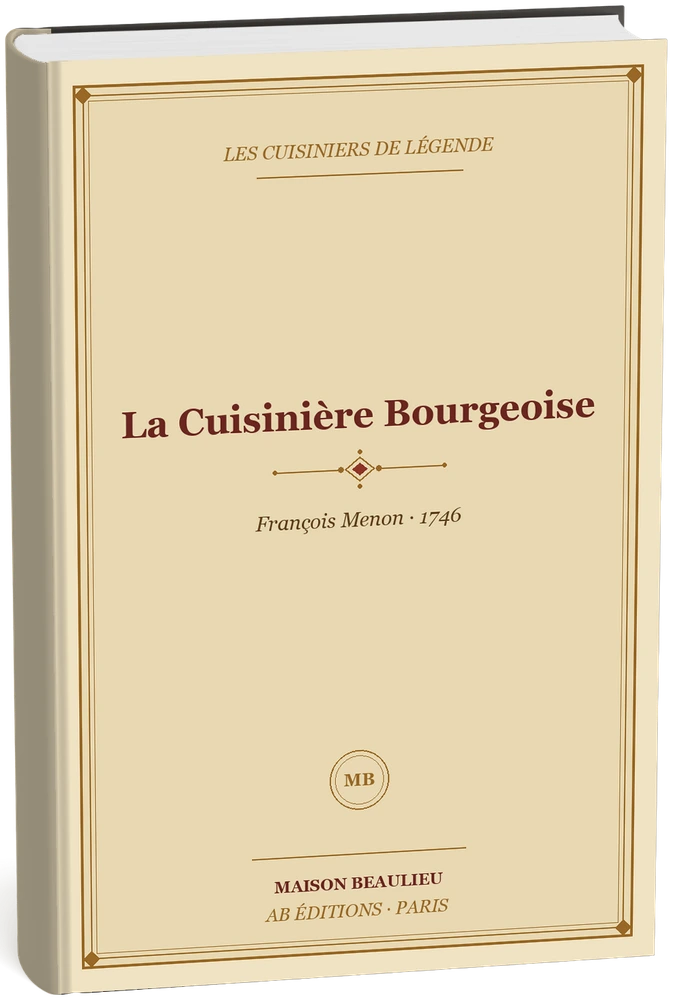
La Cuisinière Bourgeoise (1746)
François Menon
La cuisine des Lumières et des foyers français
Découvrir l’ouvrage → MAISON BEAULIEUAB ÉDITIONS · CUISINE & LETTRES
Before his name became immortalized across the brasserie menus of the boulevardiers, Antoine-Augustin Parmentier was a modest son of Picardy, born in Montdidier in 1737 into a family of merchants whose fortunes had decayed. Apprenticed at an early age to an apothecary in his native town, then summoned to the capital to master the subtle mysteries of galenical pharmacy, the young scholar was hurled into the crucible of history with the outbreak of the Seven Years’ War. Appointed military pharmacist in the royal armies of Hanover, he came face to face with the twin horrors that haunted the campaigns of the eighteenth century: the pestilence of the camps and the gnawing agony of famine.
Captured five times by the forces of Frederick the Great, Parmentier was condemned to languish in Prussian dungeons where rations were scarce and wretched. It was within those damp ramparts that his gaolers threw to the prisoners a rough, mud-caked tuber which French civilization regarded with supreme contempt: the potato, or Solanum tuberosum. While his fellow captives reviled this fare as coarse provender fit only for hogs or convicts, the apothecary observed with rigorous astonishment that this modest subterranean root not only sustained human breath, but preserved vigor and dispelled scurvy. In the darkness of his confinement, a scientific epiphany was born: the despised nightshade was, in truth, an unheralded manna.
Returning to France after the peace of 1763, Parmentier secured the post of apothecary-in-chief at the Hôtel des Invalides, where the care of wounded veterans occupied his daylight hours and chemical experimentation claimed his nights. At that juncture, the kingdom of France lived under the perpetual terror of the disette—the catastrophic grain shortages that emptied the granaries and drove the provinces to bread riots. In 1771, the Academy of Besançon offered a celebrated prize to the scholar who could resolve the tragic question: “Which are the plants that could attenuate the calamities of famine by replacing ordinary wheat?”
Parmentier submitted a treatise of breathtaking clarity, entitled Chemical Examination of the Potato. Against centuries of medical superstition—which claimed that the tuber produced leprosy, caused fevers, and exhausted the soil of all fertility—he deployed the analytical methods of the Enlightenment. He extracted its starch, proved its benign and nourishing nature, and demonstrated that it was innocent of all malevolent humors. He was crowned laureate by unanimous acclamation. Yet, scientific triumph was merely the opening skirmish; to introduce the subterranean stranger to the tables of France, he would have to conquer the obstinate conservatism of the peasant, the disdain of the physician, and the skepticism of the court.
Recognizing that human nature covets that which is forbidden far more than that which is offered as alms, Parmentier devised a psychological campaign worthy of Machiavelli or Talleyrand. In 1785, having secured the patronage of Louis XVI, he was granted fifty arpents of barren, sandy soil at the Plaine des Sablons, near Neuilly. There, he sowed his beloved tubers. As the foliage flourished, the agronomist encircled the perimeter with an imposing detachment of royal gendarmes in full dress, commanding them to mount armed guard over the fields from dawn until dusk.
The curious populace of Paris gathered in throngs, whispering of what invaluable treasure the King was cultivating with such militaristic vigilance. At nightfall, following Parmentier’s secret instructions, the sentries withdrew into their tents, leaving the fields seemingly unprotected. Succumbing to temptation, the local peasantry slipped through the shadows, dug up the forbidden tubers under the moonlight, and carried them off in sacks to plant in their own gardens. By the following season, the potato had breached the wall of suspicion; what had been guarded by bayonets was now cherished as a prize of illicit conquest.
To crown his theatrical victory at Les Sablons, Parmentier carried his campaign directly to the gilded mirrors of Versailles. On the King’s feast day in 1785, he presented Louis XVI with a delicate bouquet of purple and white potato blossoms. Charmed by the gesture, the monarch placed a blossom in his buttonhole, while Queen Marie-Antoinette pinned the flowers into her towering coiffure. That very evening, the courtiers clamored for the novel decoration, and the subterranean plant became the toast of the aristocracy.
Yet Parmentier was no frivolous courtier; his true arena remained the philosophical banquet. In his quarters at the Invalides, he convened the greatest intellects of the transatlantic Enlightenment, including Benjamin Franklin, Antoine Lavoisier, and Condorcet. The table groaned under an astonishing culinary manifesto: from the potage to the roast, through the purées, the pastry, and even the liqueurs, every single course was confected from the potato. The sage of Philadelphia marveled at the versatility of the root, while the savants of Paris acknowledged that gastronomy had forged an indomitable shield against national famine.
Though popular memory has chained Parmentier’s legacy to the potato alone, his intellect encompassed the entirety of the French alimentary ecosystem. He was the founder of the first Free School of Bakery in Paris, laboring alongside Master Baker Cadet de Vaux to modernize the milling of wheat, rationalize fermentation, and banish adulterated flour from the city's ovens. His treatises on the preservation of grain and the chemistry of bread laid the cornerstones of modern baking.
During the Napoleonic Wars, when the British naval blockade severed France from the sugar-producing colonies of the Caribbean, Emperor Napoleon summoned Parmentier to avert an industrial catastrophe. With unyielding vigor, he perfected techniques for extracting sugar from grapes and beets, and pioneered modern methods for the drying and refrigeration of food supplies for the Grand Army. Appointed Inspector General of the Health Service, he crusaded for universal smallpox vaccination and drafted sanitary codes that saved countless lives, proving that the kitchen, the pharmacy, and the battlefield were governed by the same sacred duty: the preservation of human life.
Antoine-Augustin Parmentier breathed his last on December 17, 1813, just as the Napoleonic Empire was crumbling. He was laid to rest in the cemetery of Père Lachaise, where to this day grateful pilgrims place small, fresh potatoes upon his carved tombstone instead of roses. He left no vast financial fortune, having expended his energies and resources in the service of public utility, but his inheritance to mankind was beyond measure.
In the pantheon of French culinary art, his name does not evoke the decadent excess of Roman patricians, but rather the harmonious union of agrarian virtue and domestic consolation. Whenever a chef ladles a velvety Potage Parmentier, whenever the humble hearth serves a piping casserole of Hachis Parmentier crowned with golden crust, homage is paid to the Picard pharmacist who, through patient science and brilliant cunning, vanquished the phantom of famine and taught a skeptical nation to venerate the gifts of the earth.
Découvrez dans la collection Les Cuisiniers de Légende les grands traités culinaires contemporains de son époque :
François Menon
La cuisine des Lumières et des foyers français
Découvrir l’ouvrage →
François Marin
Science et art culinaire au siècle des Lumières
Découvrir l’ouvrage →
Antoine Beauvilliers
L’âge d’or des grands restaurants parisiens
Découvrir l’ouvrage →Recettes, histoires, parutions et éditions de collection — quelques lettres par an, jamais davantage.