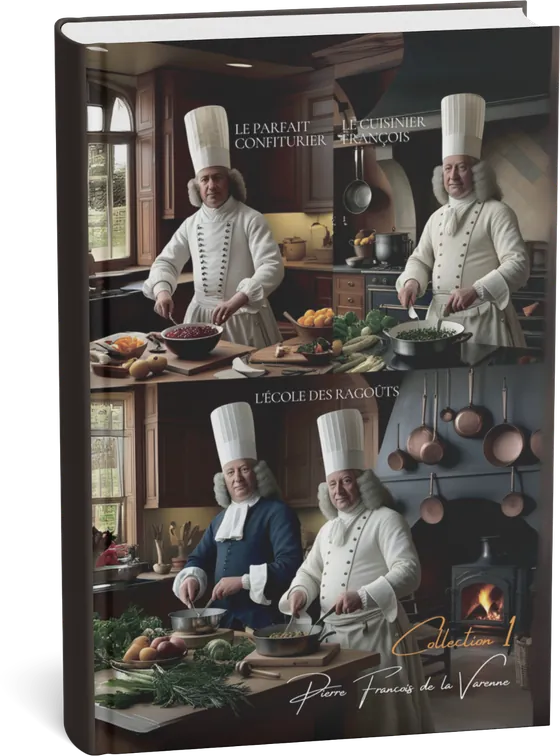
Le Cuisinier François (1651)
François Pierre de La Varenne
Les tables du Grand Siècle · Contemporain de Vatel
Découvrir l’ouvrage → MAISON BEAULIEUAB ÉDITIONS · CUISINE & LETTRES
Born in Paris as Fritz-Karl Watel, the son of a humble Swiss roofer, the man destined to become the immortal arbiter of seventeenth-century courtly feastings rose not from aristocratic privilege, but through absolute mastery of an ephemeral art. Apprenticed in his youth to the master pastry-cooks of the capital, Vatel possessed far more than a virtuoso’s command of sugar, dough, and chaud-froid; he had the vision of a theatrical grand master, an architect of spectacle who saw in dining the supreme expression of sovereign majesty.
In 1653, at barely twenty-two years of age, his peerless organizational genius caught the discerning eye of Nicolas Fouquet, the opulent and ambitious Superintendent of Finances. Installed at the newly constructed château of Vaux-le-Vicomte, Vatel was named écuyer de cuisine and subsequently maître d’hôtel. Under his absolute stewardship, the kitchen ceased to be a mere place of sustenance; it became a backstage forge wherein gastronomic symphonies were staged alongside Molière’s comedies, Le Nôtre’s parterres, and the hydraulic marvels of the grand fountains.
The zenith of Vatel’s early career proved also to be the undoing of his patron. On the evening of August 17, 1661, Fouquet offered to the youthful Louis XIV, the Queen Mother Anne of Austria, and the entire French court an entertainment of unprecedented magnificence. Vatel marshaled five hundred officers and scullions, eighty tables groaning under vessels of solid gold and silver-gilt, thirty massed buffets, and cascades of candied fruits that dazzled the assembly beneath the flares of eight thousand torches.
The dinner, accompanied by the premiere of Molière’s Les Fâcheux and an incandescent display of fireworks over the waters, was flawless in execution, yet fatal in consequence. Louis XIV, confronted with an expenditure and magnificence that eclipsed his own crown, was seized with silent, mortifying jealousy. Within three weeks, Fouquet was arrested by d’Artagnan and plunged into perpetual imprisonment. Vatel, cognizant of the political storm and fearing implication in his master’s ruin, fled across the frontier to England, an artist exiled from his chosen stage.
Yet genius cannot long remain in the shadows. Drawn back to French soil once the immediate perils subsided, Vatel found a protector worthy of his monumental ambitions: Louis II de Bourbon, Prince de Condé, famously known as the Grand Condé. The prince, seeking to repair his strained standing with the Sun King following his role in the rebellious Fronde, sought an orchestrator capable of staging feasts that would dazzle sovereign power into reconciliation.
In the prince’s ancestral seat at the Château de Chantilly, Vatel was invested with sovereign authority over the household as contrôleur général de la bouche. Here, he governed not merely the menus and the roasting-spits, but the provisions, the lodgings, the theatrical lighting, and the logistical conduits that carried the bounties of sea and soil across royal France. It was here, amidst the silver waters of the Oise and the ancient forests, that his legacy would be forged in tragedy.
In April 1671, the Grand Condé received word that the King, accompanied by three thousand courtiers, soldiers, and foreign ambassadors, would descend upon Chantilly for a three-day celebration of peace and royal favor. The burden of this titanic reception—costing the staggering sum of fifty thousand écus—fell squarely upon Vatel’s shoulders. For fifteen days prior, he slept scarcely an hour a night, directing armies of purveyors, carpenters, and confectioners.
The festival began on Thursday, April 23, with a grand promenade followed by an opulent supper served across twenty-five distinct halls. Yet, as Madame de Sévigné recorded in her immortal letters, the first tremors of catastrophe were already felt. Several tables at the furthest reaches ran short of roast meats due to an unexpected influx of guests. The fault lay not with Vatel, yet the perfectionist felt the slight as a dagger to his chest. The Prince de Condé visited his bedchamber to soothe him, crying, « Vatel, all goes miraculously; nothing could be handsomer than the King’s supper. » But Vatel, weeping in exhaustion, could only reply: « Monseigneur, your goodness overwhelms me; I know that roast was lacking at two tables. »
At four o'clock in the morning on Friday, April 24—a strict fast day requiring an abundance of fish—Vatel walked the dewy courtyards of Chantilly. Only one lone merchant had arrived, bearing two miserable hampers of marée. In mounting despair, Vatel questioned him: « Is this all? » To which the carrier, ignorant that couriers had been dispatched to every port in Dieppe, Le Havre, and Boulogne, replied: « Yes, Monsieur. »
Vatel waited an agonizing hour; no further carts appeared on the horizon. Convinced that the morning fish would not arrive, that the royal banquet was irretrievably disgraced, and that his honor as a master of hospitality was extinguished, he spoke to his deputy Gourville: « Monsieur, I shall not survive this disgrace; my honor and my reputation are lost. » He ascended alone to his room, wedged the hilt of his sword against the heavy oaken door, and threw himself three times onto the naked blade until his heart was pierced through.
Scarcely had his body cooled upon the floor when the gates of the château rattled: from all corners of the kingdom, the carts of coastal purveyors arrived simultaneously, bearing towering creels of sea-bass, turbot, oysters, and sole. They sought Vatel to distribute the catch; they forced his locked door, only to discover him bathed in his own blood.
The tragic news threw Chantilly into consternation, yet the festival proceeded; Gourville took charge, the fish was prepared with consummate splendor, and the King dined with profound melancholy, lamenting that such an extremity of honor should have cost the life of so rare an artist. To this day, Vatel remains the supreme martyr of the culinary art, a man for whom a dinner was not a commerce, but a sacred covenant between the host and his guests.
Beyond the romantic legend of his sword, Vatel left an indelible mark upon French table customs. Long attributed with perfecting the sweetened, chilled, and air-whipped cream that bears the name of Chantilly, his true triumph was systemic: he invented the modern administrative science of the grand banquet, elevating hospitality into a dramatic fine art where elegance, punctuality, and an unrelenting ethic of perfection reigned supreme.
Découvrez dans la collection Les Cuisiniers de Légende les grands traités culinaires contemporains de son époque :
François Pierre de La Varenne
Les tables du Grand Siècle · Contemporain de Vatel
Découvrir l’ouvrage →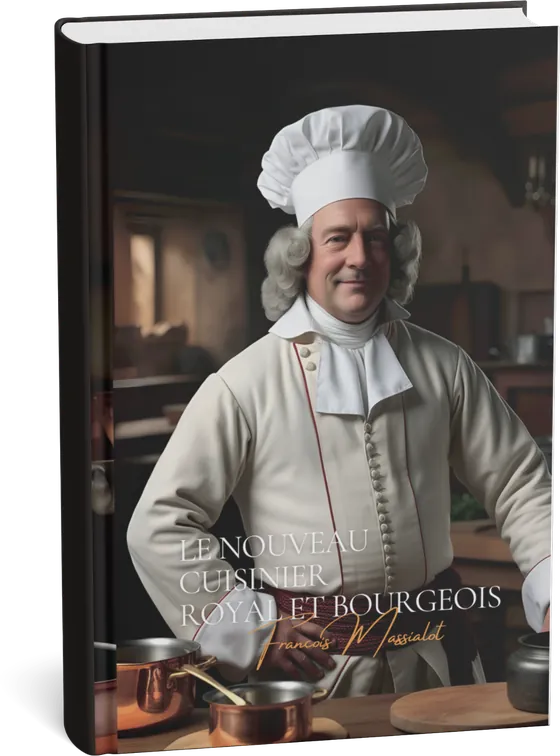
François Massialot
Les fastes de la Cour et de Chantilly
Découvrir l’ouvrage →
Nicolas de Bonnefons
L’art des jardins et du service au XVIIᵉ siècle
Découvrir l’ouvrage →Recettes, histoires, parutions et éditions de collection — quelques lettres par an, jamais davantage.